Stump Vise

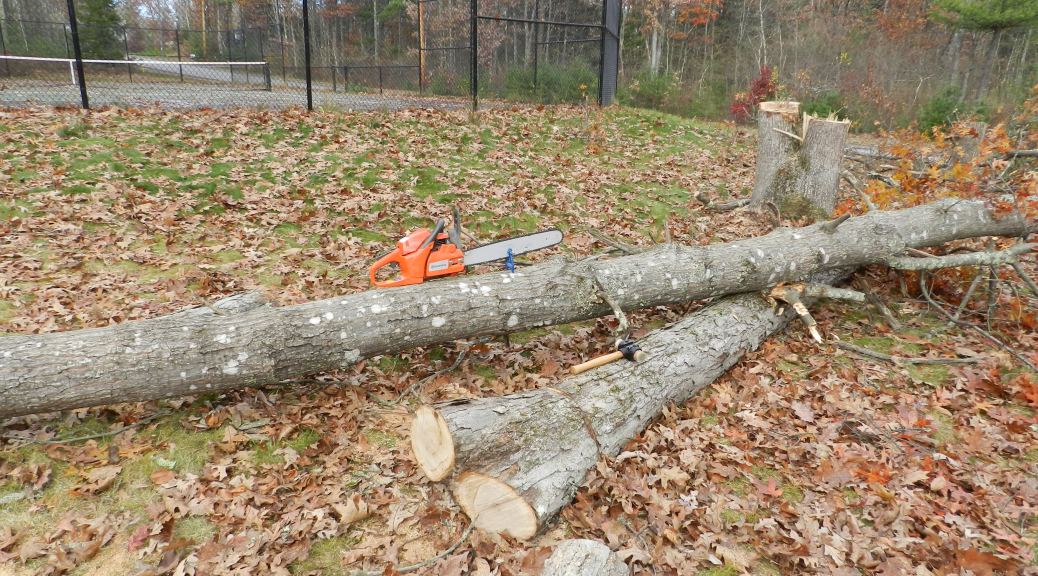
When a chainsaw is cutting well it is a joy to use — you can see shavings fly. When it gets dull and spits out dust it’s a slog at best and dangerous at worst. Working out in the field for an extended period is no excuse for not sharpening your chain. There is a great little accessory called a ‘stump vise’ that every chainsaw lumberjack should own. It allows you to quickly sharpen your chain in the field and get back to work.
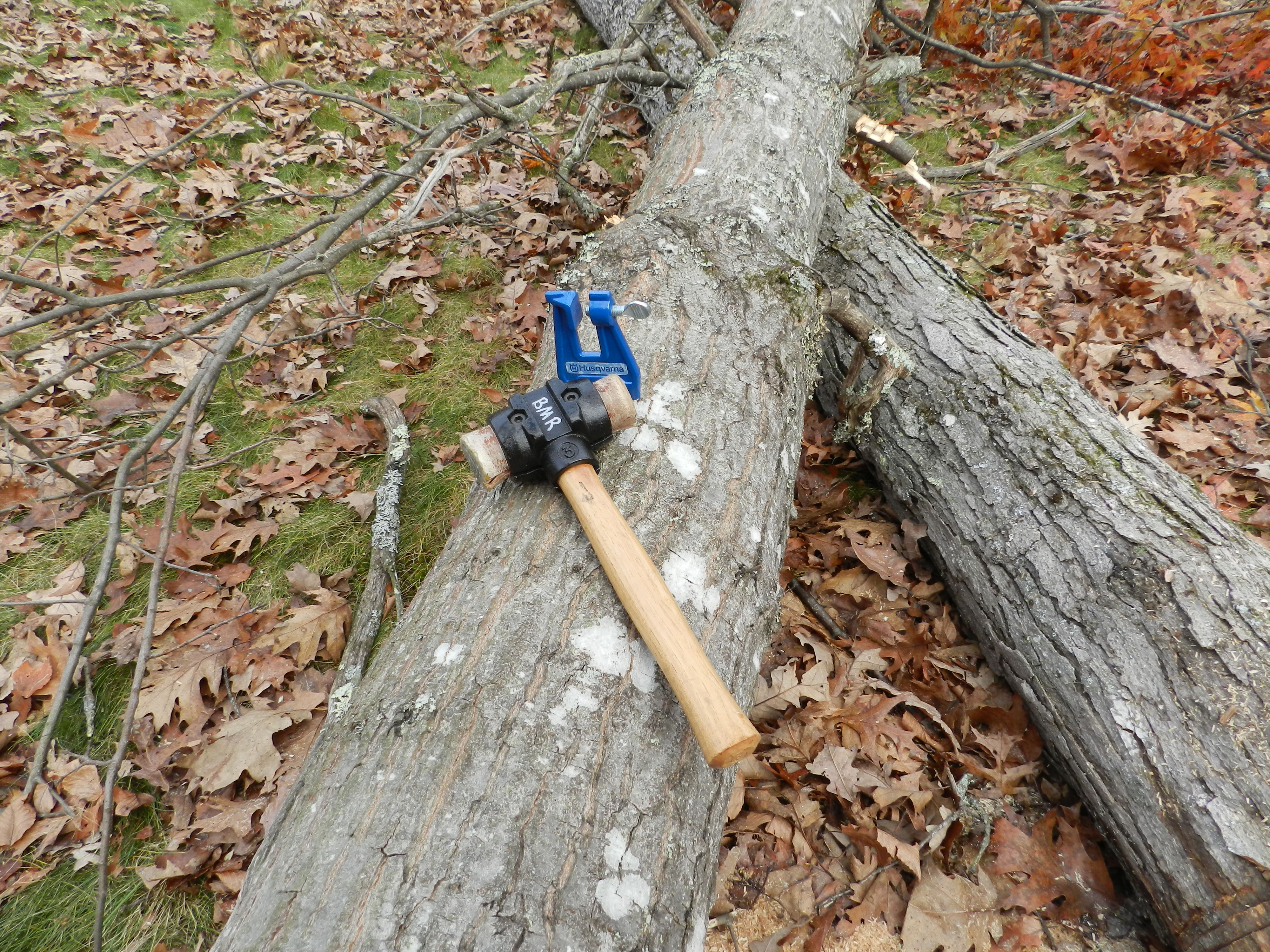
Stump vise
Stump vise

How do you use this vise?

You hammer this little vise into a stump or log. Then you clamp the chain saw bar into the vise, being sure to make sure the bottom chain can clear the vise.
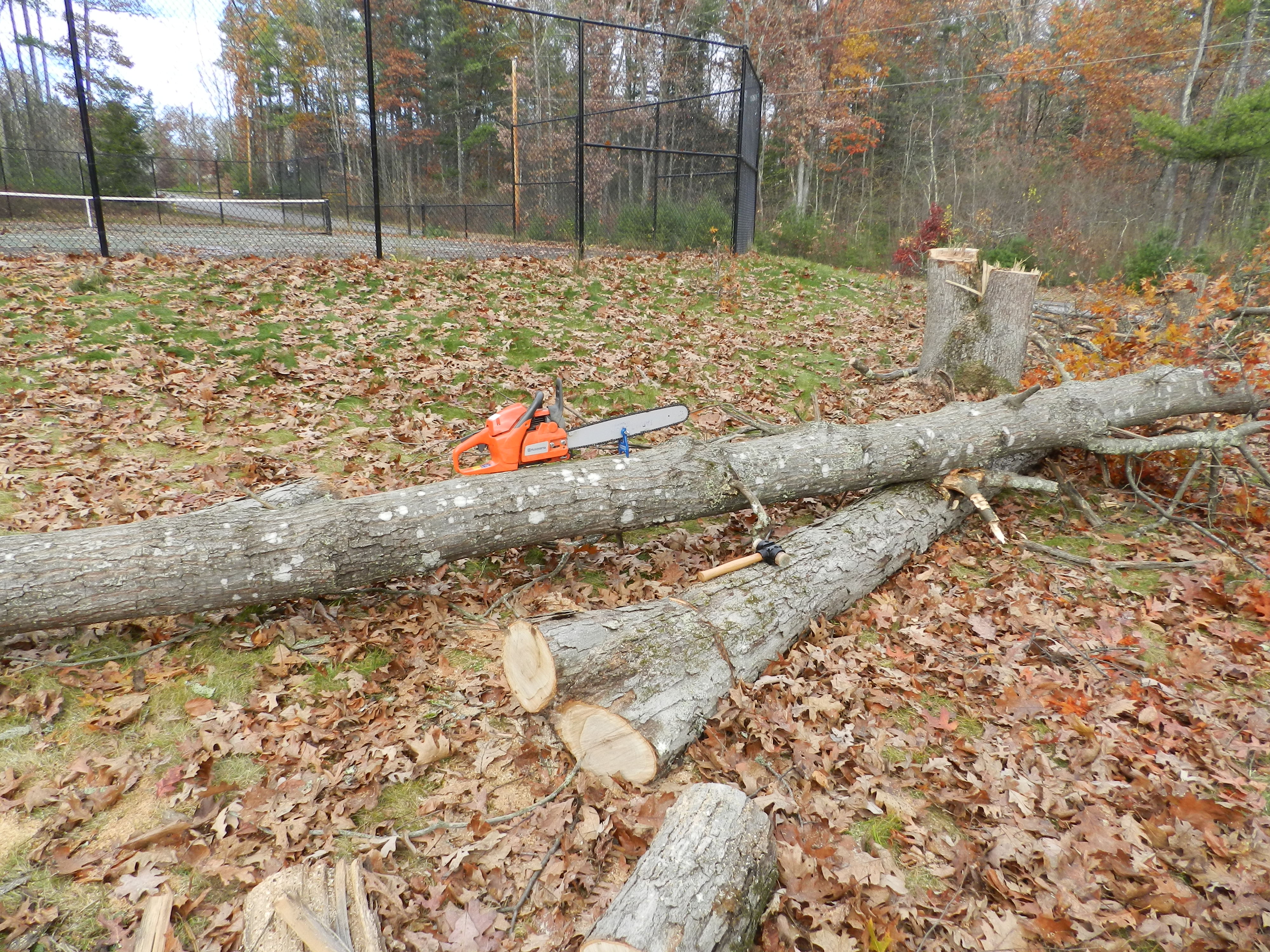
Chainsaw held in place on a tree trunk with a stump vise

Once the saw is secured you can mark the first tooth with a sharpie or similar marker and start filing. I usually do all the right teeth first taking advantage of muscle memory and using the same number of strokes. When I get back to the tooth with the sharpie mark I know I have made it all the way around the chain. Then I make a pass down the left teeth and sharpen each of them. I usually take 3 strokes with the file on each tooth.
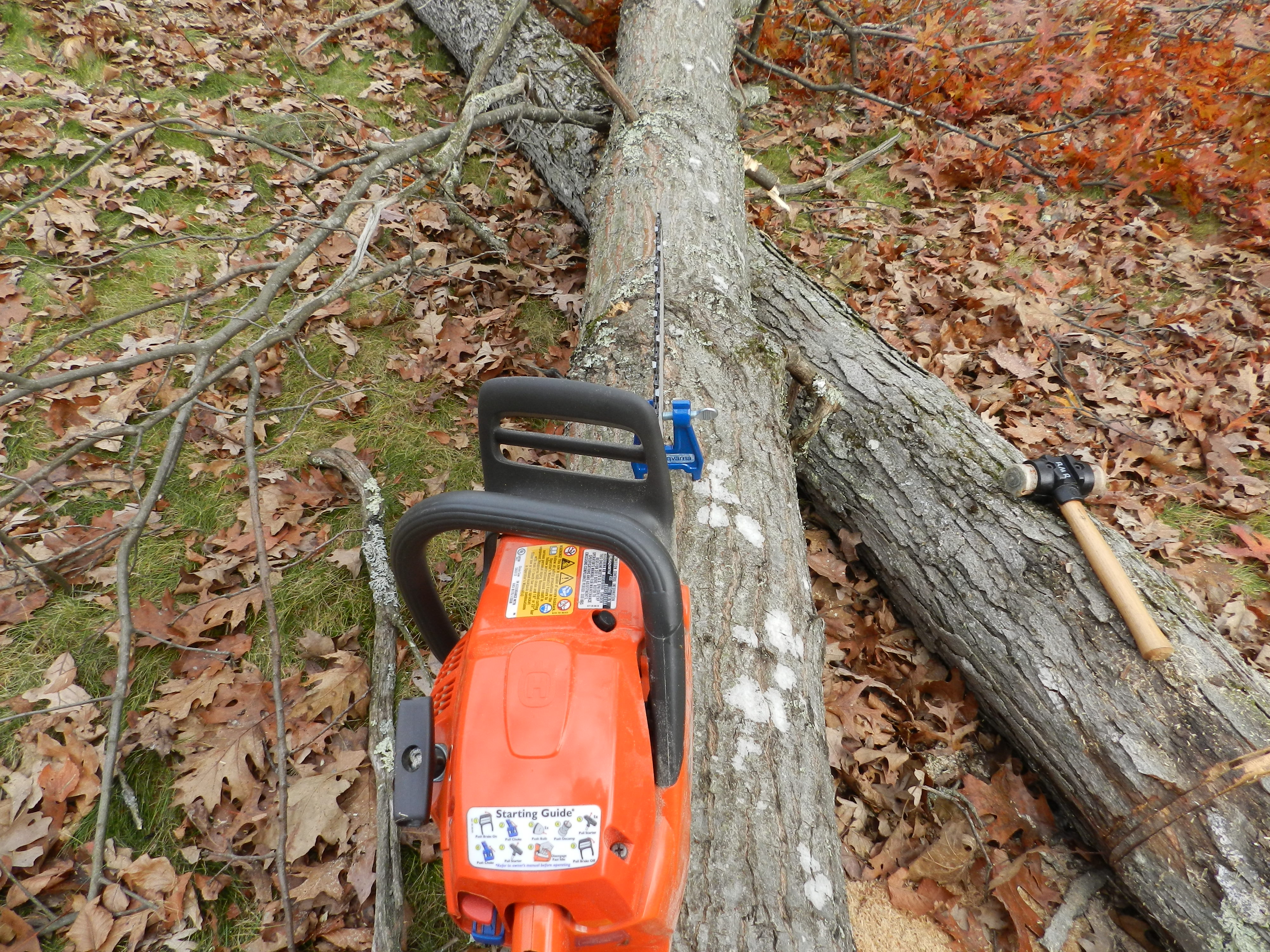
Filing a chain saw chain out in the field

After 10 minutes out in the field with a file I am ready to get back to work and making more shavings.

Where can I find one of these vises?

The vise I have was made by Husqvarna and fits nicely into its own compartment inside the blow molded plastic case I keep my chainsaw in when it’s not in use. When you don’t need one of these vises they are easy to find — when you need one they can be hard to find. Last year when I bought a new chainsaw I went to the local Husqvarna dealer seeking one of these vises and he had no idea what I was talking about  — so I showed him the plastic case they sell which had a picture of it even and you’d think I had 2 heads the way he was looking at me telling me that is not something they ever made — clearly he had not done a lot of work out in the field as all the timber framers I knew had them. Needless to say I won’t be returning to that shop. The local True Value, big box stores and Tractor Supply didn’t have them even though I know there is a LOT of logging going on up here in NH. So I caved and bought mine online from a 3rd party outdoor equipment supplier on Amazon and have been very happy with the purchase. I bought the official Husqvarna branded vise for about $18, but the castings look near identical to the yellow model you often see branded as ‘General’ or other similar brands.

I hope you’ll treat yourself or the chainsaw operator in your life to one of these vises so they can get back to cutting up blanks for future projects.

Take care,

-Bill
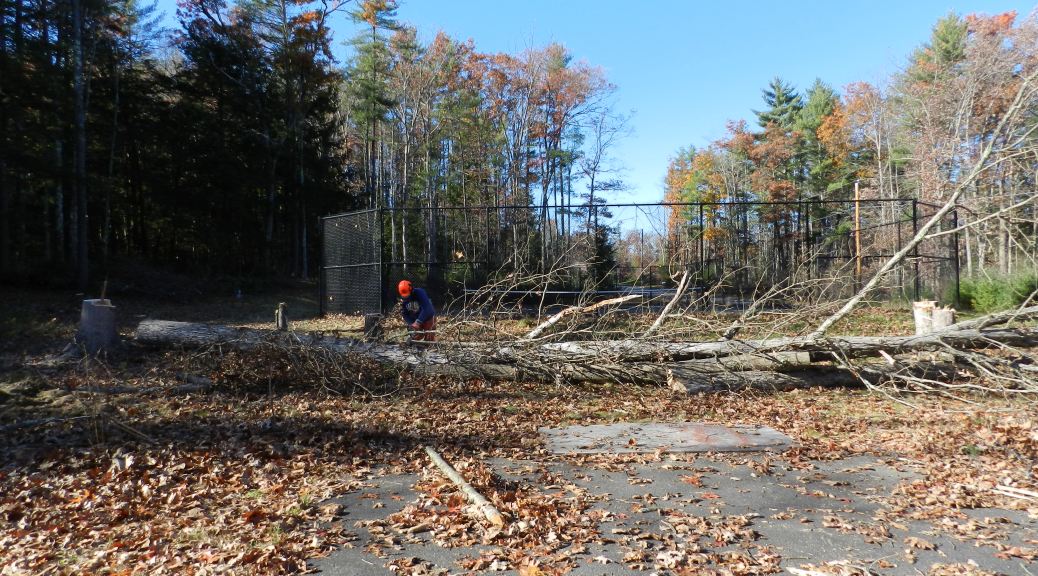
The thoughts one thinks while sawing a tree…

“The Oriental philosophy of contemplation involves forsaking all work; the European does his meditating while relaxing from work, but the American seems to think things out best while working. So the stone walls of New England may be thought of as monuments to the thoughts that occurred while they were being built, for those were the days of great decisions and profound planning. The thoughts one thinks while sawing a tree or making a stone wall are surprising. It is almost as if the mind becomes ashamed of the work the body is doing and starts doing a little “showing off” by itself. Lincoln said he did some of his deepest thinking while splitting rails. The plain farmer of two hundred years ago was weaving the fabric of a new nation and although there are no marble statues to his patriotism now, there are still his stone walls.” — Eric Sloane American Barns and Covered Bridges, 1954

Oak trees in the way of my barn...
Oak trees in the way of my barn…

I live on a heavily wooded street in New Hampshire that is lined with stone walls. As I pass them each day I think about what it took to clear all this land and build those walls. While most of the neighborhood is covered with second and third growth trees that were not actively managed, and new housing developments,  there are still a few pockets of small family farms with cleared farmland that looks like an idealistic painting of yesteryear and reminds us how this was all farmland about 100 years ago.  As the leaves changed this season I found it amusing to see tourists snapping pictures in front of some of these farms with their stone walls and weathered barns. In the book referenced above Sloane encouraged his readers to keep an eye out for early barns also made several interesting observations about stone walls. They were designed to keep animals in and not to keep humans out. When a wall fell over you had all the stones needed to rebuild it as opposed to a wooden fence that could have rotted away. I like the sense of inviting simplicity, using what you had on hand and building for the long term.

I recently set out to clear some trees out of my backyard and make room for a 12’x24′ timber framed shed/small barn to store extra wood and yard equipment. I’ve cleared about 35 trees so far, knocked off a bucket list item — taking down a full size tree with a felling axe, and still have a few more to go.

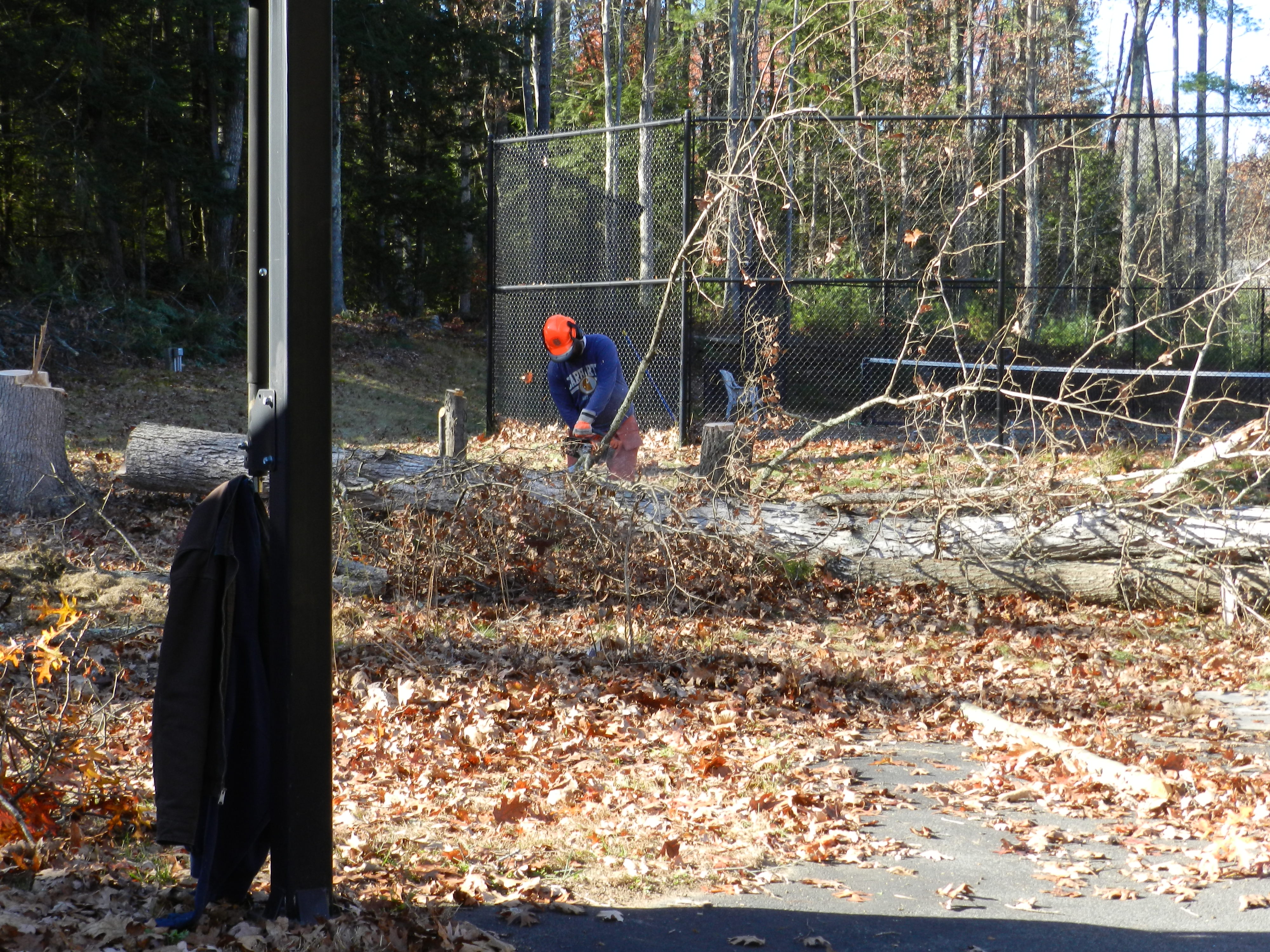
Felling oak trees
Felling oak trees

Safety Tip:

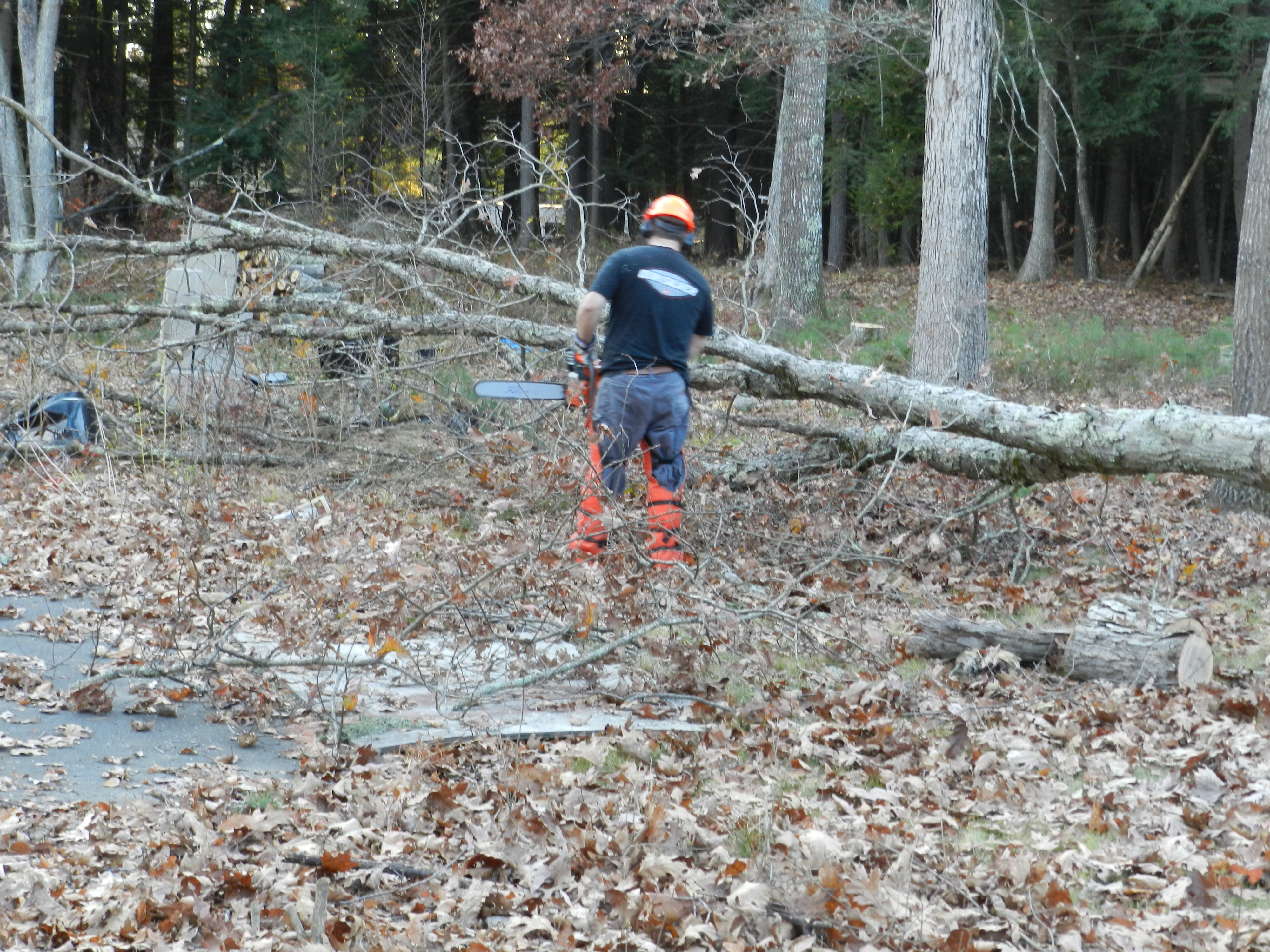
When working with large trees and high powered saw, make sure to ALWAYS wear the appropriate safety gear. Above you can see me wearing my steel toe boots, Kevlar chaps, eye protection, helmet with hearing protection and face shield and Kevlar reinforced gloves.  The chaps are like wearing an insulating blanket and rough to wear in the summer, but in cooler months they help you stay warm.

Limbing the tree
Limbing the tree

How do I cut down a larger tree?

I start by walking around the tree from all sides, sighting up at it to see what way it leans and were the mass is held by the limbs. I then mentally think about what direction I have enough space to drop to the tree without hitting houses, other trees, people or fences. With a plan in place I set about felling the tree. The process is much the same whether I use an axe or a chainsaw. I cut in at an angle on the side of the tree facing the way I want it to fall. I then make a horizontal cut to remove that wedge of wood. It should only be about 1/3 of the way through the tree. You want the intersection of those two cuts to land right on each other so you have a smooth hinging surface and a controlled drop.

90 Foot tall oak trees take a LOT of work to break down

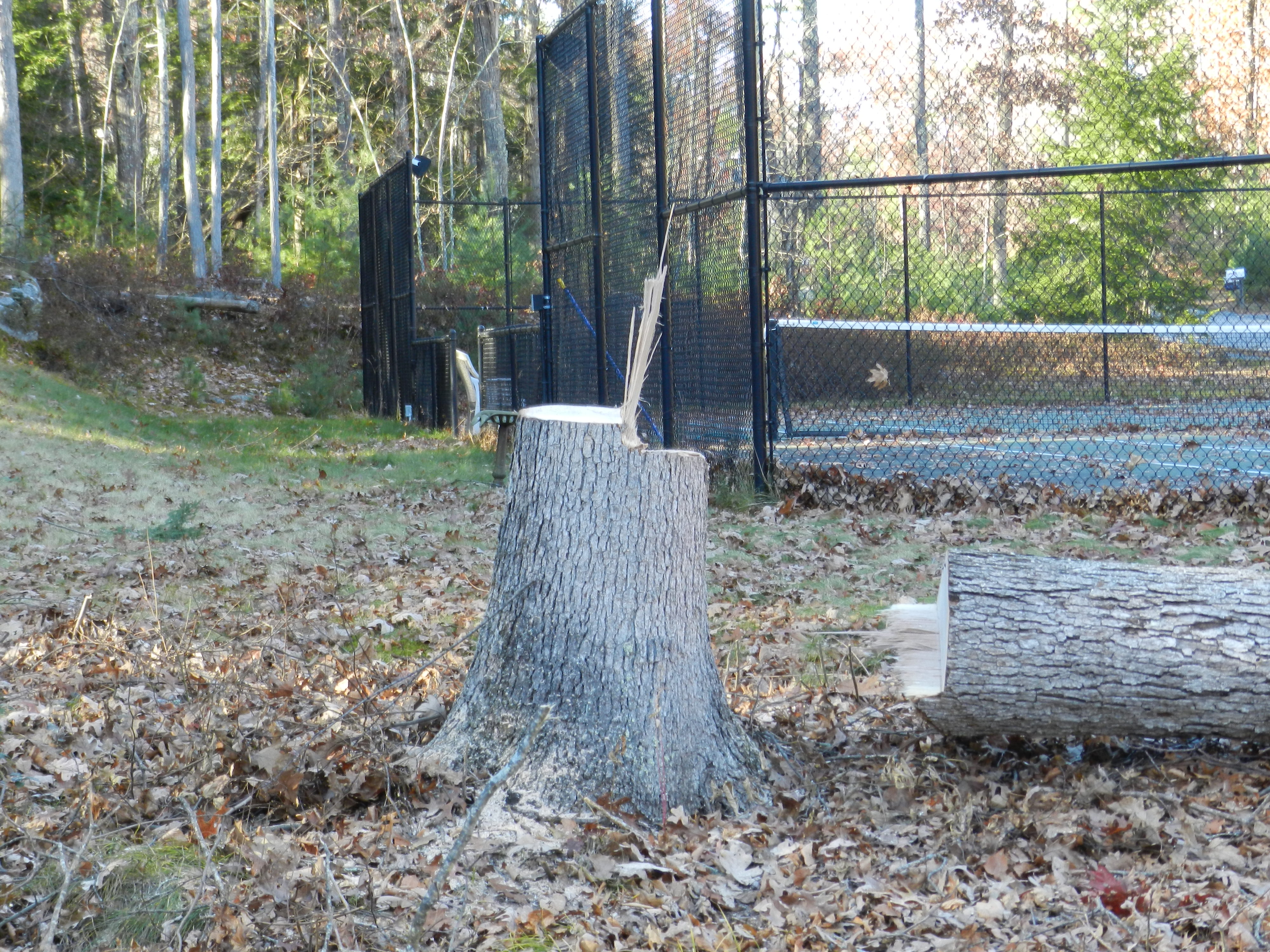
I then come from behind the tree and make a horizontal cut until I leave about a 1.5″” wide hinge of wood that will help control the fall. This cut should be about 2″ above the bottom of the wedge cut (As seen in the photo below).  If done properly the tree should slowly start to fall over exactly where you want it. The tree shown here was a 90 foot tall oak, so when it hit the ground it shook the ground with an incredible thud — anything in it’s path will get crushed. When cutting a tree like this make sure you have a clear retreat path, usually 45 degree from the way you expected the tree to fall, that way you are not in the path of a falling or splitting tree or anything it kicks up.

Notch cut and hinge used for a controlled drop

Once on the ground I start removing all the limbs from the tree. I start with all the limbs that are not holding the trunk up off the ground to make room to better access the trunk. Any limbs or branches that are holding up the trunk are likely going to bind on your chainsaw if you are not careful. Being mindful of where the tree may move as you release that tension you can use a sharp axe to remove these limbs or careful wedge cuts that will not bind the saw. When doing this sort of work you need to be thinking about where the trunk is likely to fall after removing this limb, so you’ll want to mind your legs and feet.

Breaking down the de-limbed tree into firewood

Once the limbs are removed I break the tree trunk down into either firewood or whatever I am looking to use the wood for. These trees will be processed down into several projects — a few bowl blanks, a new base for my anvil, a few chopping benches for the shop, a stump to split firewood on and of course firewood. The incredible amount of brush and branches will be ground up into chips and distributed elsewhere on the property.

More Tips on cutting trees:

  • Try to cut tree during the colder months or winter as there will be less sap and thus less weight and cleaner cuts
  • Use plastic wedges when cutting a larger stump so that it does not bind on your saw’s bar and the wedge will not damage the chain
  • Use plastic or even larger metal wedges to help a cut tree (notched and ready to hinge) that is not falling. You can use a large mallet or beetle to drive in a wedge and help give it that little push it needs to start going over.
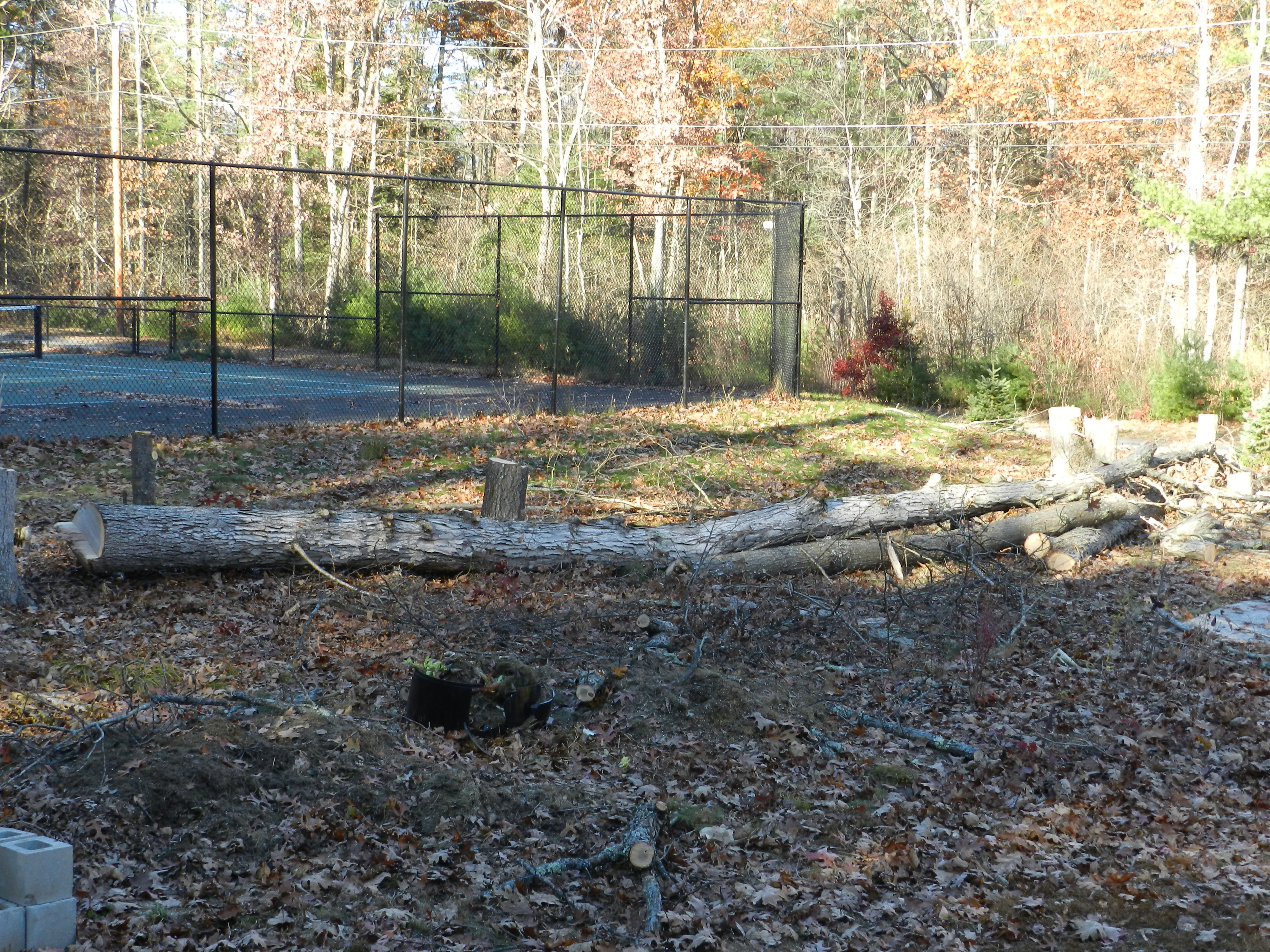
The result of a weekend of hard work

Even with all of the above information running through my head, and the sometimes backbreaking labor to break down these trees, there was still a lot of time to think. As I was doing the above work I was building the timber framed barn over and over again in my head, so by the time I actually get around to cutting the frame it will be like second nature. Unfortunately the snowy weather is creeping up on me fast, so it will be a race to see if I can get the shed put up this fall/winter or if it will get delayed until spring.

I’ll keep you posted.

Take care,
-Bill Rainford

Working with cut nails…

As a preservation carpenter and joiner my work regularly requires me to work work with a wide variety of cut nails. A lot of recent woodworking publications focus on cut nails appropriate for cabinetmaking and smaller projects, but that barely scratches the surface of what was still available if you know what you want and where to look.

From small projects requiring a few nails…

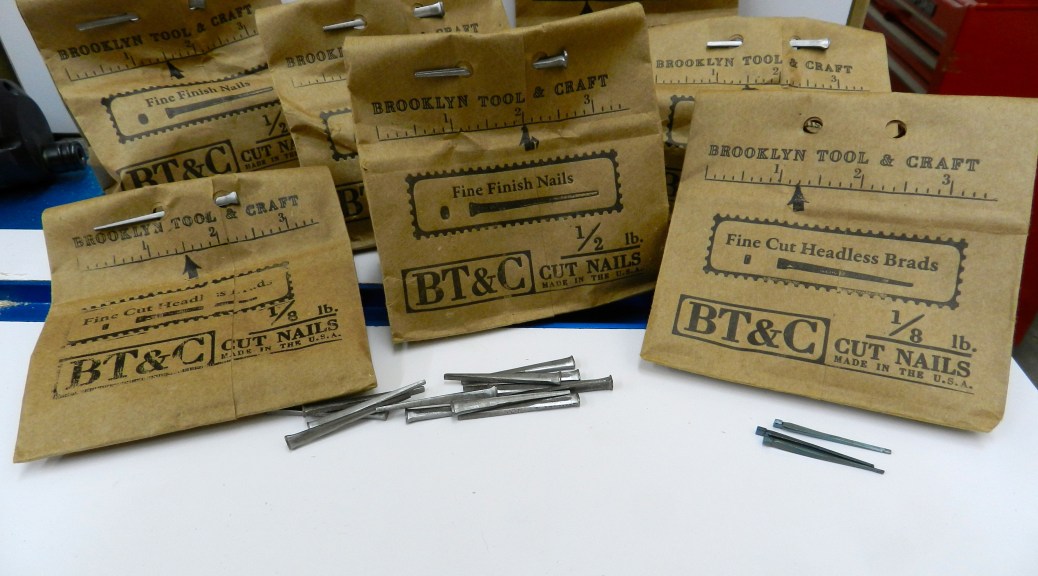
Brooklyn Tool and Craft bags of cut nails

To larger jobs needing them in bulk…

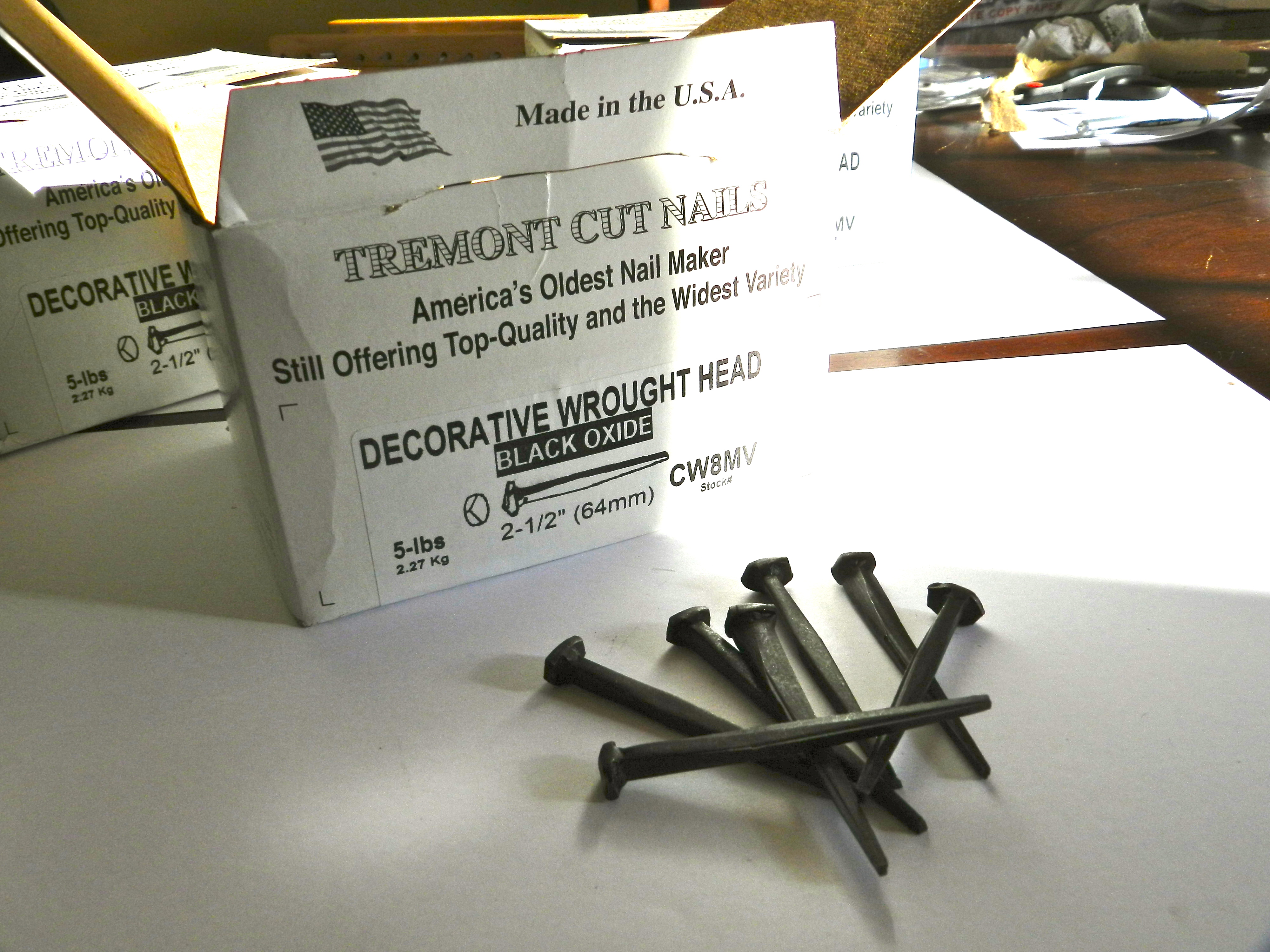
Decorative wrought head cut nails used for wide pine flooring

You can still get cut nails, even galvanized steel cut nails from Tremont, the oldest remaining and most prolific cut nail maker that is still around.

Why do I want to use cut nails?

Cut nails offer several advantages over modern wire nails:

  • The chisel shape of the end of a cut nail helps to severe fibers as it is driven into the wood as opposed to wire nails that compress the wood around it
  • The wedge shaped profile and sharp edges that result from how the nail is made help the nail hold better when compared to wire nails
  • The distinctive square head, or decorative wrought head can be quite pleasing to the eye on new and old projects
  • Cut nails with the wrought head can be a cost effective alternative to blacksmith wrought nails for larger or less historic projects
  • Cut clinch nails can be clinched (bent over onto itself) which makes them a very effective fastener much like a large staple
  • For preservation or reproduction work it is important to get the small details right — including use of the correct period appropriate fasteners
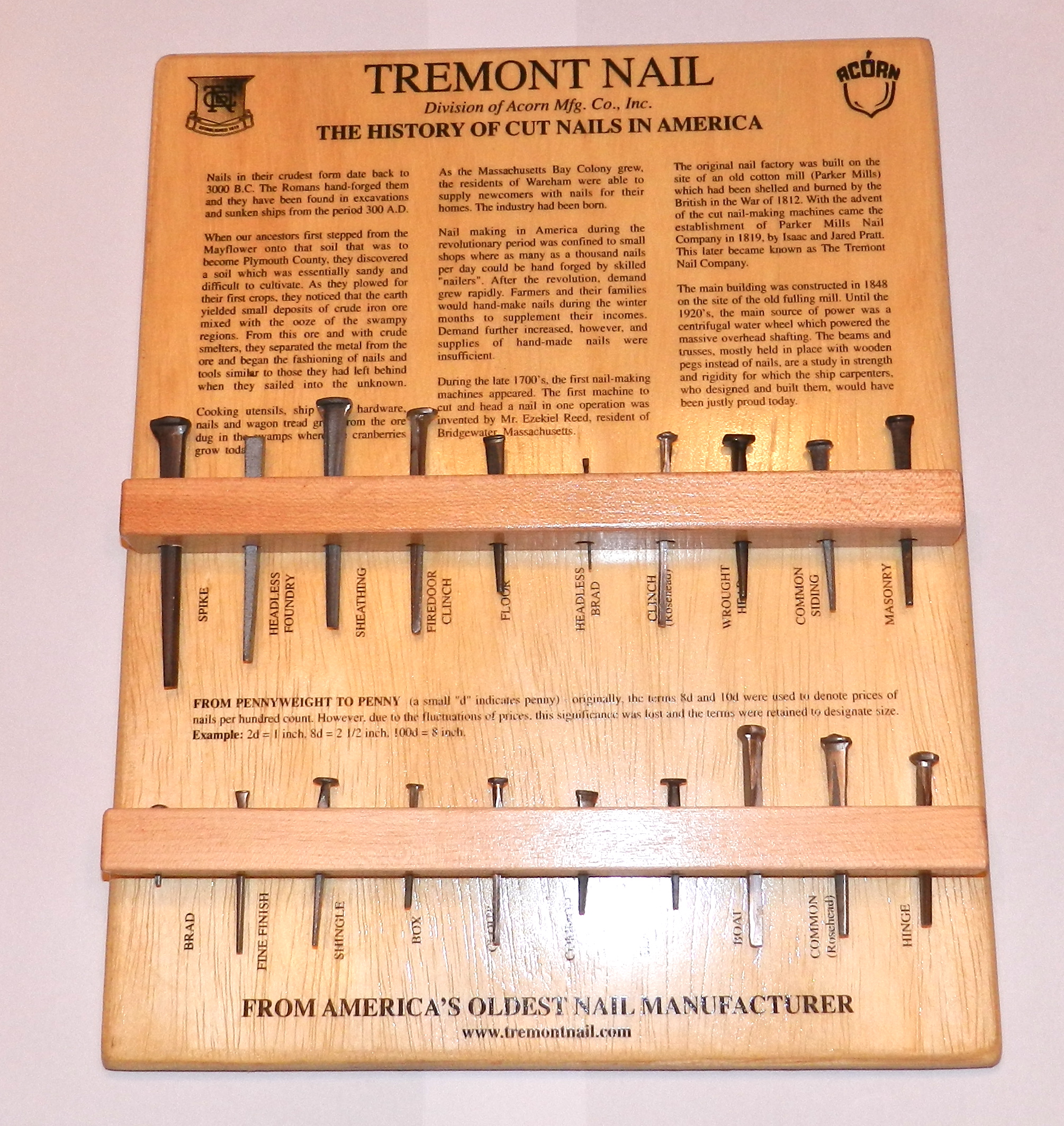
Tremont Nail Display Board

All that sounds well and good, but is it worth the extra time and expense to track down these sometimes hard to find nails?

I’d say it’s hard to argue with good results, so let’s take a look at some common uses for cut nails. From simple traditional boxes and drawers…

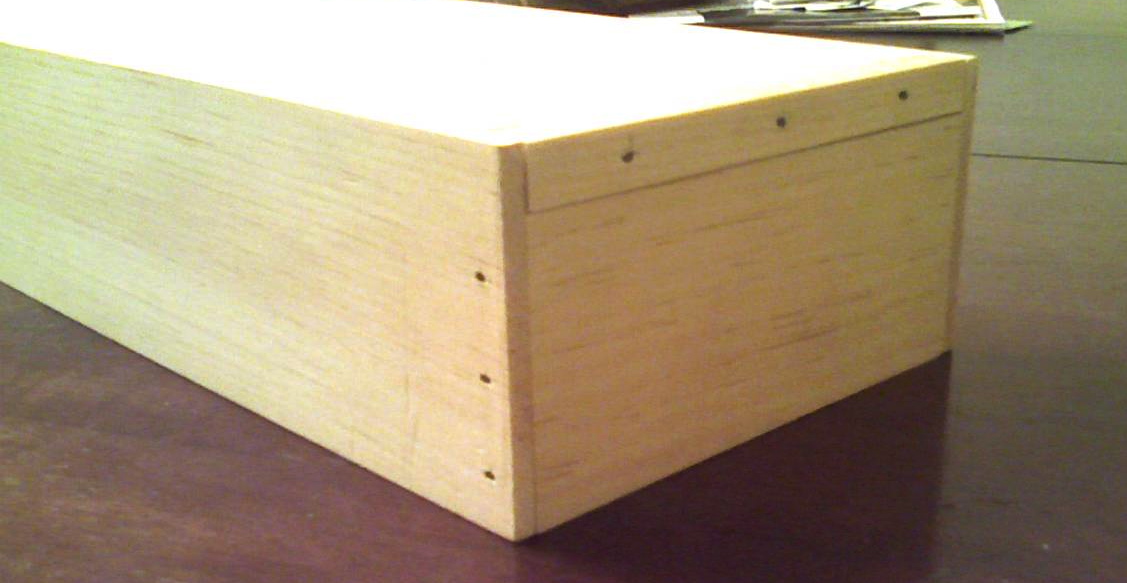
Chisel box with cut nails

To high style door pediments and architectural details..

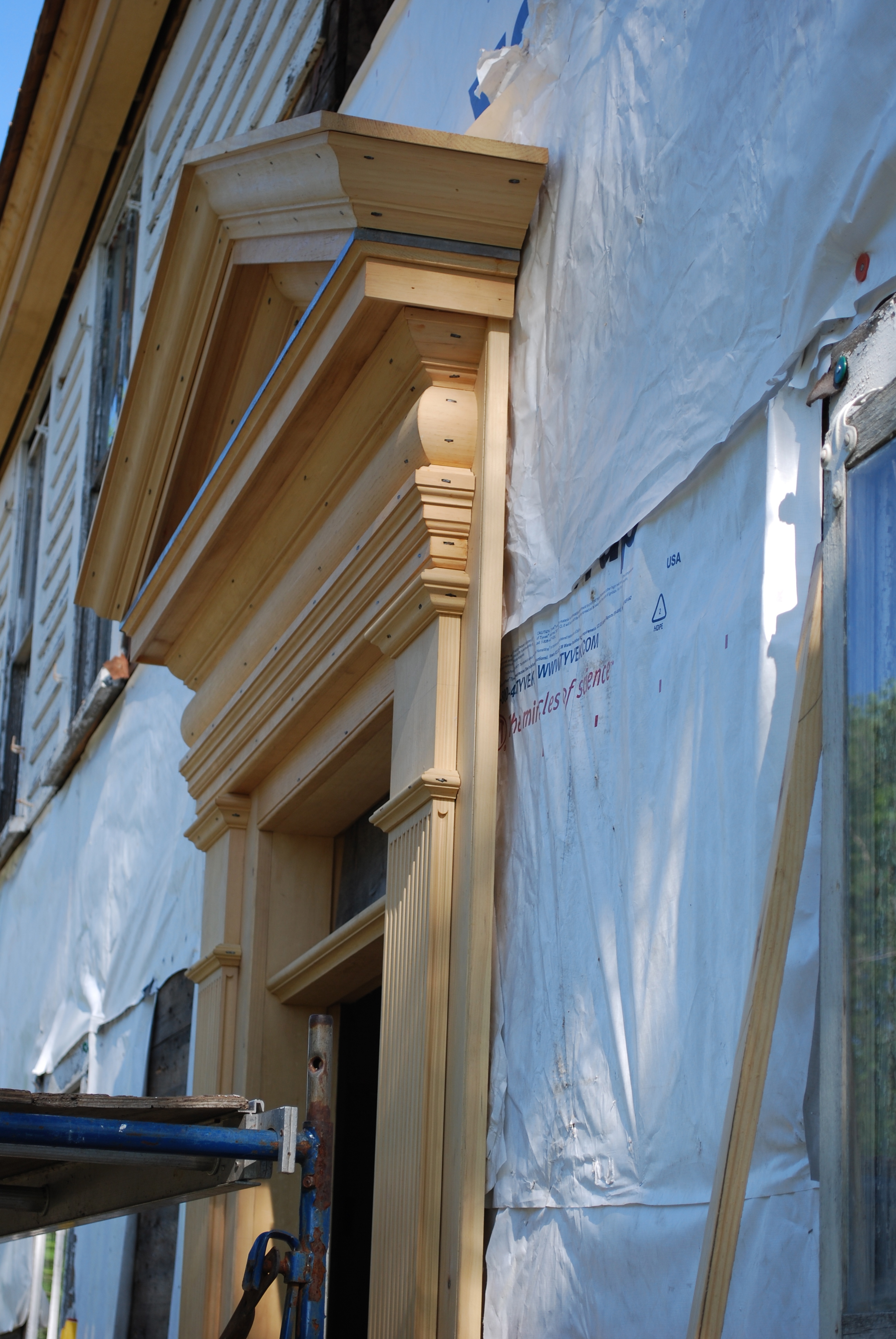
Cut nails in a traditional door pediment

To clinched nails in a reproduction door on an historic home…

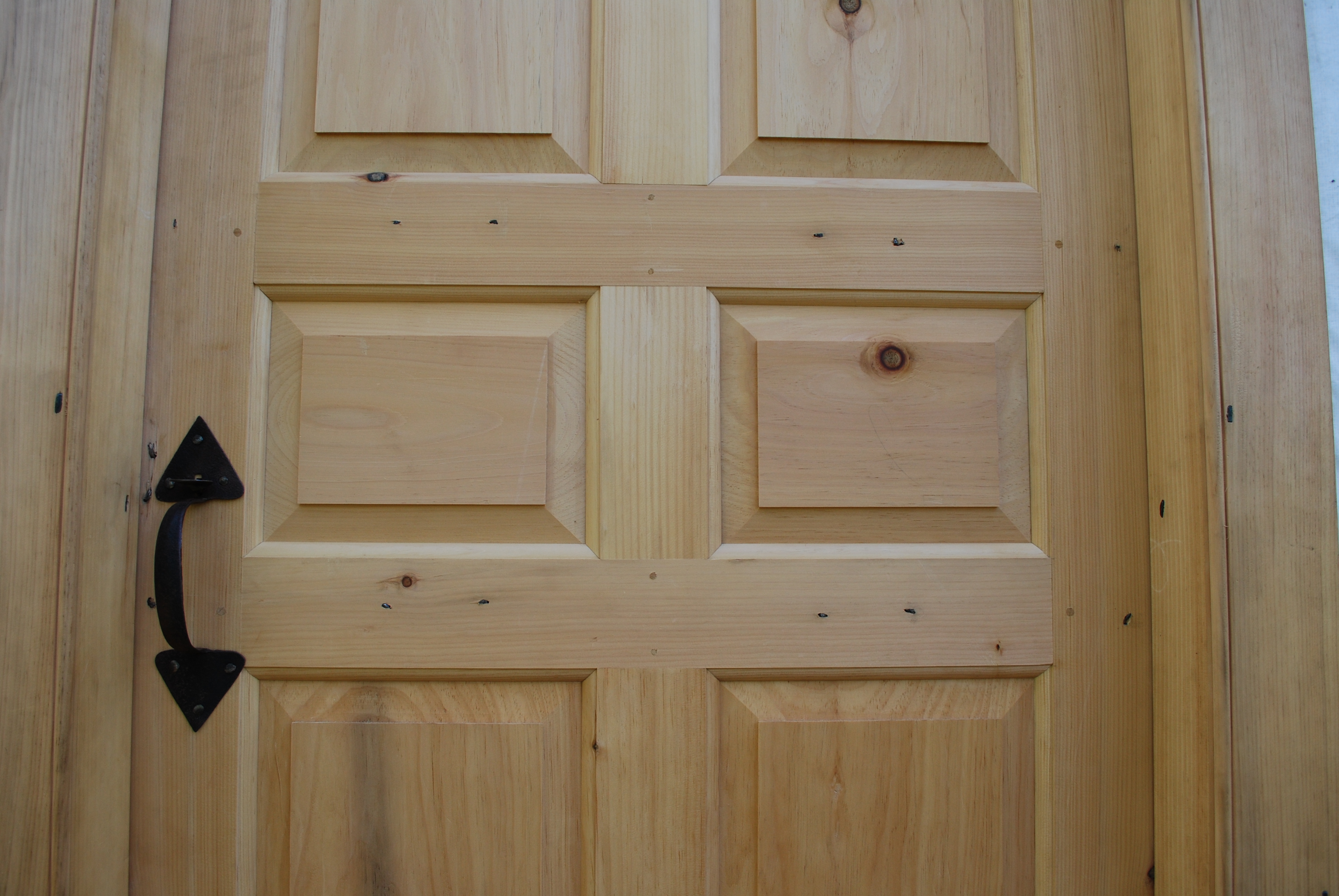
Clinched cut nails in a period door reproduction

To siding and trim details…

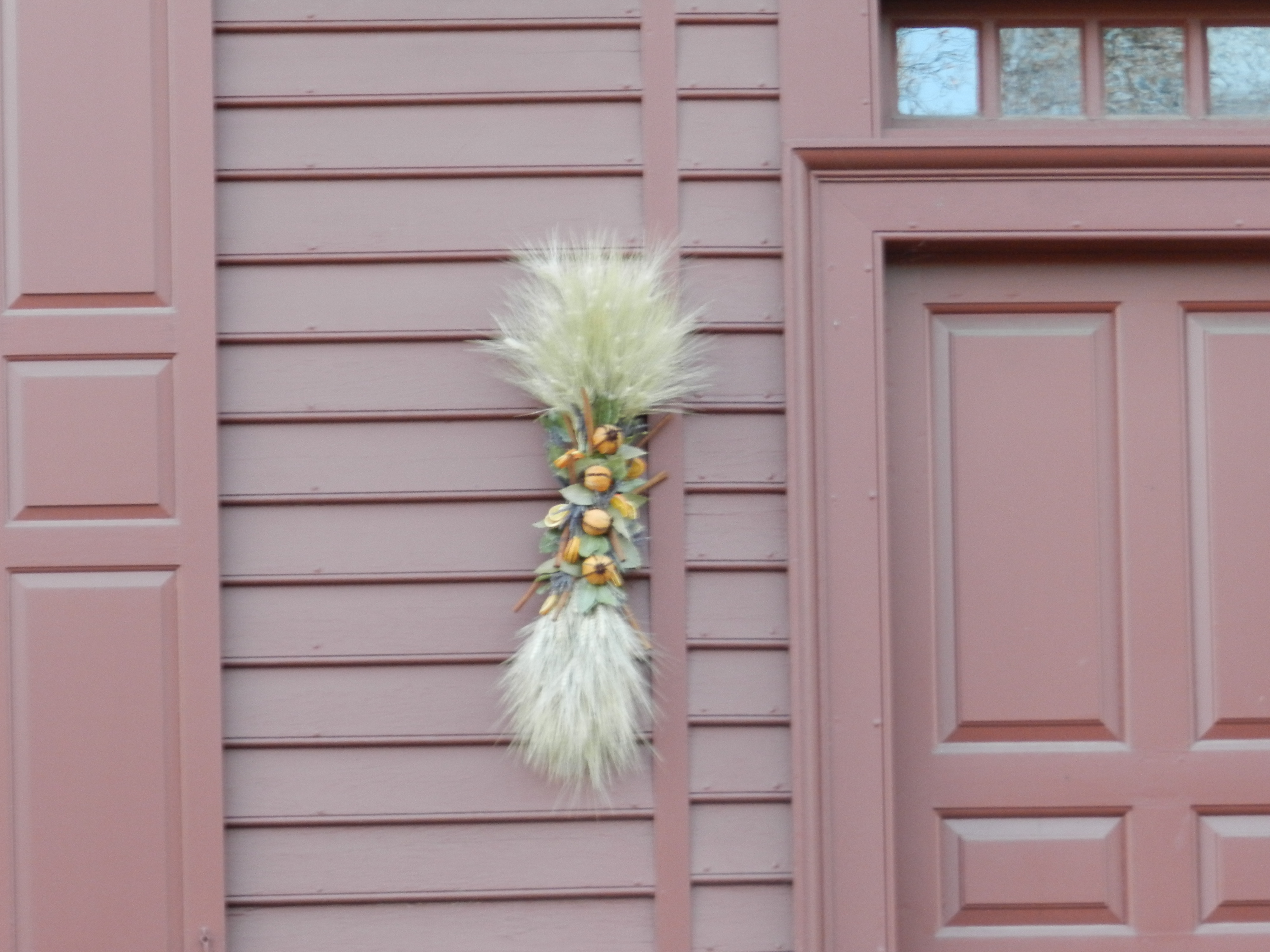
Cut nails in exterior siding and trim

The cut nails add to the visual authenticity and given their superior holding abilities will also increase the longevity of the work.

Tips on working with cut nails:

  • Make sure the chisel end of the cut nail is set in across the grain thus severing it and not acting like a wedge
  • Start off slow with a couple of light taps before driving the nail home with harder hammer blows
  • If working near the end of a floor board or using a large spike consider pre-drilling a whole that is slightly smaller than the nail to prevent splitting
  • If using the nails on an exterior application consider buying galvanized cut nails. If your local supplier does not offer that, you can send the nails out to have them hot dipped for a reasonable price. This will help the nails survive the elements and require less maintenance.
Cut nails in exterior siding and trim
More cut nails in exterior siding and trim

Gallery of the 20+ Cut Nail Types still available (If you are viewing this in email, you’ll need to click over to the blog to see this gallery properly displayed):

Where can I find these cut nails?

  • If I need a small number of cut nails I usually order from Tools For Working Wood as they sell 1/8lb bags which are secured shut with another cut nail (Labeled as Brooklyn Tool and Craft I believe they are repackaged Tremont nails)
  • If I need a large number of cut nails I usually order direct from Tremont Nail (A company in MA with over 190 years of cut nail making experience)They offer, 1lb, 5lb, 50lb and custom larger size (think nail casks) orders
  • The Tremont Nail wood board with sample nails is available for purchase from Tremont — it’s a great addition to any shop and allow folks to examine each of the above described nail types in person. I have one in my shop and have found it to be a nice visual aid in my teaching.

I hope to see more folks using cut nails on their projects.

-Bill

I am a Joiner…

I’ve been keeping my local haberdasher busy as I often find myself wearing a wide variety of hats in the course of my work. I regularly have to function as a preservation carpenter, cabinet maker, turner, tailor, timber framer, historian, carver, draftsmen, author, instructor, blogger, handyman and traditional hat aficionado.

That’s a bit of a mouthful to rattle off when you meet someone new.  To simplify I usually tell people I work as a traditional joiner. Often there is a bit of a pause and some clarifying questions. Many folks realize that most of the epithets above generally revolve around a core of skilled woodworking, but they cannot articulate what makes it a true specialty.

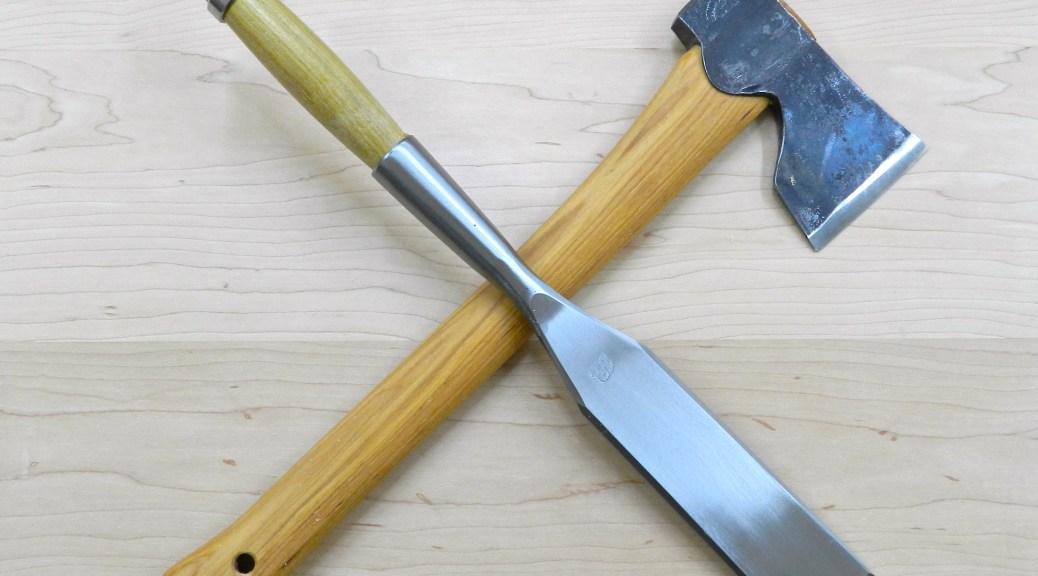
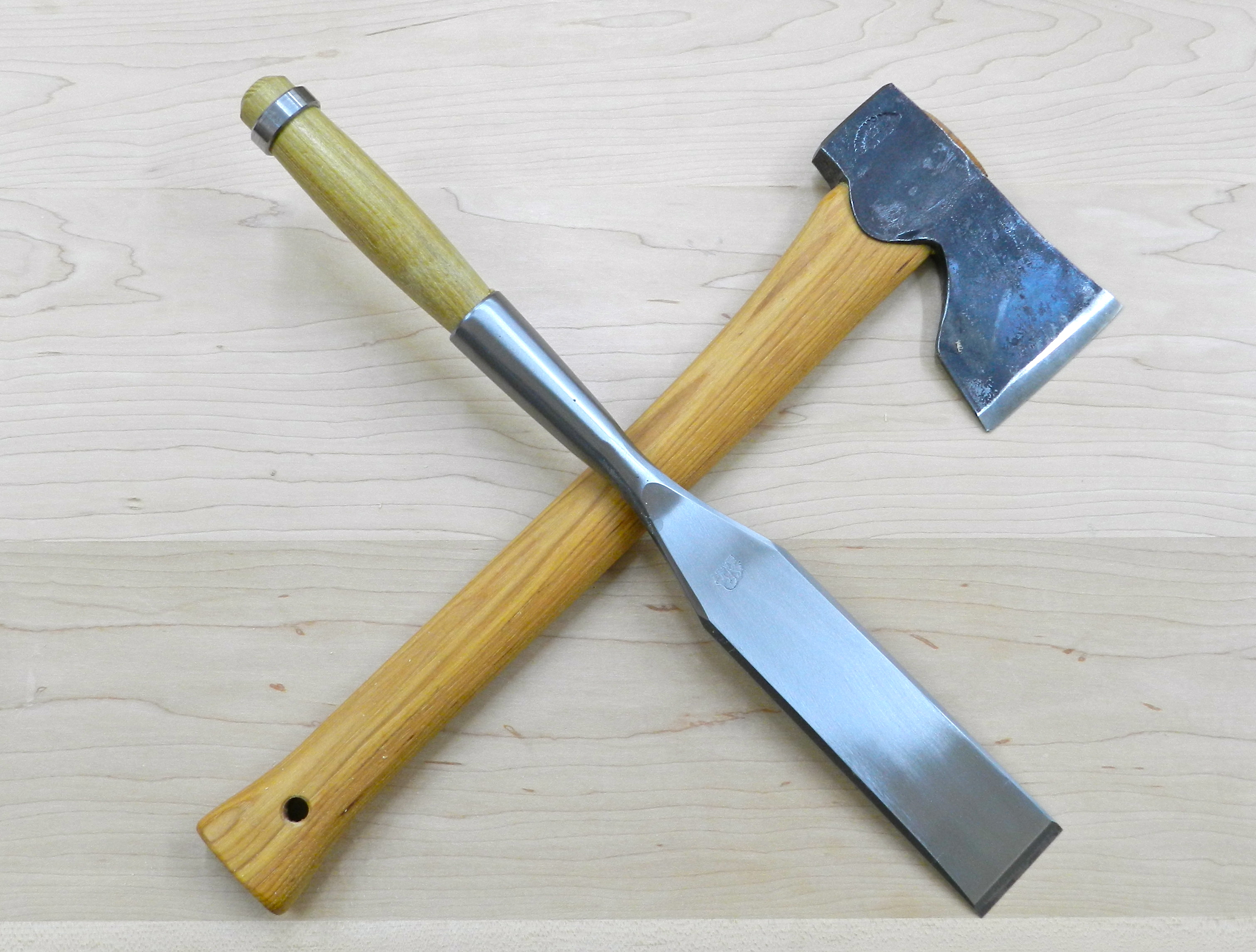
Symbol of a Joiner -- Axe for Rough Work and Chisel for Fine Work and Joinery
Symbols of a Joiner — Carpenter’s Axe for Rough Work and Chisel for Fine Work and Joinery
What does it mean to be a joiner?
Let’s consult our trusty friend the dictionary:
join·er
noun
1. a person who constructs the wooden components of a building, such as stairs, doors, and door and window frames. *

That’s a start, but doesn’t capture the whole of what makes someone a joiner…

In a traditional sense a carpenter often works on the frame and envelope of the building. The joiner is a specialized type of carpenter who literally ‘joins wood’ often focusing on the production of windows, doors, staircases, wainscoting, built-in case goods and other items that make up a home and require a higher degree of skill compared with regular or ‘rough carpentry.’ A joiner’s work often starts in the shop and ends out in the field as it gets installed in the client’s home or business location.  In more rural locales a joiner often functioned as a part time cabinet-maker regularly delving into finer work that required a high level of skill. Many traditional ‘country’ style pieces of furniture were often made by joiners using the same tools and techniques as any other cabinetmaker. In urban areas where there was enough demand to support specialized trades and full time cabinetmakers we can still find records demonstrating how joiners were able to compete and straddle the line between fine finish carpenter and cabinetmaker.

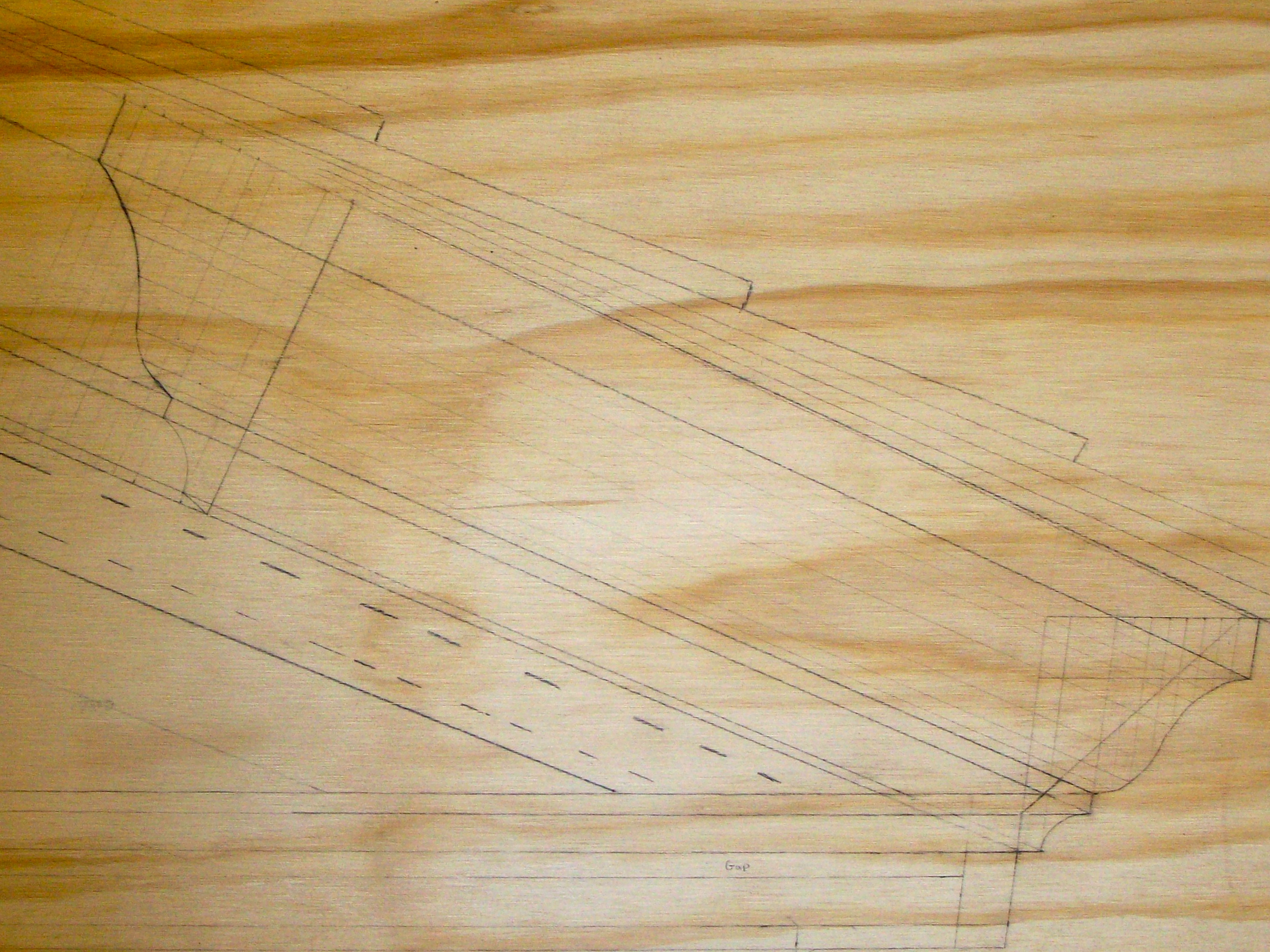
Full size story board for a door pediment

How does this relate to modern day woodworkers? Are joiners simply modern finish carpenters?

A ‘modern day’ Carpenter generally starts with materials procured from big box stores and lumber yards that are manufactured and uses them to build homes largely by assembling those pieces, using modern fasteners and possibly customizing a few of the details. All of this lends itself well to the use of modern tools and methods.

In contrast, many of today’s ‘Preservation Carpenters’ occupy the space between a carpenter and dedicated cabinetmaker, thus effectively taking on the role of a Joiner —  equally at home in front the bench or on the construction site. A joiner often starts with raw materials (wood etc) and has to fabricate the items he or she needs to produce — doors, windows, built-ins, large case pieces etc. using traditional joinery, tools and techniques. Sure some modern and powered conveniences can simplify a few tasks, but often the most expedient way to generate the intricate joinery and intended results is to use the same tools and techniques our forefathers used. Routers and sand-paper cannot reproduce the same results you get from a sharp plane iron and a skilled hand. All the fancy tech-laden measuring devices on the market cannot beat the simple efficiency and accuracy of a story stick and a marking knife. Biscuits and dominoes are no replacement for through mortises and draw-boring.

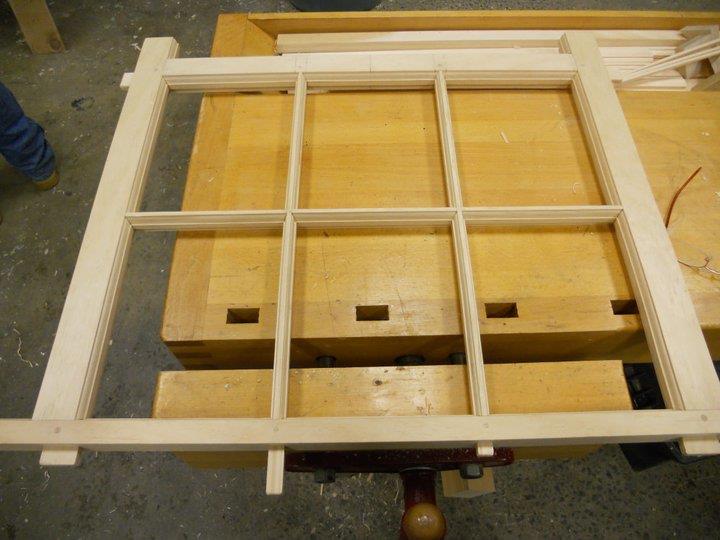
Hand made window sash

Other hallmarks of a good joiner is an attention to detail and knowledge of classical orders (especially with respect to moldings), layout and proportion. If you get the proportions wrong on a piece of furniture you can potentially hide it in a corner, if you mess up a cornice or fenestration on a building you cannot hide it. A joiner’s work is joinery on the large scale, out in public view and it demands that you stay on top of your game from layout through execution.

What’s next?

My goal is to help preserve the ancient trade of being a Joiner for future generations. I am attempting to accomplish this via my travels and in my teaching. I hope to continue helping others learn how to be good joiners, cabinetmakers, carpenters and hobbyists.  No matter what you call yourself or what you specialize in, woodworking requires creativity and hand skills which are taught through practice and maintained through continued use and passion for the craft.

If you are interested in learning more about traditional joiners, please stay tuned to this blog. In the meantime if you have any questions, you can contact me here.

-Bill

*  The definition above was taken from here. The rest is based on my own life experiences. Your mileage may vary.

NBSS Drywall Workshop October 2013

Teaching a weekend workshop is often like a two day stage performance. I’m up at dawn to prep, drive down, unload, on my feet non-stop for the class, then cleanup, head home, quick dinner, then out like a light, and lather rinse repeat. For most people that sounds like torture, but for me it’s fun.

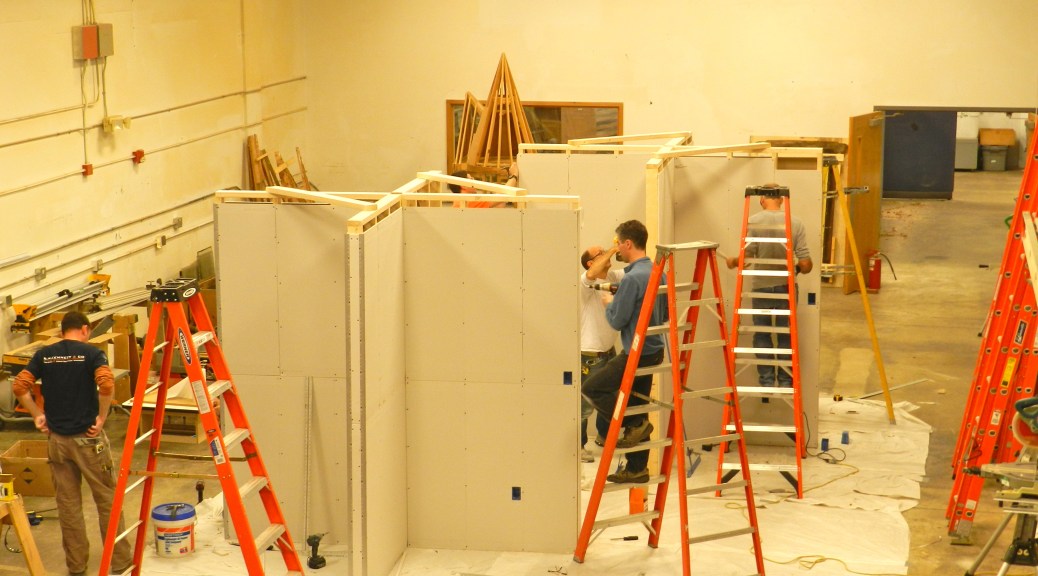
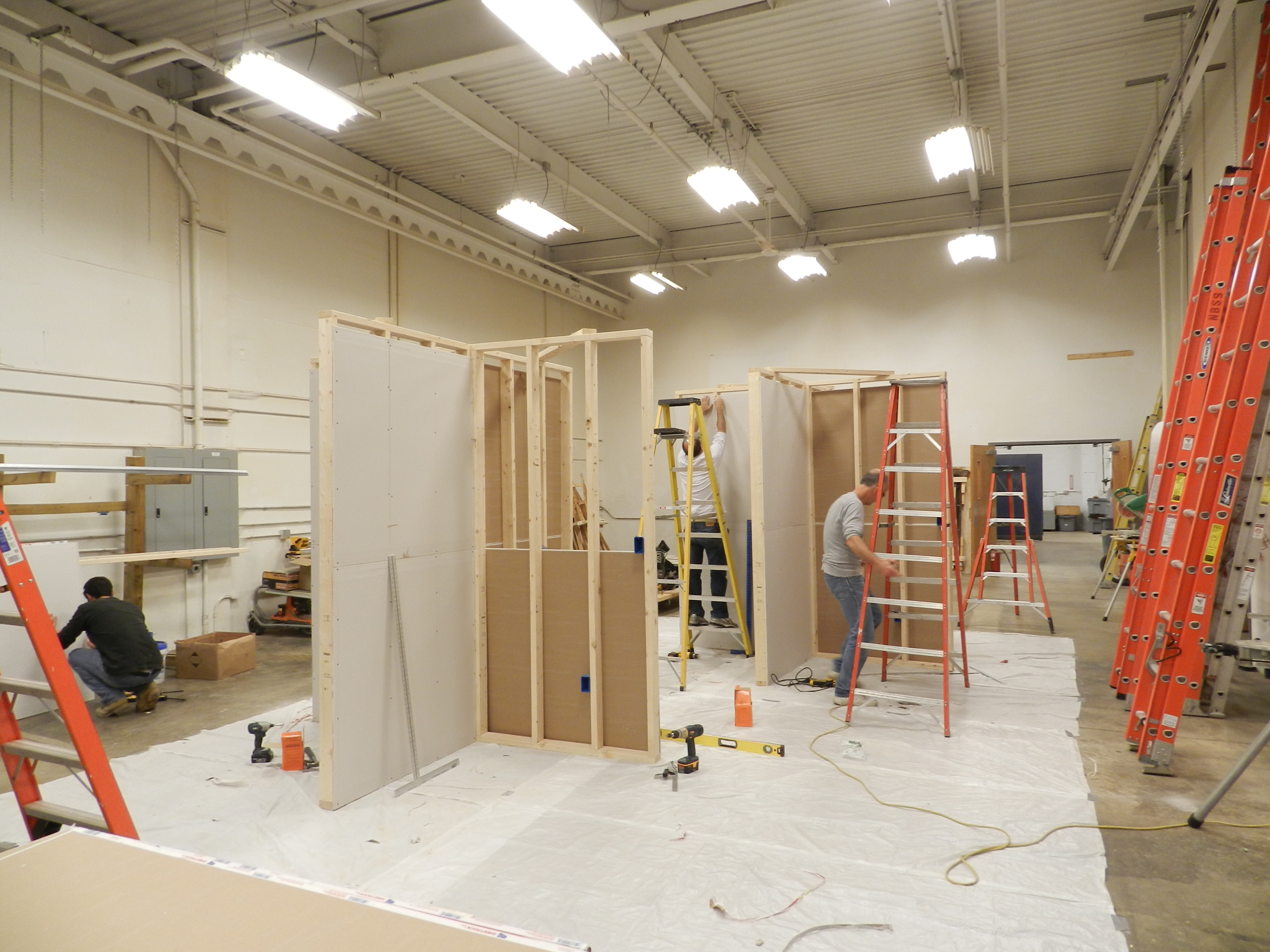
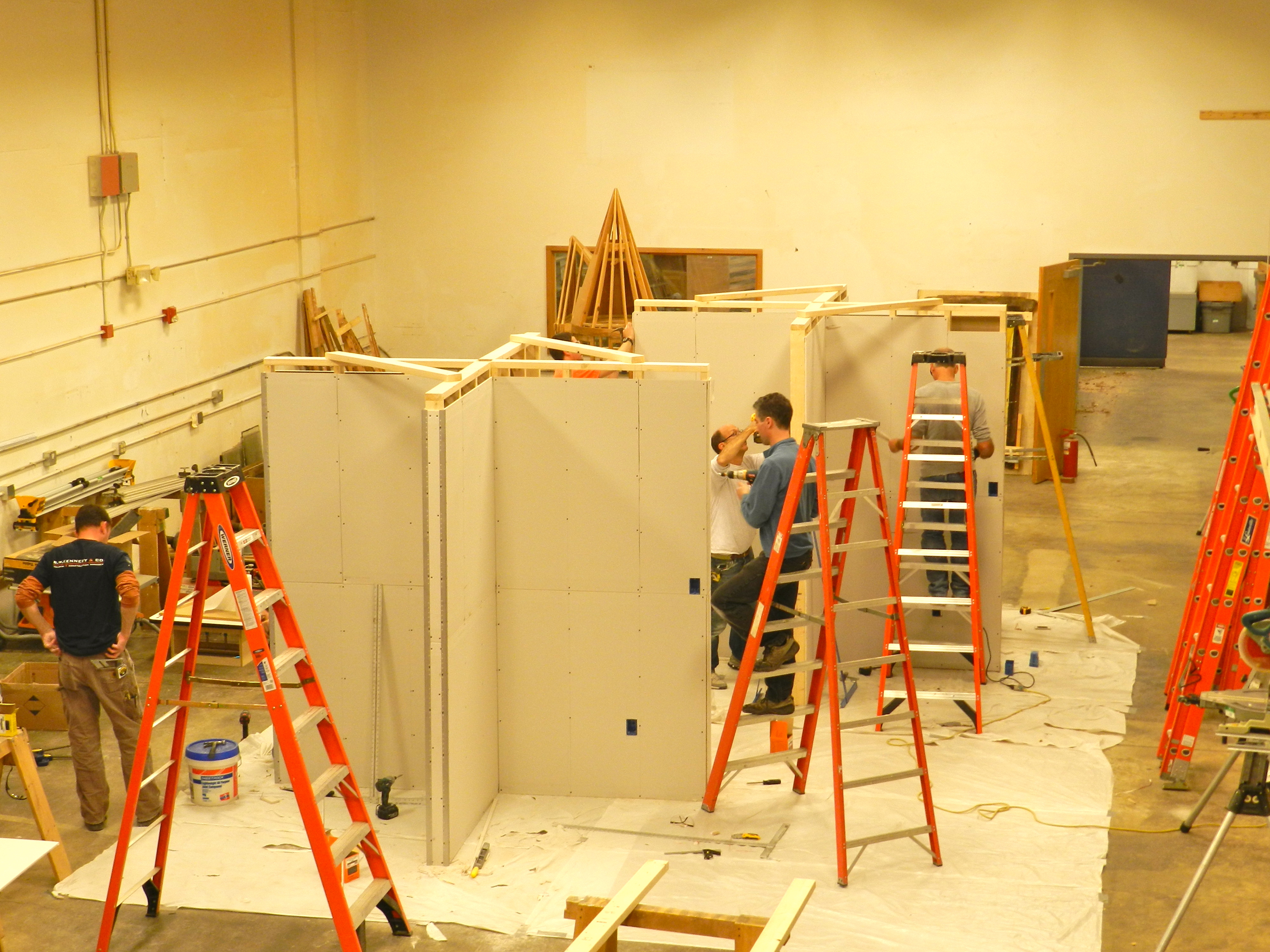
Light stick framing lesson, then hanging sheetrock
Light stick framing lesson, then hanging Sheetrock

I love to share my passion for woodworking with others and teaching helps to feed the tool and and supply kitty for my various projects .

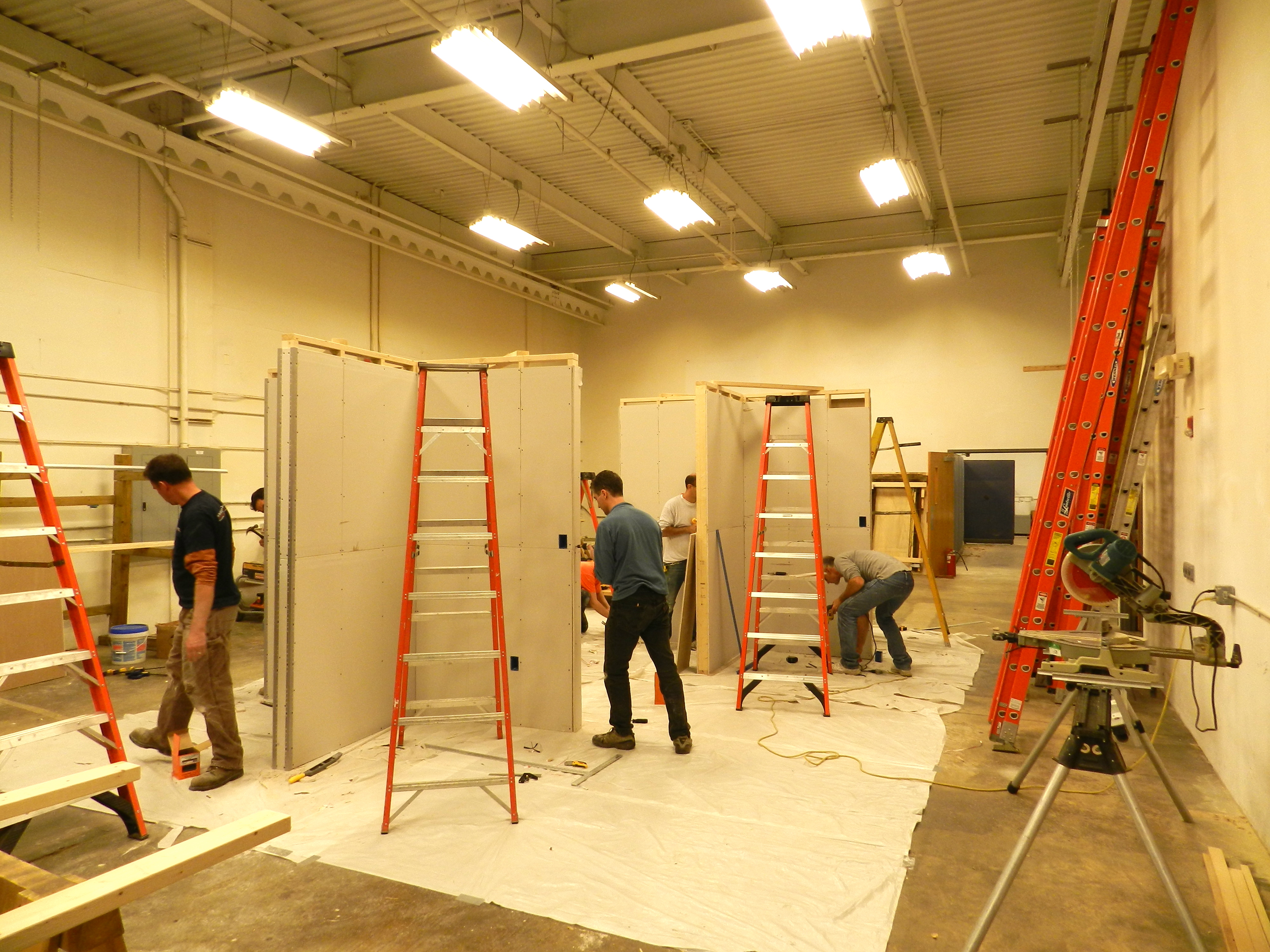
Closing in the wall
Closing in the wall

Last weekend I taught a two day workshop on drywall, mud work and textures. I designed the class last January and this was the second time we ran it. I’m happy to say that it sold out both times and we covered a lot of ground given we only had 2 days to work.

Aerial view of the class

Each student had the opportunity to learn all the basics needed to tackle a new drywall installation or repair project.

Using a hawk and applying mud to the corner joint

The course covered a wide range of topics including:

  • Basics of Stick Framing
  • Hanging Drywall and Coursing
  • Taping, Inside and Outside Corners
  • Working with ‘Mud’
  • Wet and Dry Sanding
  • Texture Work
  • Repairs
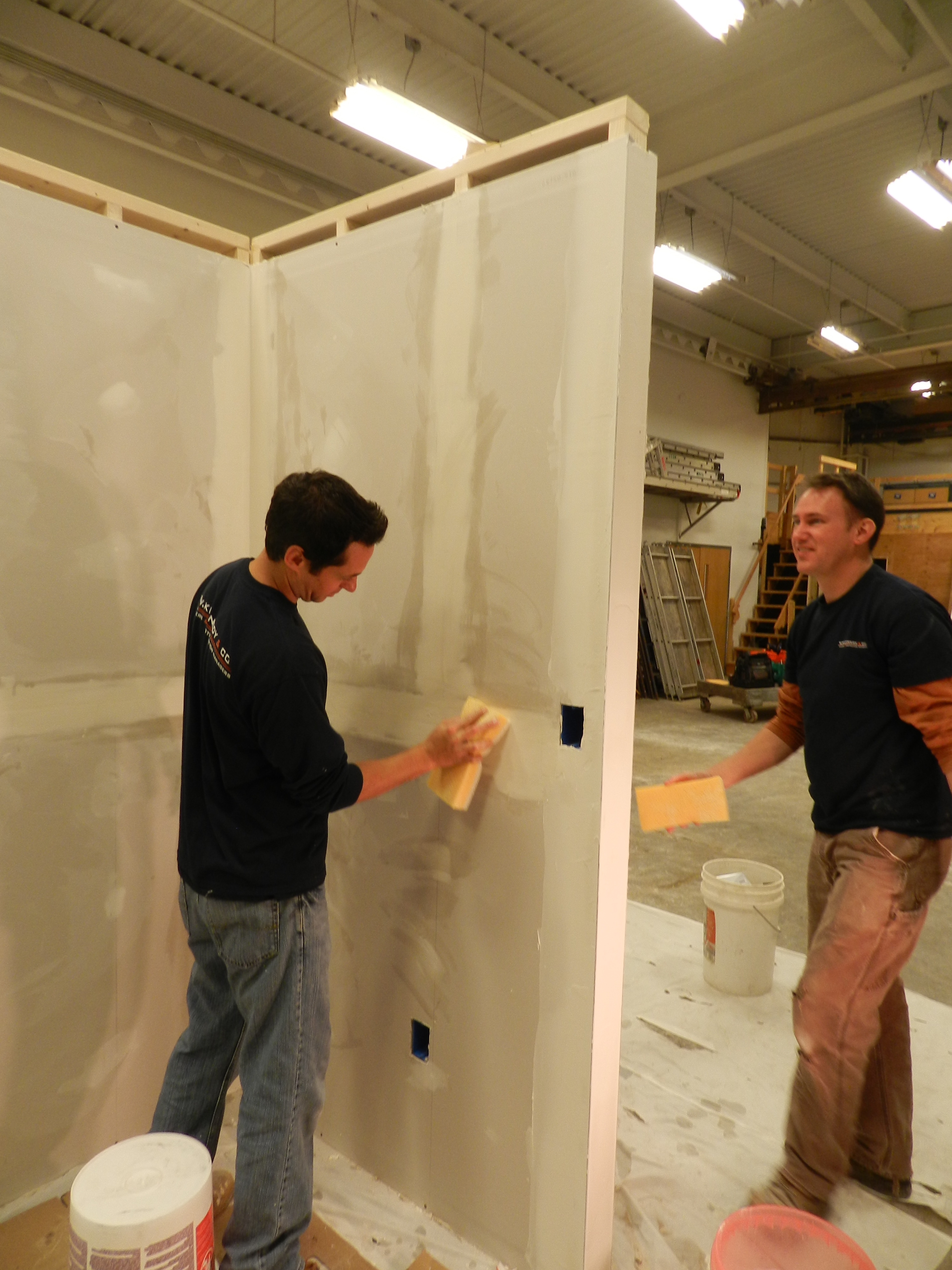
Wet sanding
Wet sanding

My last workshop back in May was going to be the last workshop the NBSS Arlington Location which is a 10,000 square foot workshop which was my home when I was a student at NBSS. (It used to be the workshop and classrooms for Preservation Carpentry and Carpentry departments at the school). The school has now relocated all the programs back under a single roof on North Street in the North End of Boston a couple of blocks from where the school spent its first 134 years. This workshop requires a lot of space, ceiling height and access to a large dumpster and with all the hustle and bustle of the school setting up at the new location it made sense to run this workshop in the old and largely empty space left in Arlington. The class went great, but the the one sad part for me was at the end of the second day when I had to say goodbye to the Arlington space for the second time. But like all good-byes, it is also a new beginning…

The good news is that I have a few workshops scheduled in the spring at the new campus location. You can learn more about them here.

-Bill

Winding Laths — Improve How You Flatten a Board

A good pair of winding lath or winding sticks is sometimes hard to find — I suspect not many survived the burn pile. The good news is that a new set is easily made in an few minutes at the bench.

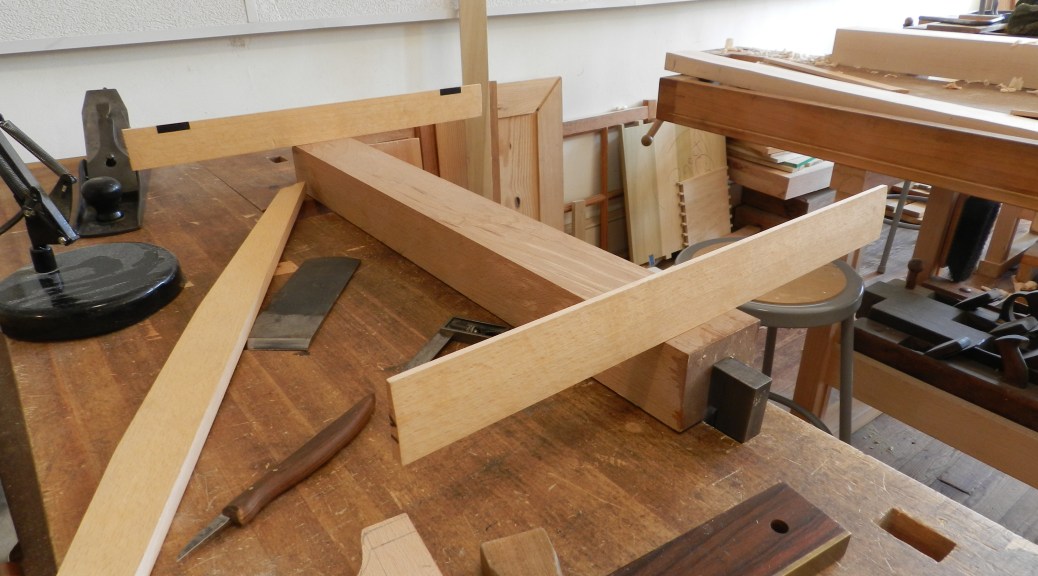
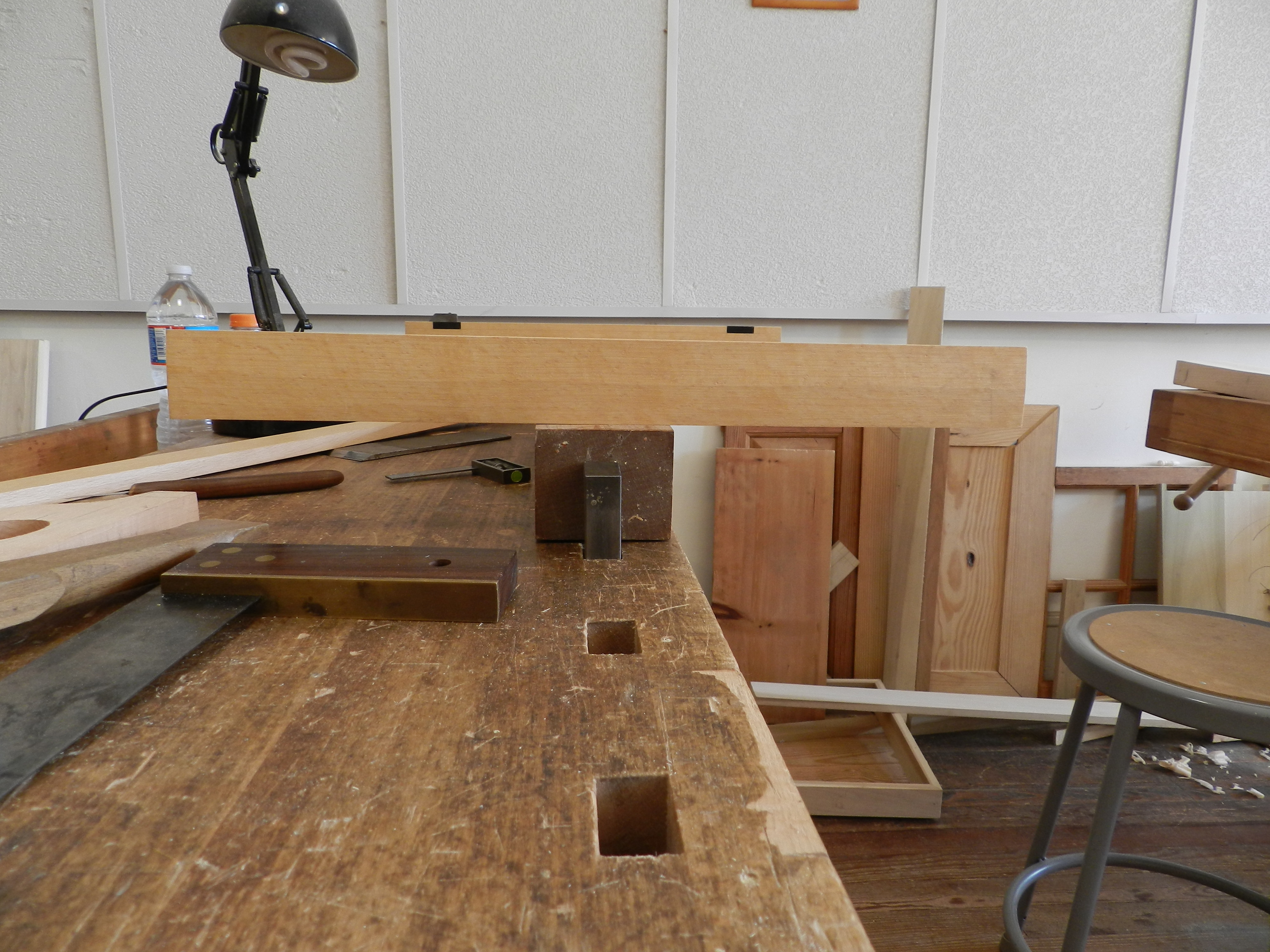
Sighting down a board with winding sticks
Sighting down a board with winding sticks — (This set was made by my friend Bill Anderson of Edwards Mountain Woodworking)

Why would I want a pair of ‘Winding Sticks’? What do they do?

  • This pair of matching straight-edges are a fast and invaluable tool that allows you to quickly see if a board is flat.
  • By placing them at each end of a board, sighting down across the near stick and looking at the far one, you can more easily see any twisting or warping in the board. The sticks help accentuate any non-planer surfaces.
  • By moving one stick and sighting the board at a few locations along its length, you will quickly see how the board flows.
  • Using a single stick you can also check for any cupping or warping as you would with any other straightedge.
  • Once you identify parts of the board that need to be addressed, you can quickly plane them and re-evaluate the board using these sticks. (After a bit of practice, process goes quite fast)
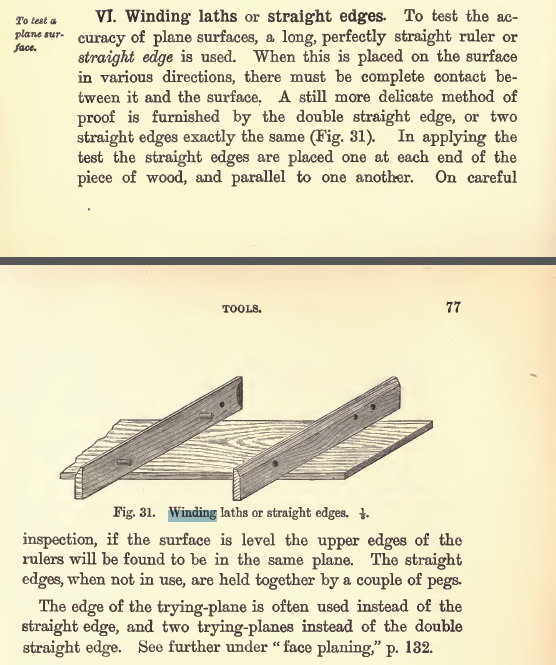
Winding Lath by Otto Salomon in the Teacher's Handbook of Sloyd
Winding Lath by Otto Salomon in the ‘Teacher’s Handbook of Sloyd’ — a great prototype for your own winding sticks

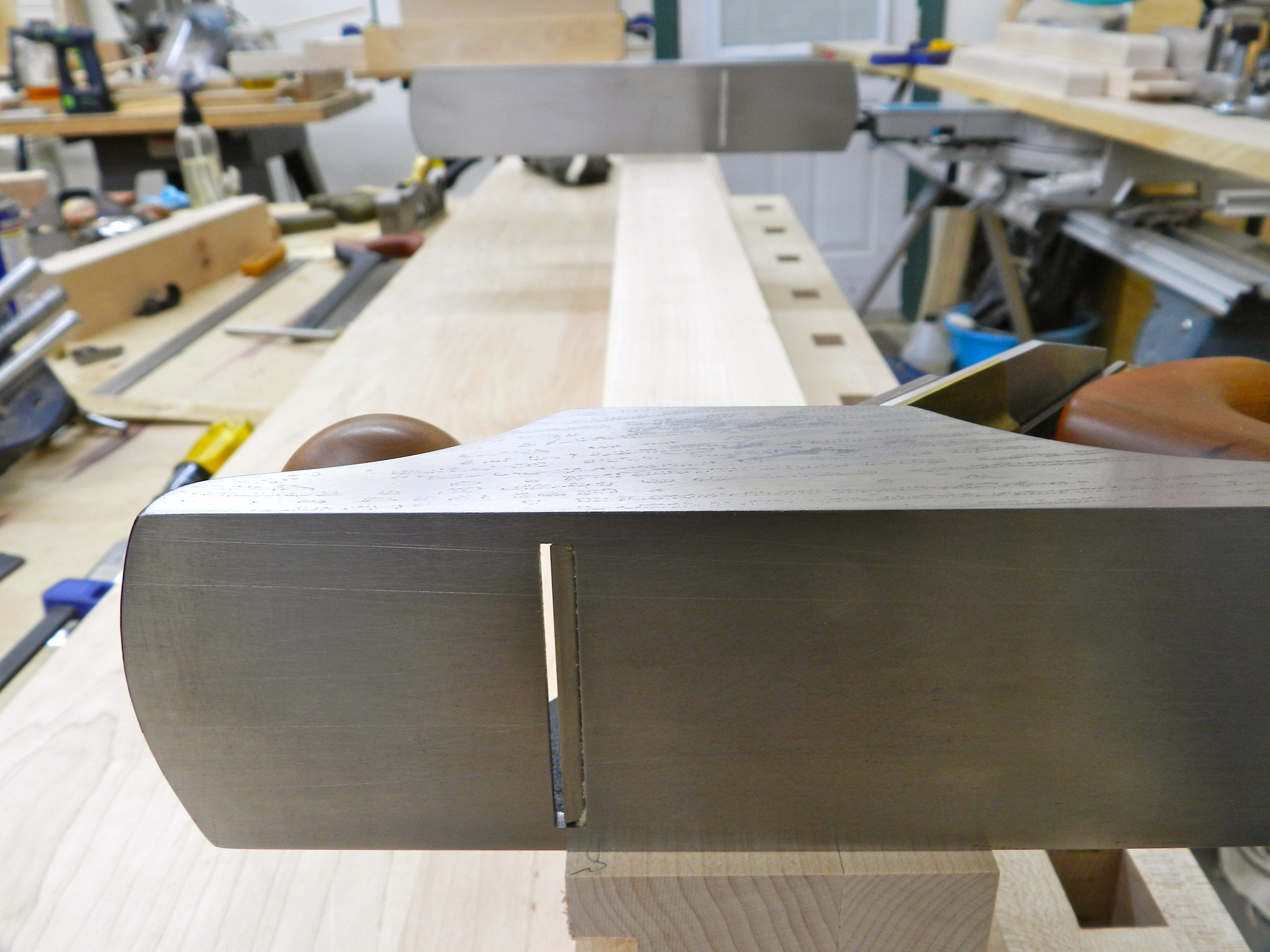
From Otto Salomon’s ‘Teacher’s Handbook of Sloyd’ above you can read a nice description for how to use winding laths efficiently. The pair of wooden Sloyd winding laths shown above nest with each other via a set of fitted wooden pins and have a nice relief one the edge of the short sides so you can easily get a finger hold in there and separate the sticks when you want to use them. Otto also calls out an interesting alternative you can use in a pinch — by turning two try-planes on their side you can use them as an impromptu set of winding sticks and sight across them.

Sighting down two bench planes as impromptu winding sticks

Tips on making your own winding sticks:

  • Use quarter-sawn hardwood like hard maple or beech
  • Consider adding a contrasting inlay or strip to make it easier to sight across the sticks
  • I like to use sticks that are 1/2″ thick, about 2″ wide and about 18-24″ long
  • Sticks that can nest with each other or otherwise stay together are more likely to survive
  • Taper each stick  on one side so that it’s clear what edge is the top (it will not stand on its own on the edge you plane down to 1/8″)
  • If your sticks ever get out of true they are easily squared up again with a plane

The next time you are out in the shop, make a quick set of winding sticks and see how much it can improve your board flattening efficiency.

-Bill

P.S. If you don’t have the the time or scrap to make your own set from wood, and don’t have 2 jack or try planes handy, you need to have a stern talking to, but there are commercially available winding sticks available from Lee Valley and others. I admit that I do have a pair of the Lee Valley aluminum winding sticks which I bought when I first got started in hand tool woodworking. They are well machined and the design hits all the major tips called out above — with the exception of being made of wood of course.

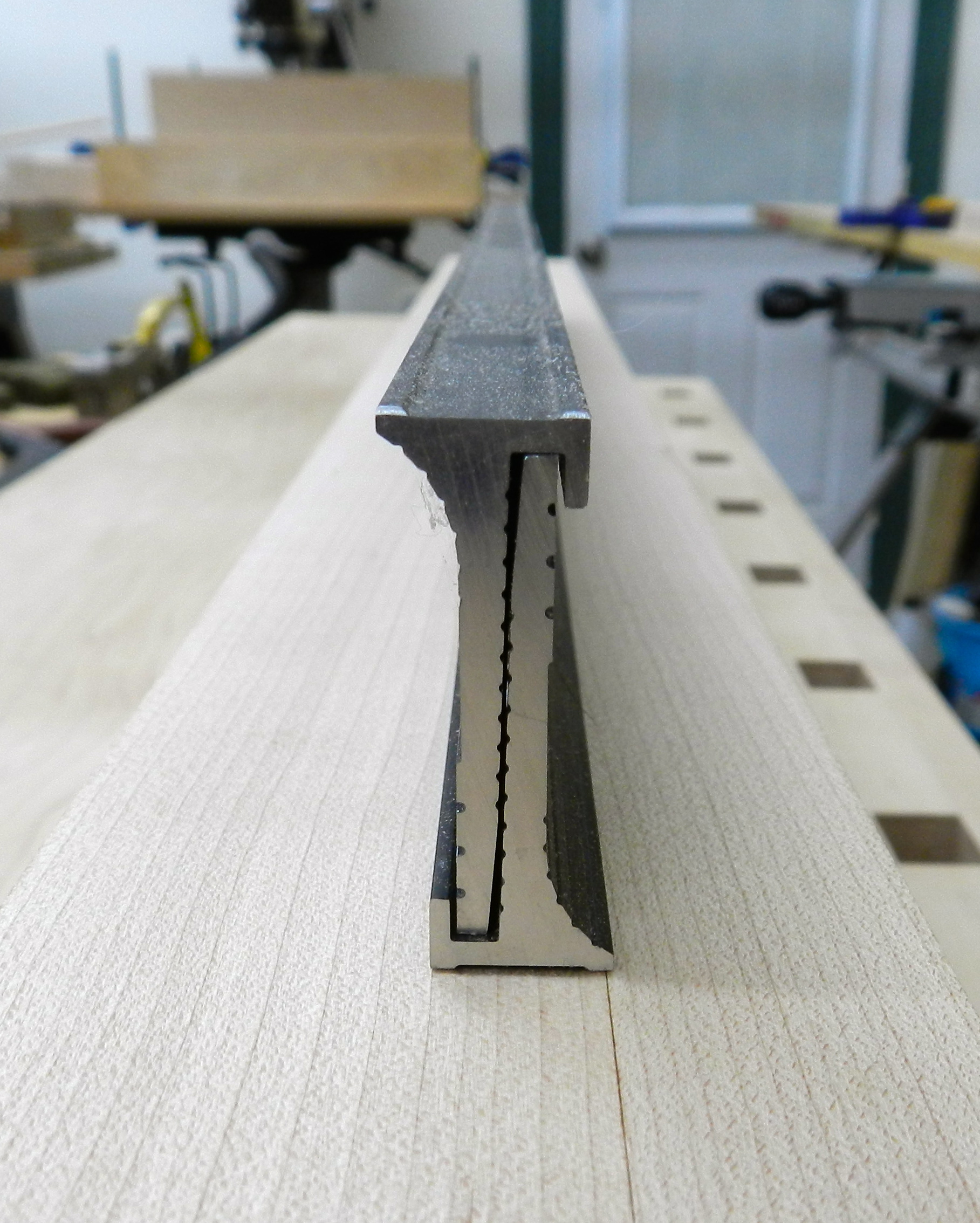
Nesting metal winding sticks from Lee Valley

Much like the shop made winding sticks, these aluminum sticks work well and need virtually no maintenance.

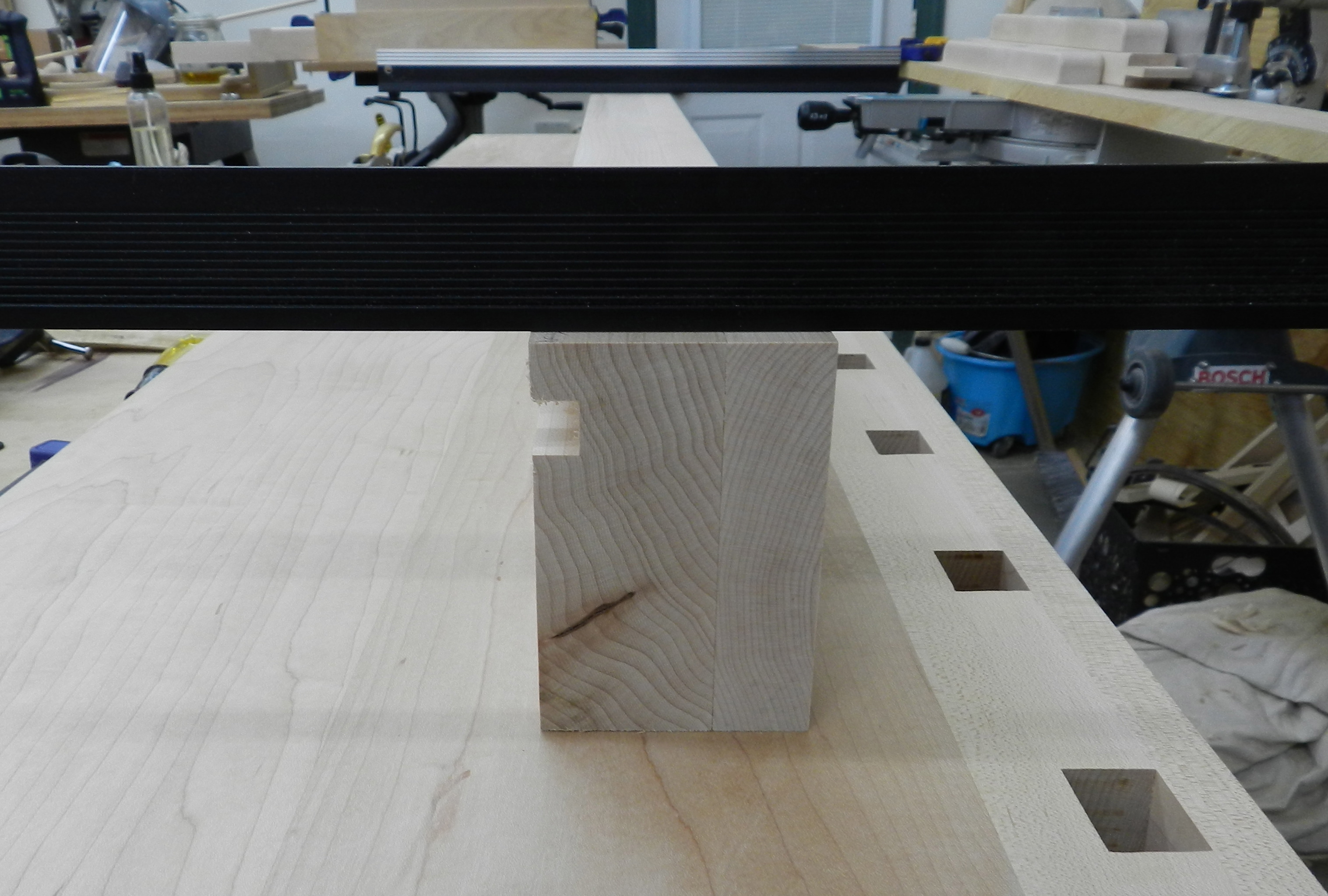
Metal Winding Sticks in Use

P.P.S — This is an extended version of a post I put together for my friends at Popular Woodworking on the contributor’s blog which can be found here.

The hunt for an Auger Bit Tool Roll…

A well tuned auger bit and brace can be a joy to use. Most new auger bits are mass produced junk and even some of the few remaining better quality bits like the Russell Jennings Pattern auger bits from Clico (UK) take a fair amount of tuning before they cut well. So if you are going to spend a lot of time and hard earned money on these tools,  why would you let them bang around in a tool box?

I set out to find a good home for my auger bits…

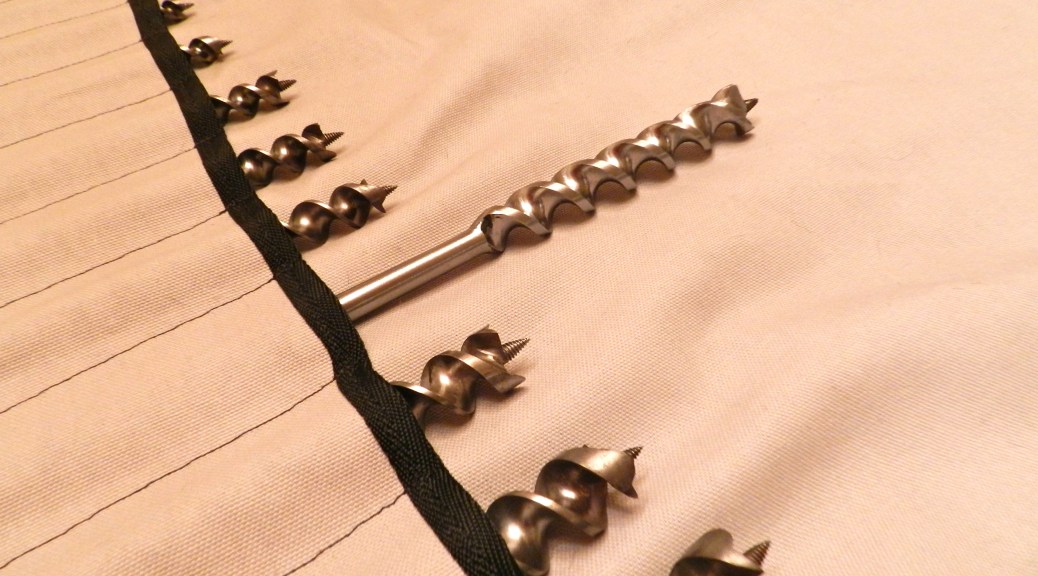
Auger bits in new tool roll

Unfortunately there are not a lot of options out there. I was unable to find any auger bit tool rolls that met my quality and budgetary needs. Given the lack of commercial options, I decided to fire up the old sewing machine make my own auger bit tool roll. I made another pilgrimage to Jo-Ann fabric and braved the awkward conversation with the ladies behind the desk at the cutting station. When asked about what I was making they just gave me the usual look of ‘you’re crazy, why would someone want to protect drill bits like that?’ But after some more polite conversation they seemed happy to see someone doing something out of the ordinary.

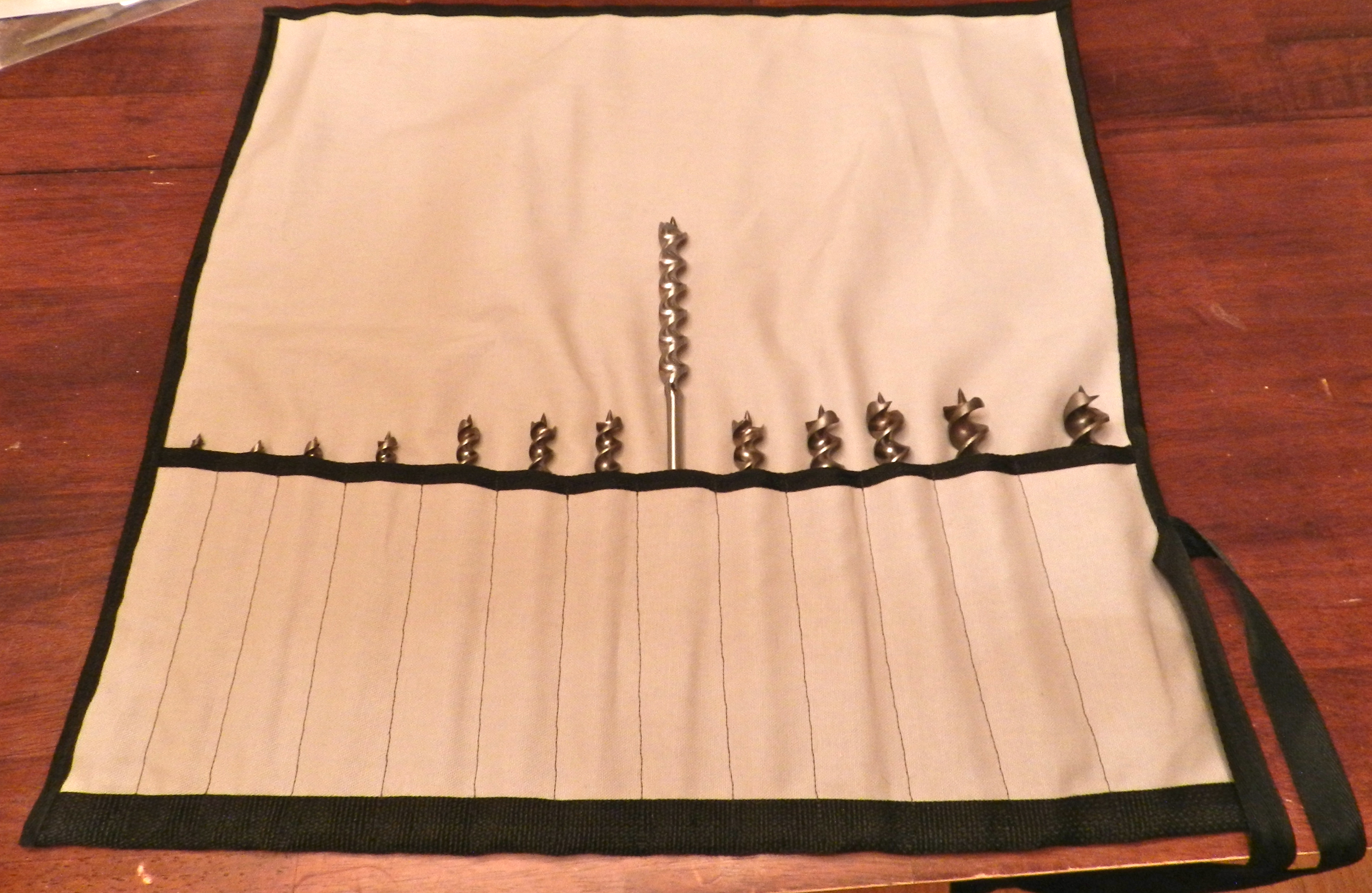
Completed Auger Bit Tool Roll

Design Goals:

  • Protect the cutting end of the auger bits
  • Have individual graduated pockets for each bit in a standard set (sizes 4-16)
  • Be made from tough materials that will wear well
  • Have reinforced corners and bottom
  • Have a tie off string/ribbon that allows for quick and easy storage
  • Protect the tools from flash rust
Rolled up for storage -- complete with with a bow.
Rolled up for storage — complete with with a bow.

I’m not trading in my chisels to become a tailor (Who would of thought I’d remember so much from middle school home ec?), but for for a modest amount in materials and a few hours of taking over the dining room table I’m quite happy with how the tool rolls turned out.  This roll has earned a place in my tool chest.

I’m hoping some other woodworkers out there will give it a try and make some interesting new tool rolls and help protect a few more auger bits from the ravages of a messy toolbox.

Take care,
-Bill

P.S. If you’d like to see more details of how I put this tool roll together, please check out the slideshow below (if you are viewing this via email click over to the post on the actual blog to see the extra photos)

Slideshow Below:

This slideshow requires JavaScript.

The joys of working with reclaimed old growth timber….

When working with reclaimed wood you generally want to be extra cautious — you never know what you are going to find in the wood. Normally I visually inspect the wood, remove anything glaring (bits of old nails, stones, loose knots etc), then make a pass with a lumber wizard metal detector, remove what it finds and start working my way through the wood. Every so often something makes it through that system….

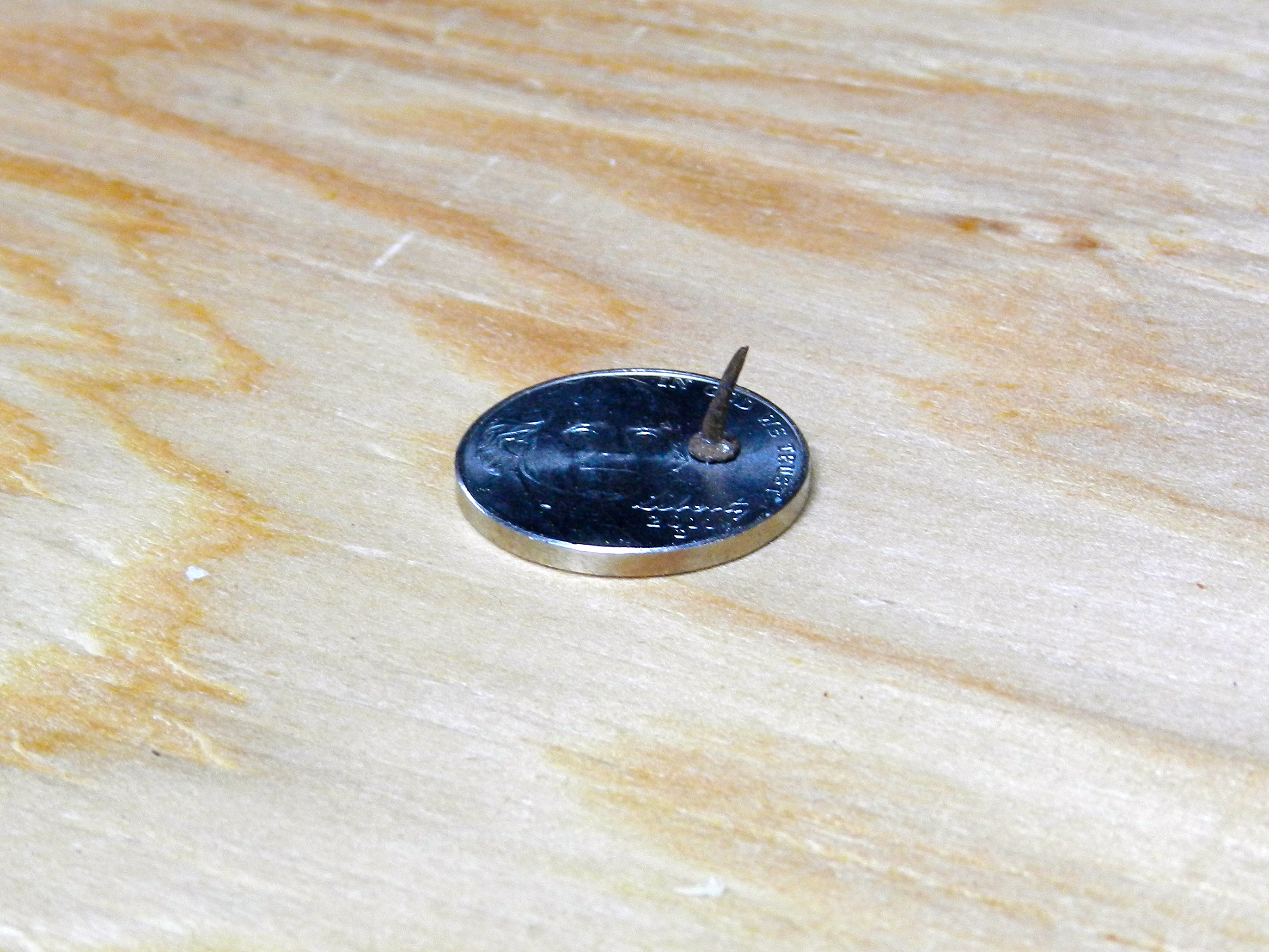
Tiny Tack
Tiny Tack

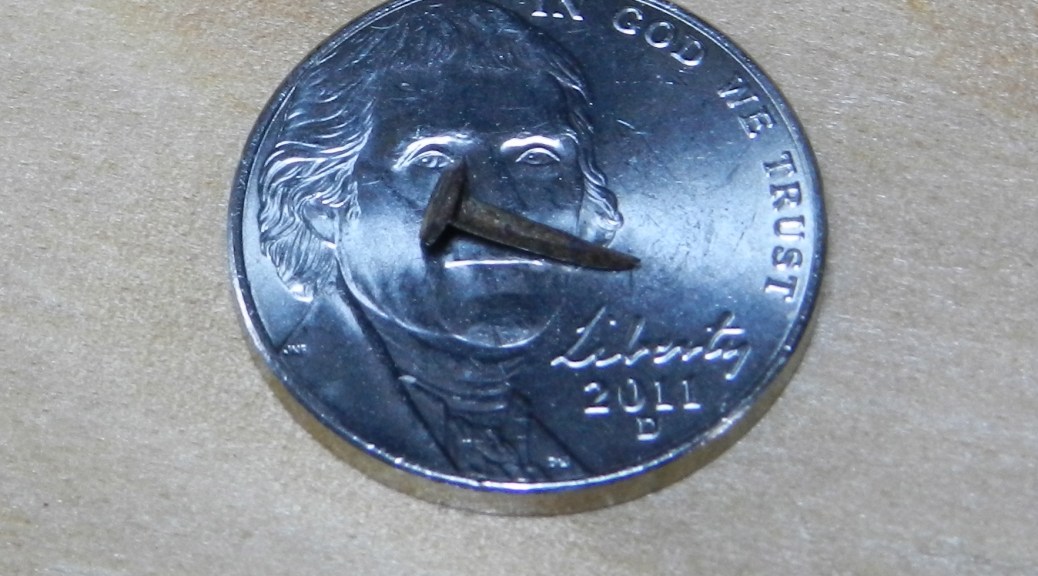
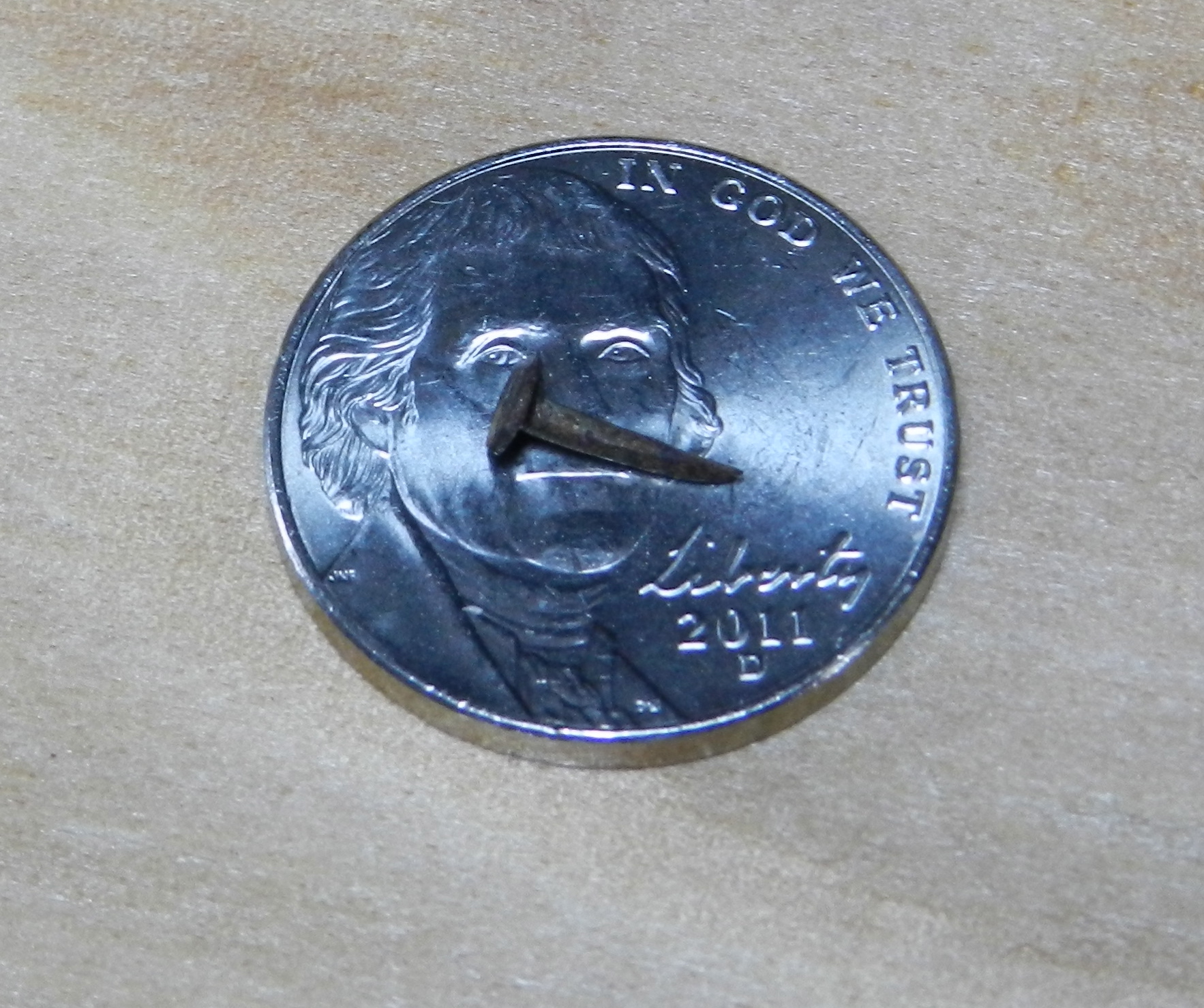
Above and below is a VERY tiny tack was embedded deep into an old barn board I was reclaiming. It must have been fairly deep into the board as the metal detector didn’t find it, but it sure found my planer knife.

Very Tiny Tack on End

But such is the price we sometimes have to pay in order to work with old growth timbers. On an 8-10″ wide board I was counting well over 150 years of growth rings and this pine often handles like hardwood.

Laying out the boards to even out the texture and grain profile.

For projects like this rustic headboard the trick is to stop milling before you lose all the history and character of the old wood.

Texture detail
Texture detail

But in the end the extra effort is worth with for the results cannot be duplicated with modern woods and simulated aging techniques.

Finished Headboard
Finished Headboard

You can see a bit more of this project on an earlier post I made here.

Take care,
-Bill

A move 134 years in the making…

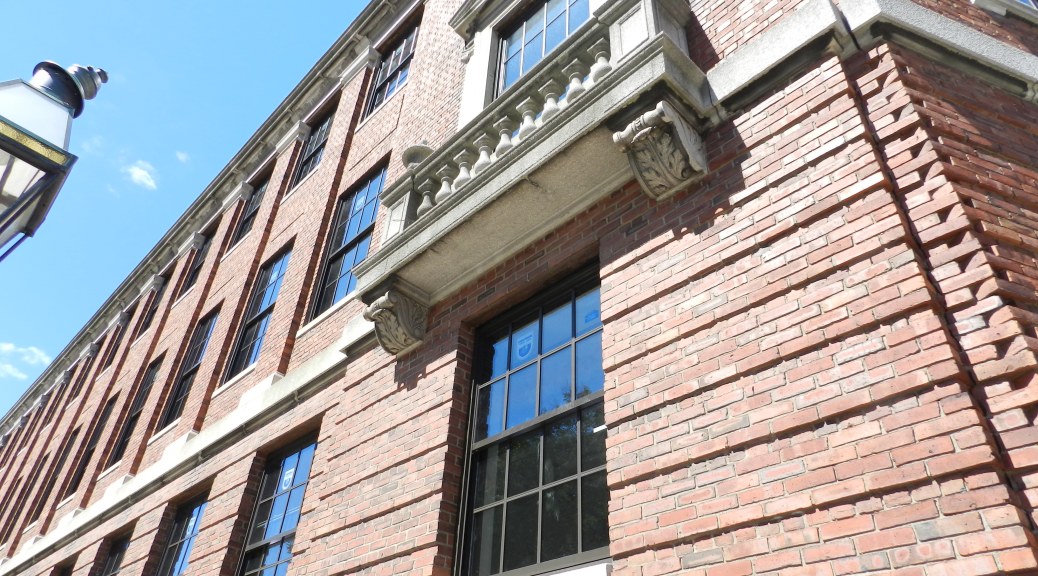
The North Bennet Street School (NBSS), America’s Oldest Trade School, has been a Boston institution located at 39 North Bennet Street in the North End since 1879. The school was incorporated in 1885 and has a long history of offering vocational training and forward thinking social services which continue through today.

After more than a century at the original location the school eventually grew beyond what the old assemblage of buildings (an ex-church, sailor’s retirement home, townhouses etc)  could fit and some of the programs had to move to other locations around the Boston area. In an effort to re-unify the school, update the facilities, and get everyone under one roof again the school embarked on an aggressive fundraising campaign and has now moved to 150 North Street in Boston (about 1/3 mile from the original location). This new building takes up a city block and has recently opened for the new school year. This new set of buildings once served as the Boston City Printing Press and a Police station. They sit above the entrance to the Callahan tunnel right on the Greenway. The buildings have a stately facade, are stoutly constructed and have an interior fitting for a school of this kind.

Wednesday night was the first North Bennet Street School Alumni Meeting at the new building. We had the opportunity to tour the new facility.I took as many pictures as I could with my iPhone and have shared them below as a virtual tour of the new building. This small set of photos do not do it justice, so I recommend coming by to see it in person yourself during this year’s open house events Nov 8-9. If you click on any of the photos below you can see it in a larger size and can also cycle through them like a slide show.

As a graduate of the Preservation Carpentry Program and workshop instructor at the school, the old building will always hold a special place in my heart, but I am happy to see this new building come together as it took an incredible amount of work by the school and its many supporters to pull of this move.

You can learn more about the history of the school here and here.

Take care,
-Bill

Feast or Famine….

This past Thursday and Friday I made my bi-annual pilgrimage to the ‘Live Free or Die’ Tool Show and Auction in Nashua, NH.

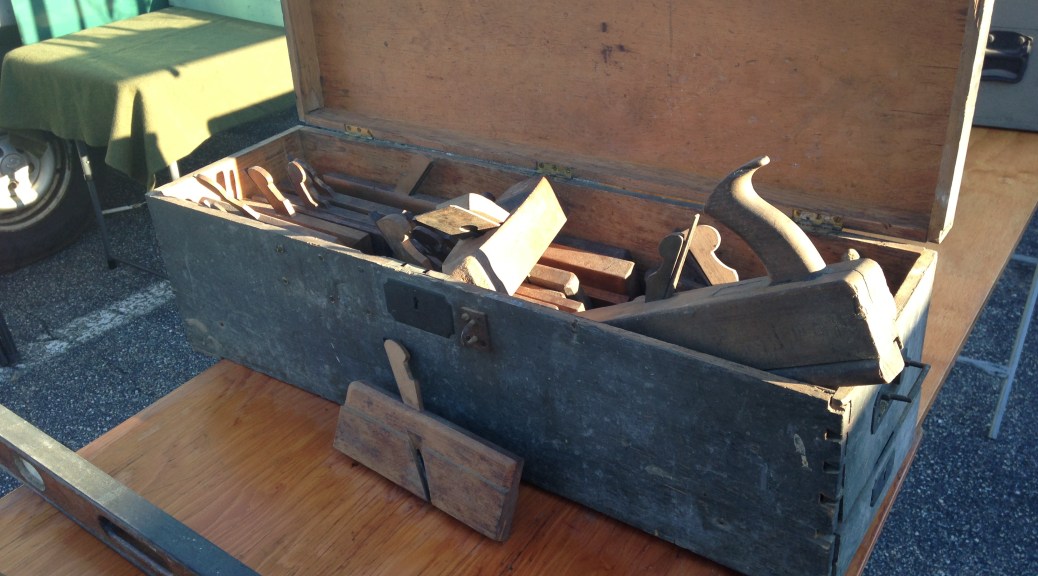
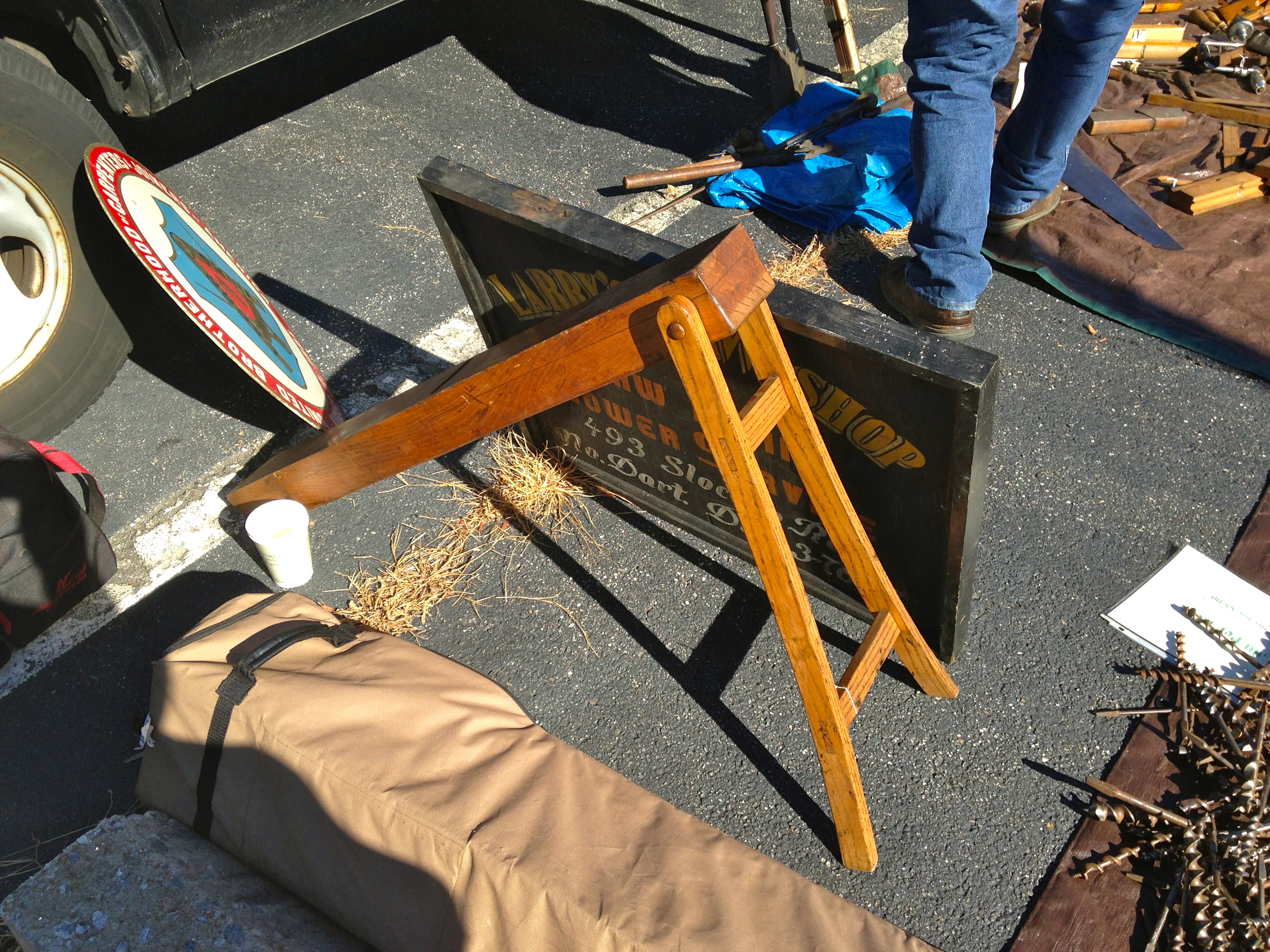
Old dovetailed tool chest full of molding planes

I always enjoy hunting for whatever oddball tool I have on my wish list or whatever new treasure I didn’t know I couldn’t live without until I discover it.

Small cooper's plane with nice bentwood folding legs
Small cooper’s plane with nice bentwood folding legs

Beyond my own tool shopping its good to see old friends and familiar faces at the show.

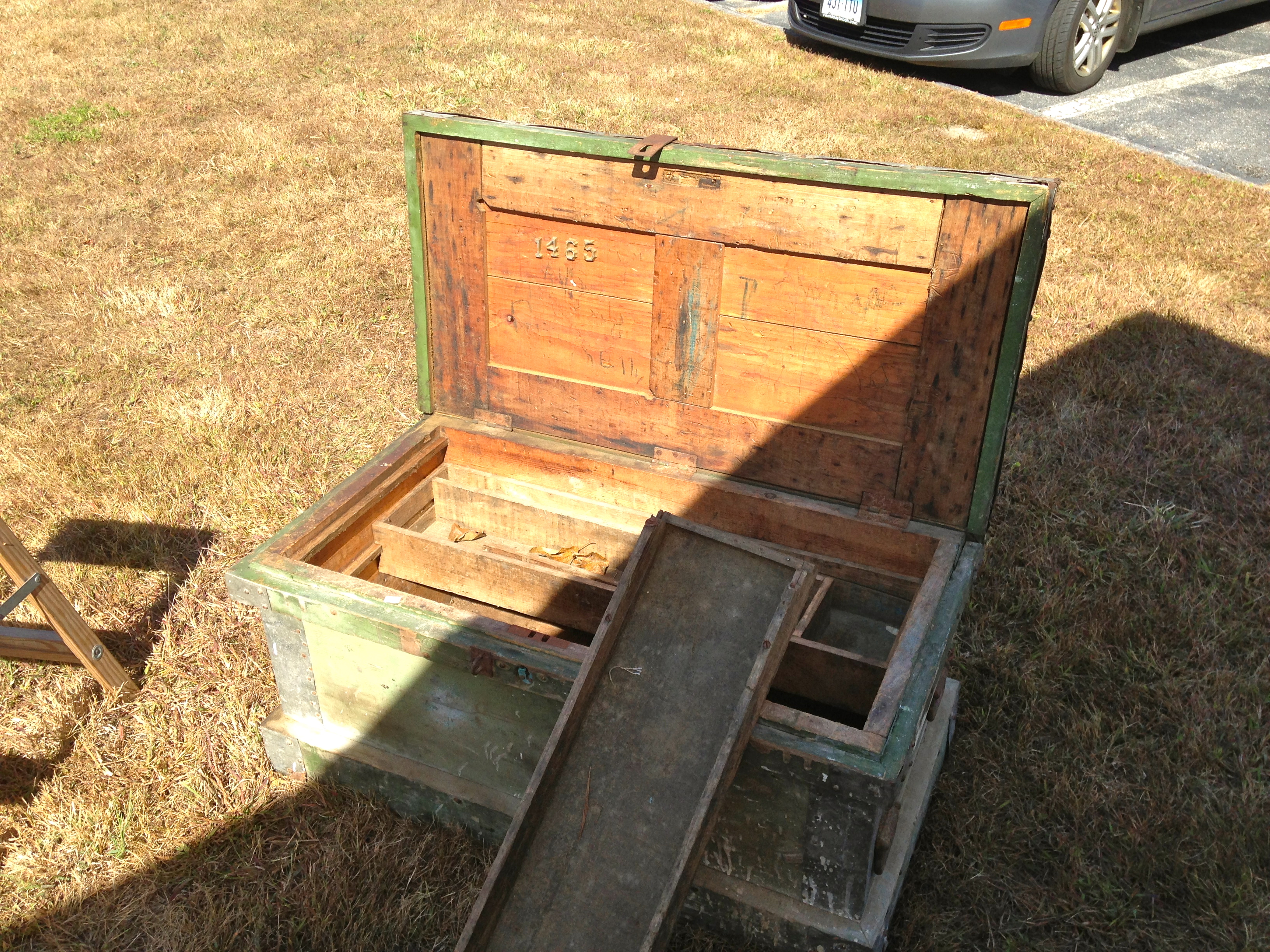
Carpenter's Chest with reinforced edges made from sheet tin.
Carpenter’s Chest with reinforced edges made from sheet tin.

Some years you’ll see tons of a given type of item, other years that same item might be real hard to come by. This year hand drills and Stanley 45s and 55s seemed to be plentiful.

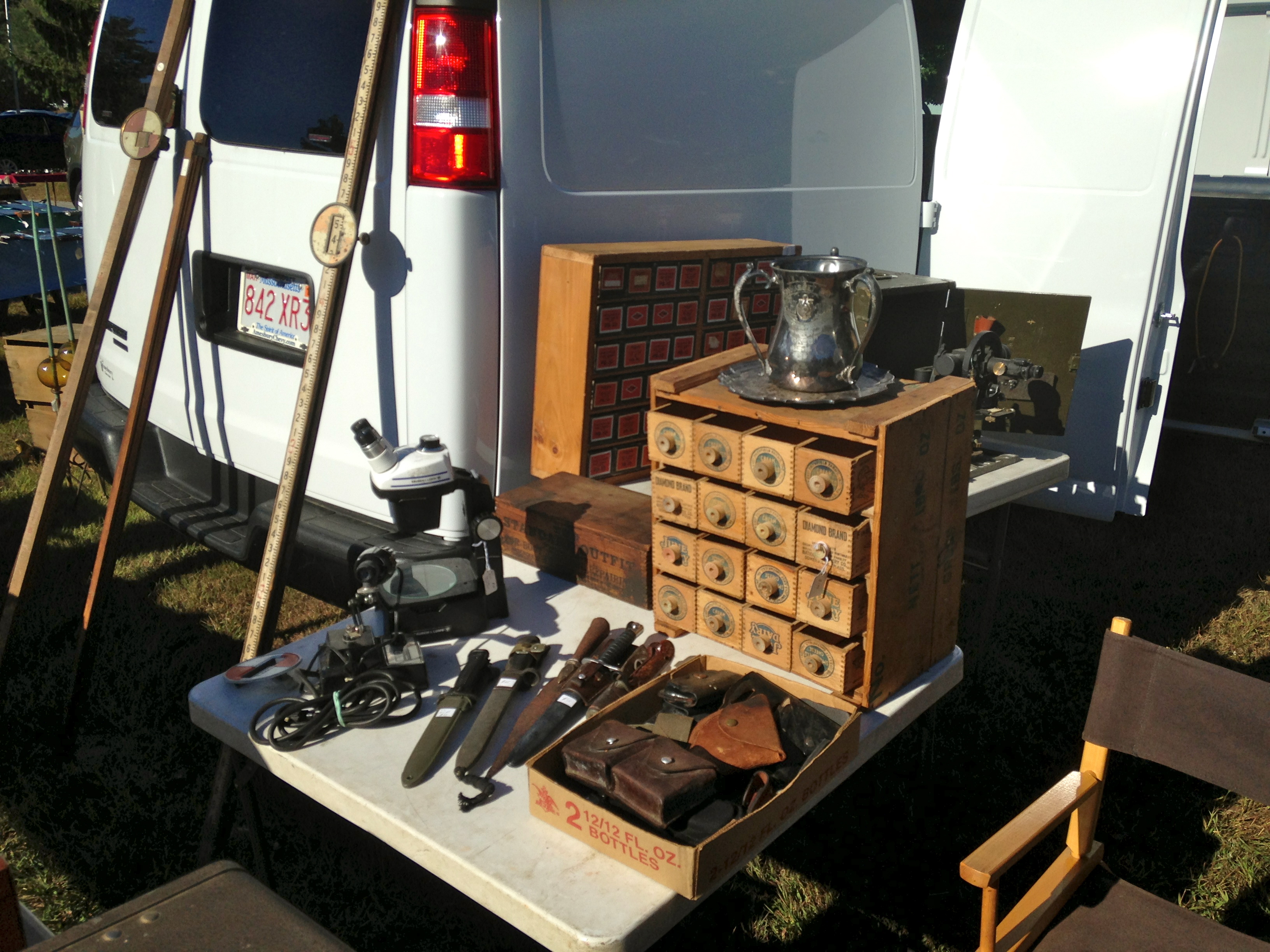
Nest of drawers, survey equipment, knives etc

Tool chests on the other hand were not in season it seems. So I grabbed a few snapshots of what I saw this time out, but nothing overly notable.

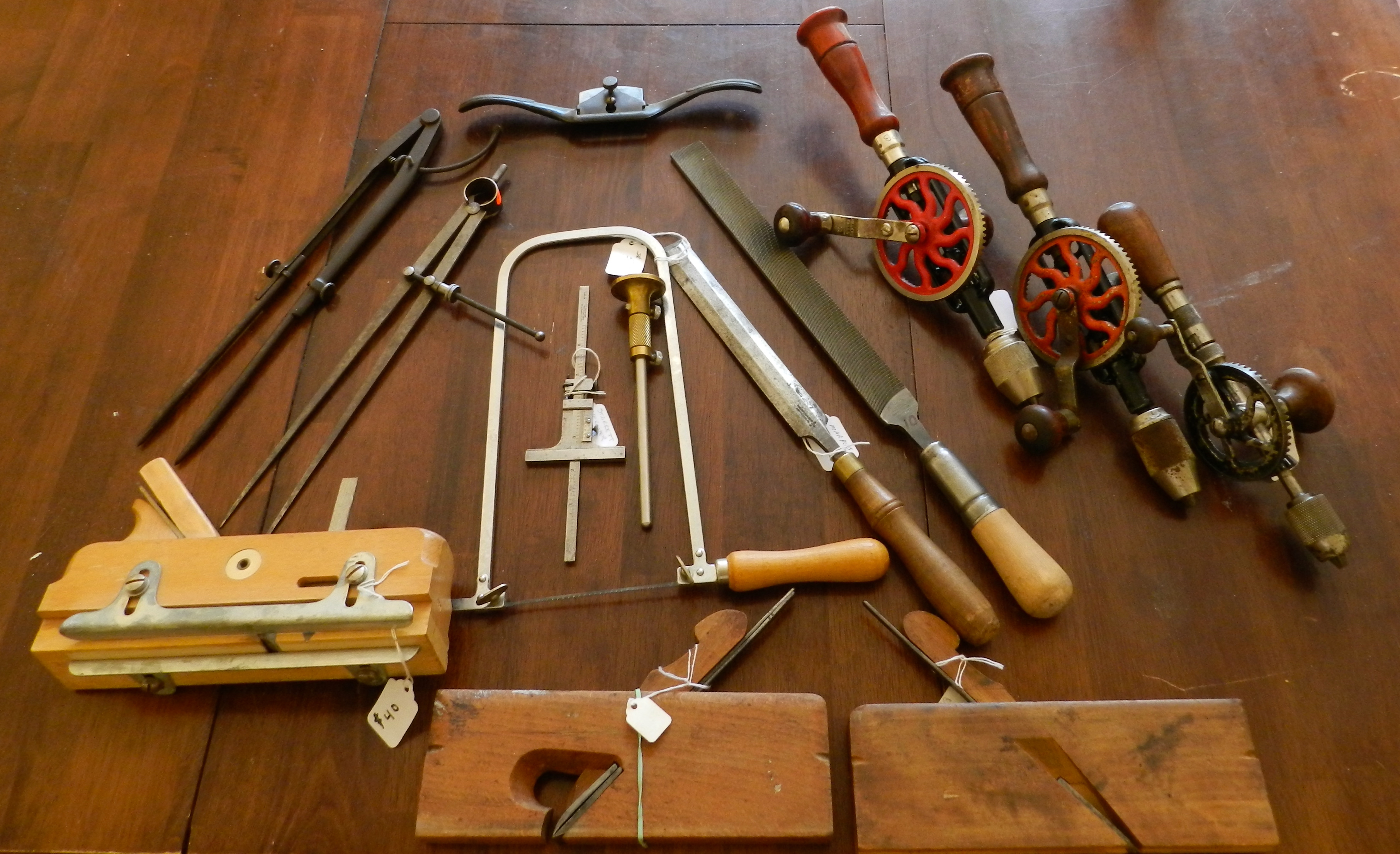
Millers Falls Drills (2 #2, 1 #3), Rabbet Plane with chip-breaker, Shear Cut File, Marples Paring Chisel, Ulmia Moving Fillister Plane, Tite-Mark, Starrett Depth Gauge, Spoke Shave, Starrett Large Dividers, Miller's Falls Large Dividers, Astragal Plane
Millers Falls Drills (2 #2, 1 #3), Rabbet Plane with chip-breaker, Shear Cut File, Marples Paring Chisel, Ulmia Moving Fillister Plane, Tite-Mark, Starrett Depth Gauge, Spoke Shave, Starrett Large Dividers, Miller’s Falls Large Dividers, Astragal Plane

Some years I come home with a ton of stuff from my mental list and some times I don’t get much but I still come home with some finds. This time out I got some great deals and found several items I’d been hunting for, for a long time. I found a nice LARGE Starrett No. 85 dividers which are great for laying out staircases and other large scale projects. I also got a deal I could not pass up on another Tite-Mark, an Ulmia Moving Fillister plane and a nice old Starrett depth gauge with a real nice micro adjustment knob. Since the last show I seem to be really into Miller’s falls double gear hand drills — which I first learned about from my friend Tom Fidgen. Last year I picked up a #5 that I now use all the time. This time I got 2 real nice #2s an a nice #3 for the shop.

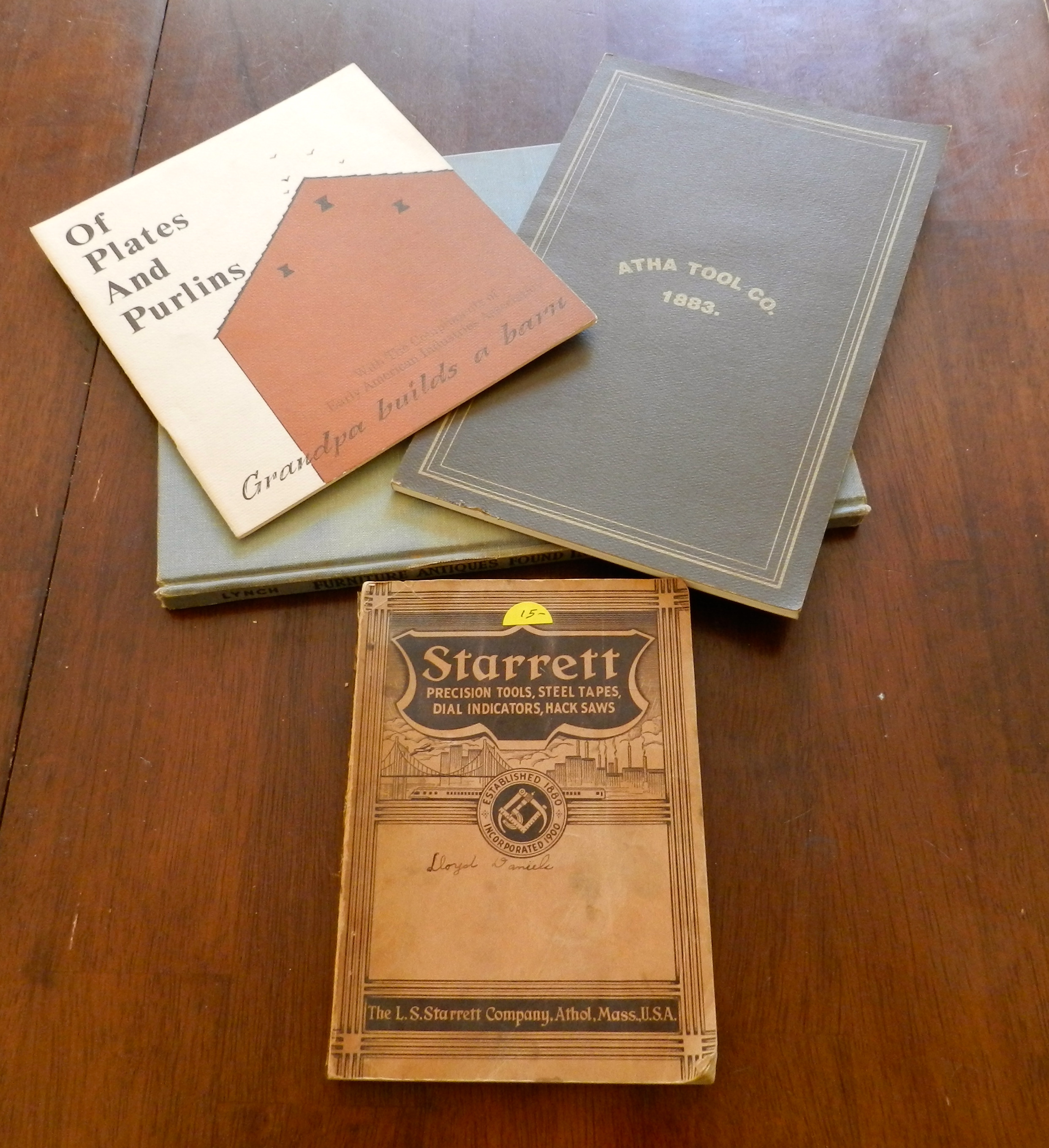
1938 Starrett Catalog, Old EAIA Pamphlet on Timber Framing for Old Bethpage Village, Atha Tool Compay Reprint, Book of Old Virginia Furniture Plans
1938 Starrett Catalog, Old EAIA Pamphlet on Timber Framing for Old Bethpage Village, Atha Tool Company Reprint, Book of Old Virginia Furniture Plans

I also found some nice old tool catalogs including a 1938 Starrett Catalog, a reprint of an 1883 Atha Tool Company Catalog, and a book from the 1950s on old Virginia furniture with great shop drawings inside. My favorite find which was given to me for free is an old EAIA Pamphlet from 1971 that was put together for Old Bethpage Village in NY (which I remember going to in grade school) called ‘Of Plates and Purlins — Grandpa builds a Barn’ This great little pamphlet has a very Eric Sloane-esque feel to it and walks through the basics of building a dutch barn.

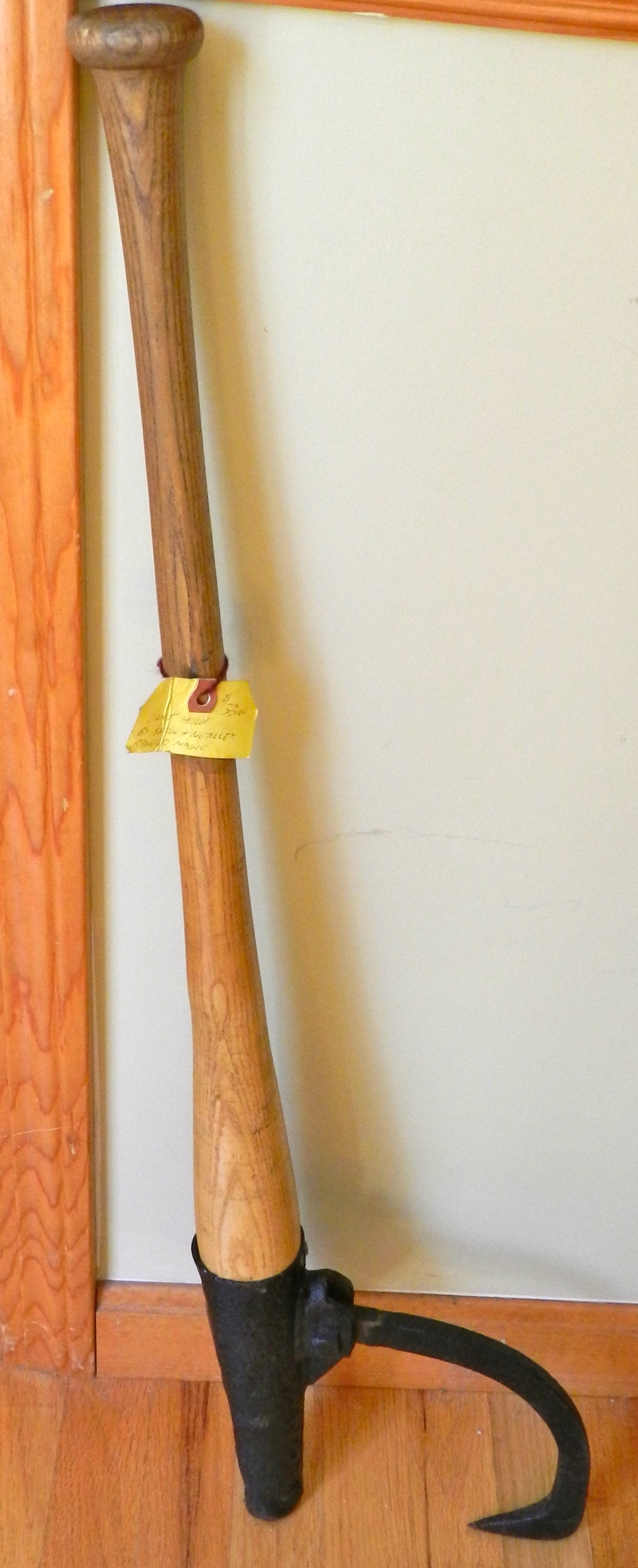
Cant Hook for rolling logs

And last but not least was as real nice forged cant hook from Maine. In the coming weeks I need to clear some land out in the yard for a forthcoming timber framed barn/shed so I am sure it will get some good use.

Now it’s time to get out to the workshop, try out the new toys and start and start saving for the next show in April….

Take care,
-Bill

A Joiner's Guide To Traditional Woodworking and Preservation