Tag Archives: Bill Rainford

Tage Frid — The Great Dane

Woodworking is a lifelong journey of discovery and rediscovery. Along the way you’ll meet a lot of great folks and interesting characters who are surprisingly willing to share advice and help you out. The craft has been passed down this way for millenia.

Everything Old is New Again

Modern woodworking media seems to go in cycles much like clothing styles or car designs. Right now it’s popular to study the early works of Moxon, Roubo and Nicholson etc., or prove you have the best router or table saw trick. Others are interested in espousing the mix of old and new tools and techniques which is not a new concept. Manual training programs like those at NBSS have been doing it for over 125 years and the Shakers before them etc.

I want to buck the current trend and take a trip back to the 20th century. When I got started in traditional woodworking one of the first teachers I had was Tage Frid via the  ‘Tage Frid Teaches Woodworking’ 3 volume set with its iconic white covers. I haven’t seen these books or Tage’s work come up much lately and thought it would be helpful to blow the dust off those books hopefully re-kindle some interest as I think they are a great resource.

Tage Frid

Tage (Pronounced ‘Tay’) taught me and countless other woodworkers the basics via his books and teaching.  He grew up in Denmark and apprenticed as a cabinetmaker. His time as a journeyman took him to various other shops including the Royal Danish Cabinetmakers. In 1948, at the age of 33, the American Craft Council persuaded him to immigrate to New York and teach woodworking. Tage lead the woodworking program at the School for American Craftsman in Alfred NY which was later moved to the Rochester Institute for Technology. From 1962-1985 Tage was a professor of Woodworking and Furniture Design at RISD helping to propel that program to national prominence.
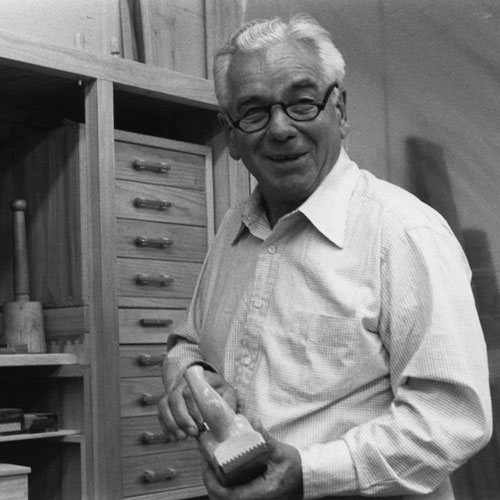
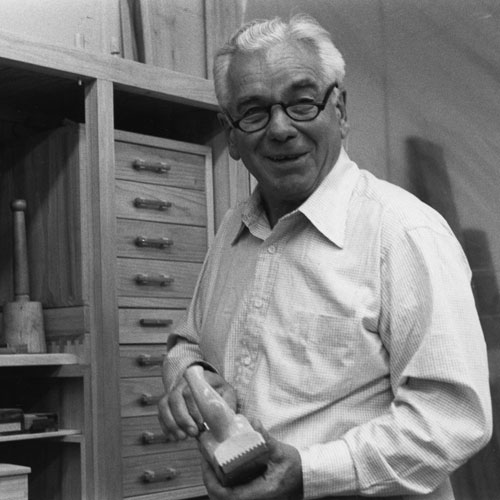
Tage Frid
Tage Frid

Also notable was Tage’s involvement with Fine Woodworking where he worked as an editor from it’s inception in 1975, through 171 issues until his passing in 2004. Described as having a sharp tongue and an ‘impish’ smile you can get a small taste it it through his writing and interviews which often have some memorable nuggets.

He could cut a dovetail while joking and flirting with the ladies. He referred to nails in furniture as ‘Swedish dowels.’ When critiquing a piece of work, which was nerve-wracking for students, the blow was slightly blunted by his sarcastic humor.  Hank Gilpin recounts some memorable zingers:

“Oh, good curve. Too bad it’s the wrong one”
“Nice dovetails. What’d you use — a chainsaw?”
“Beautiful legs Henry. What were you thinking about — an elephant?”
And the classic: “Congratulations, you’ve just figured out the most complicated way to hold a board 30 inches off the floor.” [*]

The goal was not to put anyone down, it was to help each student stay humble and push him or herself to reach new heights in a fatherly kind of way. I had a similar experience during my own training and find myself rehashing some Frid one liners and Rich Friberg-isms in my own shop and classroom. Thankfully the flavor of sarcasm I learned from Rich is a little less harsh, but still fun.
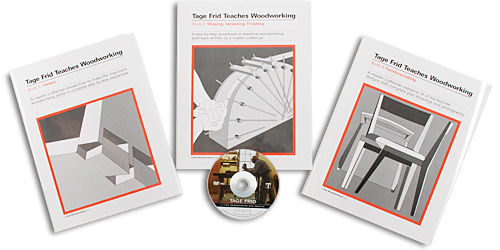
Tage Frid Teaches Woodworking Boxed Set by The Taunton Press

Teaching

When asked about teaching repetitive topics Frid had the following to say:

Don’t you get bored demonstrating the same old dovetail?
“Maybe you left too early. I always demonstrate difficult joints and techniques depending on what the audience wants. The dovetail is just the overture. What I like about teaching is that I learn something new every day. A student asks me, ‘Why can’t I do it this way?’ and I think, ‘Why not?’ Then we figure it out.” — Tage Frid (excepted from an old interview in Fine Woodworking you can read here.)

Levity aside, Frid’s teachings focused on teaching solid joinery — form should follow function, wood has a beautify of its own that should be enhanced and not hidden and instilling an innate sense if proportion via a keen eye for detail.

“The best tool is the eye. Train the eye. The eye guides your hands to achieve the form. If the eye says ‘It’s right’, it is right” — Tage Frid [*]

With a solid grounding in the basics and exposure to a wide range of tools and techniques students are able to take on whatever challenge a project or shop can throw at them. During his lengthy career as a teacher, writer, editor and studio craftsman Frid helped teach several generations of woodworkers. You can see his work live on through his students and their students.
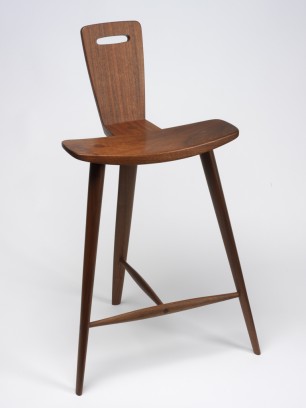
Tage Frid Stool
Tage Frid 3 Legged Stool

Design

Working in the Danish-modern style a lot of Frid’s pieces had a distinctive look compared to many of his American contemporaries. They were generally lighter looking with delicate lines and curves that celebrated the grain. The designs are especially interesting when you view them in the context of the time they were produced — the 1940s-1980s.  Many of them were years ahead of what we think of as the the mainstream designs of the time .

For me, one of his most iconic pieces is the now famous 3 legged stool. If you read his 3rd book you’ll learn about how he came up with the design while watching a horse show and sitting on a fence. It was an interesting case study as he explains some of the revisions he went through to hone the design. These stools have been on my mental to-do list for about a decade now and I hope to eventually build some for myself.

When he first arrived in the US in the 1940s there were no good places to get a solid workbench. As a result Frid had to design and build a bench for himself and for his classrooms.  Based on a traditional continental design with a shoulder vise and a tail vise the bench below was well suited for a cabinet maker. Over the years many a student, both in person and via his writing, would build and use one of these benches or a similar variant.  In some upcoming posts you’ll see me build a scaled up version for my own shop.
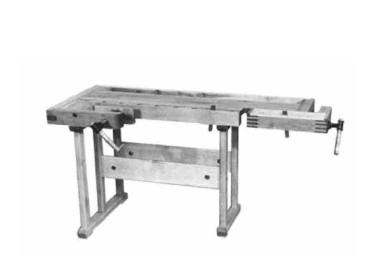
Tage Frid Workbench
Tage Frid Workbench

What’s with the book report on Tage Frid?

Tage Frid’s work has shaped several aspects of my woodworking, design and teaching and I had a laundry list of odds and ends I wanted to share with you here. I also have been working to finish off my Tage Frid inspired bench and wanted to set the stage for it.  And lastly because once I saw it, I could not un-see it — my Dad (who was my first woodworking instructor) is a bit of a doppelganger for Tage Frid. (Check out the picture below and compare it to the first picture of Tage Frid in this post) They both have very similar body shapes, taste in glasses, hairline and half smiles. I can’t talk too much because I look a lot like my Dad, I’m just the taller model at 6′-2″, so I suspect there will be a similar picture of me someday in the shop.
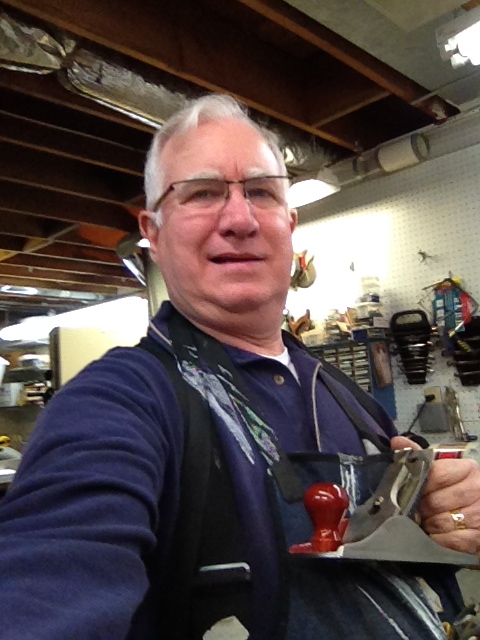
William D. Rainford -- My Dad -- And Tage Frid Lookalike
William D. Rainford — My Dad — And Tage Frid Lookalike

If you are interested to learn more about Tage Frid please check out the links below, it’s worth the time.

Other Tage Frid Resources:

Time to get back out into the shop — it’s cold outside.

Take care,
-Bill

P.S. I never got to meet Tage Frid in person, he passed away while I was living out in Seattle but I would have loved to meet him. If anyone knew him personally I’d be curious to know a few things I haven’t been able to find online:

  • What happened to his shop, bench and tools? Are they in a museum somewhere? Did they go to his grandson?
  • Anyone have a picture of him in the classroom near the iconic benches he used to build?
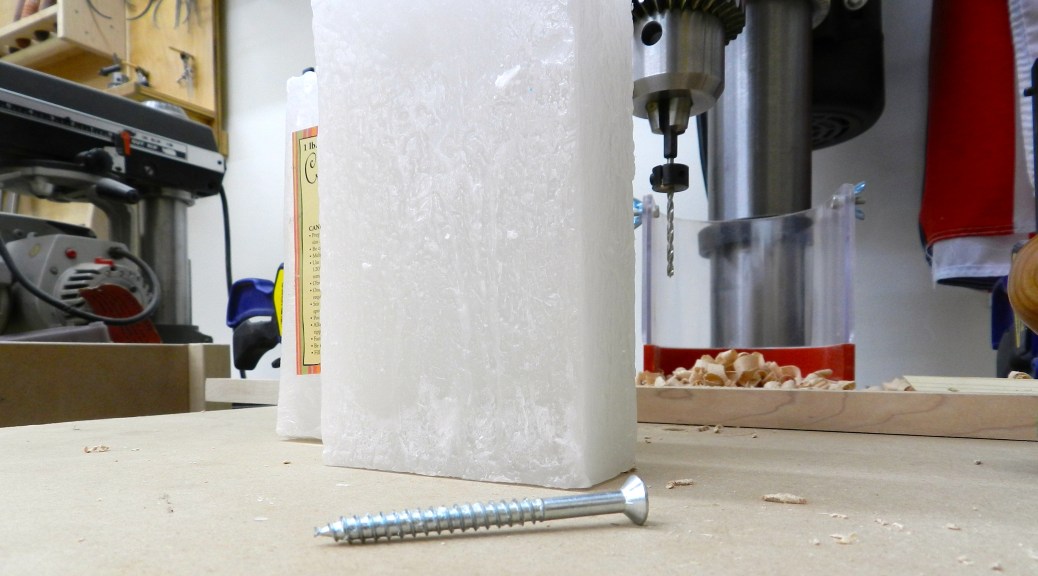
Where did all the paraffin wax go?
Paraffin wax has many uses around the shop and can often be found in my tool belt or shop apron. It’s something I often take for granted and rarely thought about until recently when I needed to replenish my stock and could not find it in any of the usual places…

The Hunt for Paraffin Wax:

I tried all the places I’d swear I had seen it before…

  • My local food stores — Shaws, Hannafords, Market Basket, and Stop and Shop
  • The big box stores — Target and Walmart. (Walmart even listed it in stock on the website with a product ID but after searching on my own nobody in the store had a clue about it and all claimed people regularly come into the store expecting them to have things the website says are in-stock but nowhere to be found)
  • Any other place I thought might reasonably have it — Walgreens, Rite-Aid, CVS, True Value

No luck.

The next best idea I had was to try some craft stores. Michael’s and AC Moore didn’t list it on their websites, but Hobby Lobby claimed to carry some but was sold out online. After clearing snow in the evening and feeling a bit of cabin fever I decided to give Hobby Lobby a try in person. After hunting around I finally found some in the candle-making section. Given all my hunting around I bought the last two 1lb blocks of paraffin — likely a lifetime supply for most woodworkers.

The Strategic Paraffin Wax Reserve

My favorite workshop uses for paraffin wax:

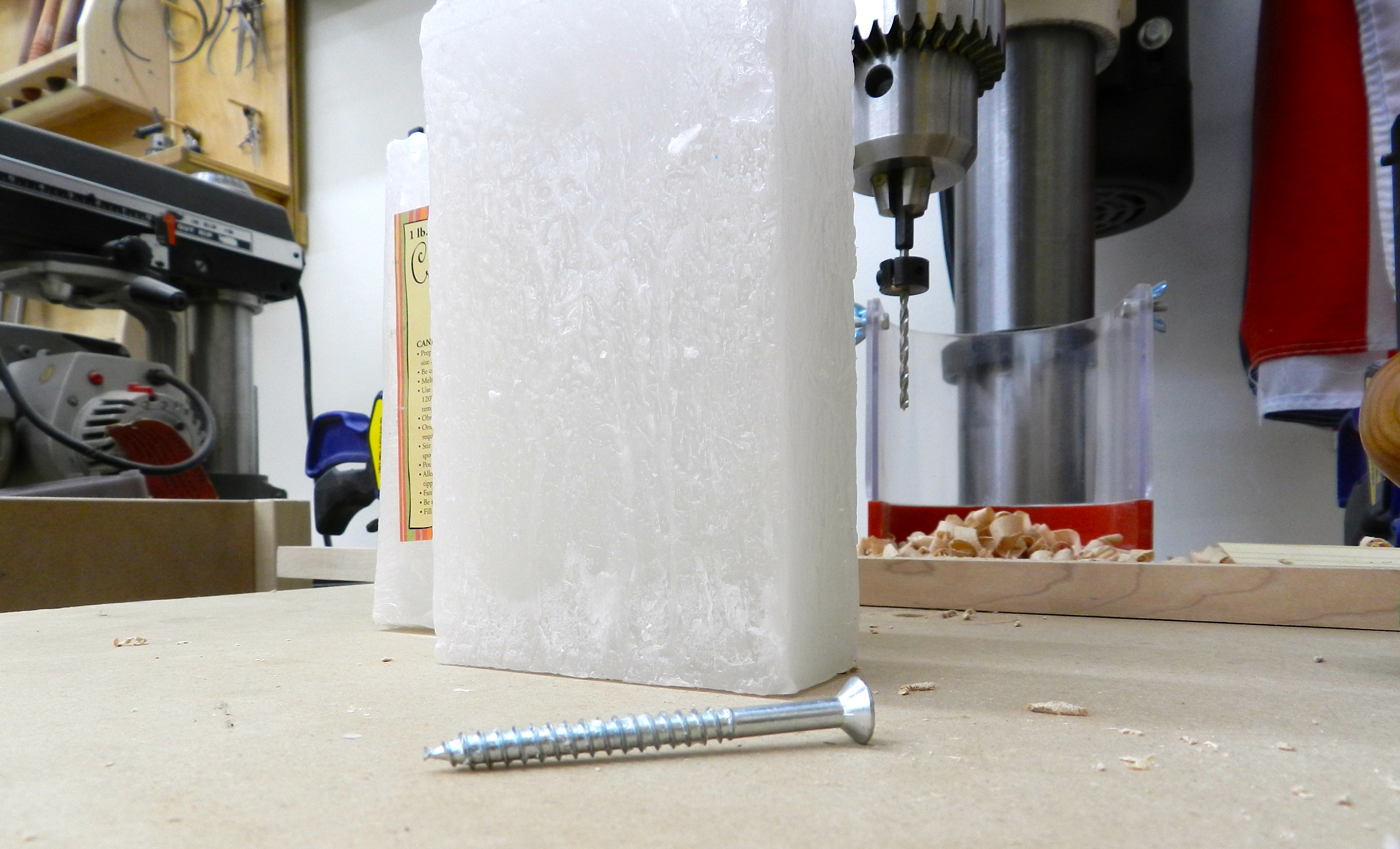
  • Lubricating screws — especially when driven into hard woods or when the screw made of a softer metal like brass it lubricates the threads and makes it easier to drive the screw. It does not affect the screws ability to hold in the wood, and is accomplished quickly by dragging the threads through a block of wax
  • As part of a workbench and similar shop finish — From Tage Frid and other sources he would dissolve paraffin with turpentine and boiled linseed oil and use it as a durable renewable workbench finish
  • Sealing metal and tools — by dipping them into melted paraffin
  • Lubricating planes and saw blades — a quick rub with some paraffin will help your planes and saws glide easily through the wood
  • Lubricating wood on wood moving parts — such as the tail and shoulder vises in a traditional workbench or on a drawer slide
Waxed Screws In Hard Maple

Tips on working with paraffin:

  • You can cut up the block of wax into any size chunk you like using a large kitchen knife. I tend to use a block about the size of a hotel bar of soap
  • Be careful in the summer as it can melt in the sun, so be careful where you store it in warmer weather. I normally have an old Altoids tin in my toolbox to keep it from getting on everything
  • For making a finish be careful as paraffin is flammable so you’ll want to melt it in a double boiler or slice it very thin or use an old cheese grater to increase the surface area before mixing it with your solvent(s)

Where did all the paraffin wax go?

Paraffin wax is generally a bi-product of the gasoline production industry and is most often used to make candles, seal jars, and as a USDA approved coating for candies and some fruits and vegetables. For folks that used to can their own food they would often seal the jars with paraffin wax (often marketed as ‘Gulf Wax’ in the food store near the Ball Jars — it came in a white box and was cut neatly into 4 bars.) From looking online it seems the USDA has advised against using wax to seal your preserves and canning seems to be less popular in recent years as most food stores no longer stock Ball jars and that sort of thing — replaced by ziploc containers and other modern plastic disposable junk. Without the connection to food, I could see food stores dropping it from their shelves.

I suspect there might be more to the story, so if you have a better theory on why paraffin seems to be a lot harder to find, or have spotted some recently, please share your thoughts in the comments section below.

Take care,
-Bill

A Few Good Carpenters

A good carpenter can be hard to find. Many of us like to think that in earlier times there were was an abundance of exceptional carpenters, but this sort of lament is not a new phenomenon. Check out the interesting except below from the 1850s:

“The Author’s Experience.

These facts and reflections have been impressing themselves upon the mind of the Author of this work for twenty years past, while he has been serving the Public as a practical carpenter. During much of this time it has been his fortune to have large jobs on hand, employing many journeymen mechanics, who claimed to understand their trade, and demanded full wages. But it has been one of the most serious and oppressive of his cares, that these journeymen knew so little of their business.

Few Good Carpenters

They had, by habit, acquired the use of tools, and could perform a job of work after it had been laid out for them; but not more than one man in ten could himself lay out a frame readily and correctly.

Why Apprentices do not Learn

Now, it is not commonly because apprentices are unwilling to learn, or incapable of learning, that this is so, but it is because they have not the adequate instruction to enable them to become master-workmen.”

— William E. Bell ‘Carpentry Made Easy: The Science and Art of Framing’ (1858)

I think Bell’s comments ring as true today as they did when he wrote the above in 1858. I won’t focus on the lazy workmen uninterested in learning, but I will focus on those who want to keep learning new skills. As with many of life’s pursuits, you’ll get out of it what you put into it, and there is much to be learned if you know where to look.

Finding a good carpenter

Most of the best carpenters and woodworkers I know get the majority of their work via word of mouth and are booking months out at a time and  thus don’t have to invest much in marketing. If you’re looking to find one of the ‘few good carpenters’, ask around at a local woodworking school, shop, guild, club or friends and family for referrals and interview your next carpenter.

Learning More

One of the best ways to learn a woodworking skill is to take a class or workshop.

I have a few upcoming workshops this spring at the North Bennet Street School (details below) and there are some seats available if you are interested in joining me.

Molding planes
Molding planes

Making Traditional Moldings Using Hand Planes @ The North Bennet Street School

Saturday, April 12 – Sunday April 13 2014

8:30 AM – 4:30 PM Register

Instructor: Bill Rainford
$365

Learn to use traditional molding and joinery planes to produce beautiful traditional molding profiles. Learn the basics of tuning and using these planes. Build a basic sticking board, used to hold the moldings you are making. Layout and execute historic profiles. We discuss the history of traditional moldings, examine planes/profiles students bring (optional) and, if there is time, an introduction to carved moldings.

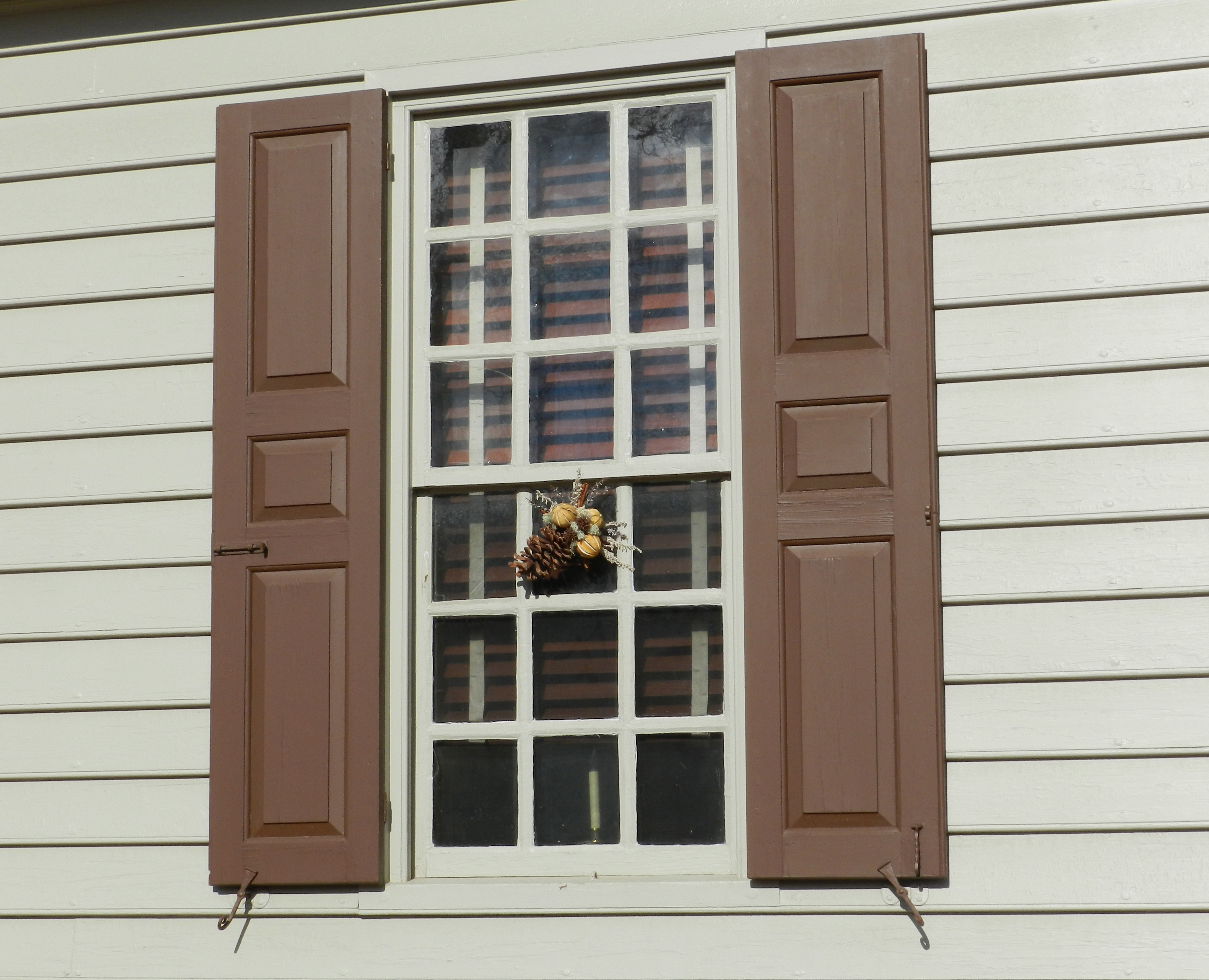
Shutters Workshop
Shutters Workshop

Introduction To Shutters @ The North Bennet Street School

Saturday, March 15 – Sunday March 16, 2014

8:30 AM – 4:30 PM Register

Instructor: Bill Rainford
$365

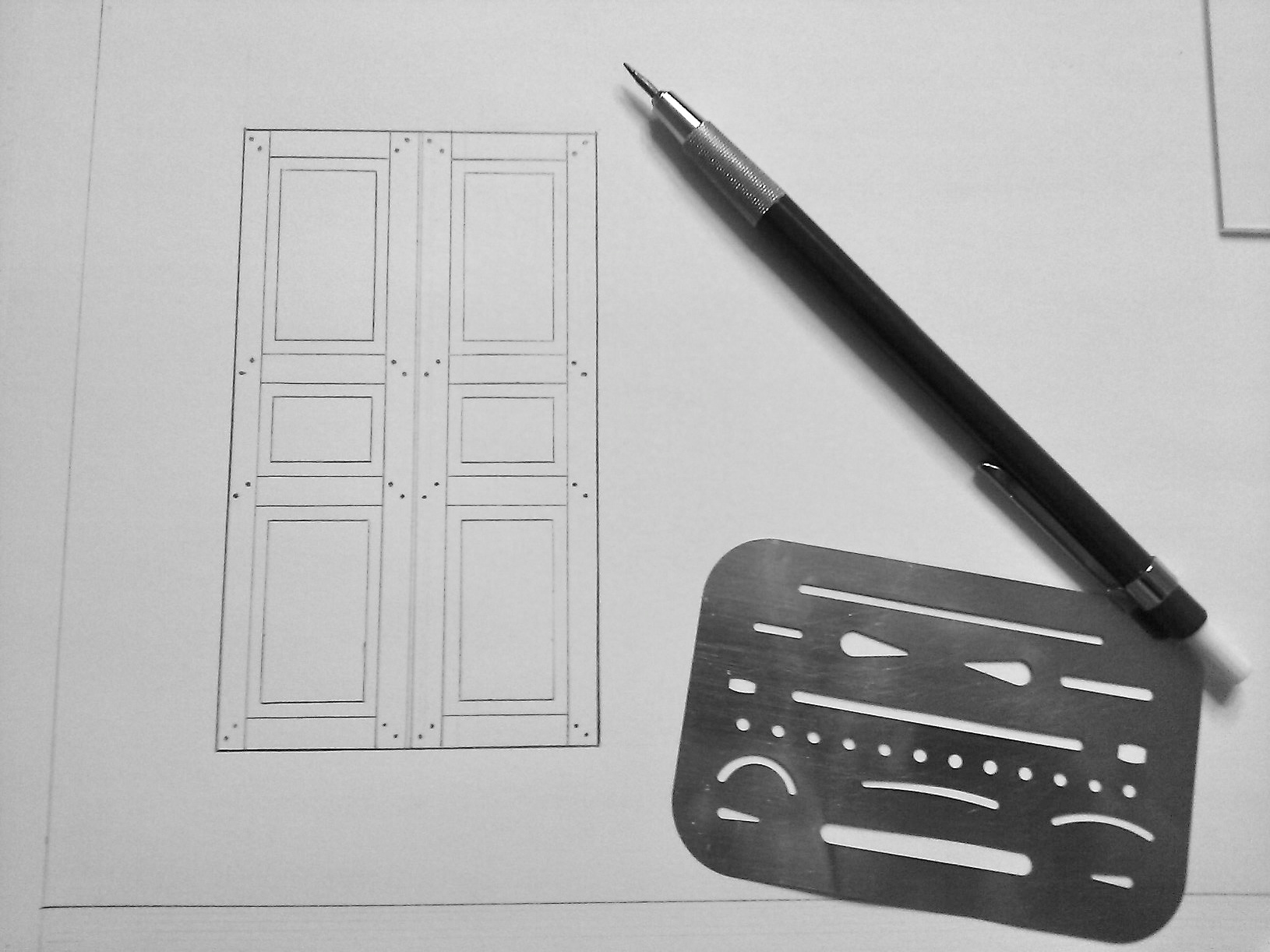
Learn about traditional wooden shutters in this two-day workshop. Using traditional joinery, students build a sample shutter and learn the skills needed to layout and build shutters for custom projects. Discussion includes interior and exterior uses, fielded panels and louvered styles. Students should be able to plane and square up a board by hand and have some experience laying out and cutting traditional mortise-and-tenon joinery by hand. Some experience with tuned hand tools and power tools is required.

Traditional Shutters


If the above does not appeal to you, there are several schools around the country that teach solid woodworking and carpentry skills. I encourage your to explore classes at any of these schools: The North Bennet Street School in Boston, The College of the Redwoods in California, The Heartwood School, The Shelter Institute in Maine, Philadelphia Furniture Workshop, The Kelly Mehler School of Woodworking, Phil Lowe’s Furniture Institute of MassachusettsConnecticut Valley School of Woodworking, and Roy Underhill’s The Woodwright’s School

If you’re not able to make it to one of the above schools there are scores of books that can help you along your woodworking journey. I think every carpenter would benefit from reading all 4 volumes of Audel’s Carpenter’s Guide, Tage Frid Teaches Woodworking Vol 1-3, Bell’s Carpentry Made Easy: The Science and Art of Framing, and Get Your House Right.

Woodworking is a life long journey and I hope that you will continue pursuing new aspects of the craft.

Take care,
-Bill

Balloon Framing

Between Timber Framing and modern Platform Framing was an intermediate style of framing a building called ‘Balloon Framing’.

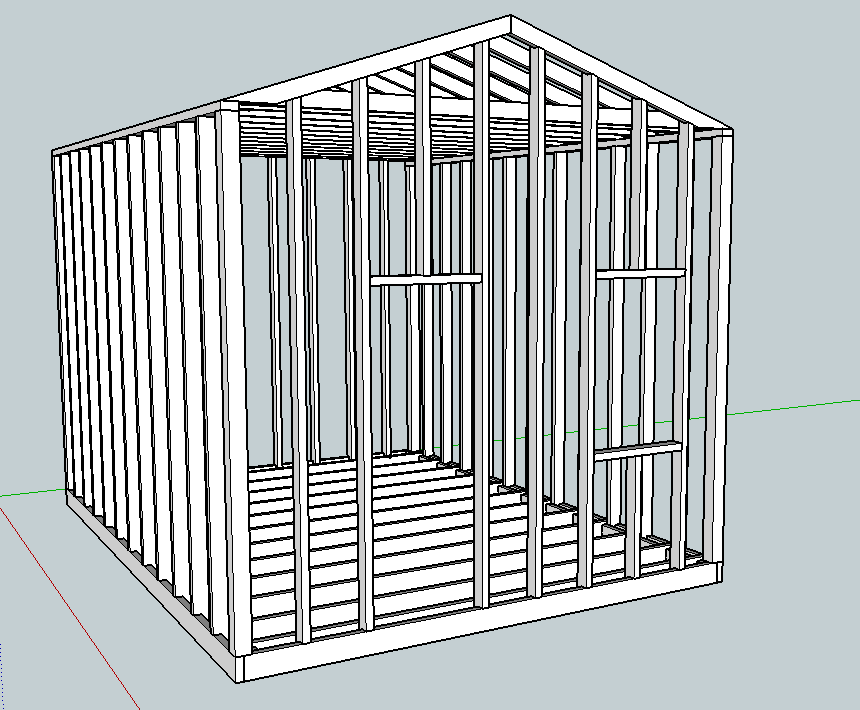
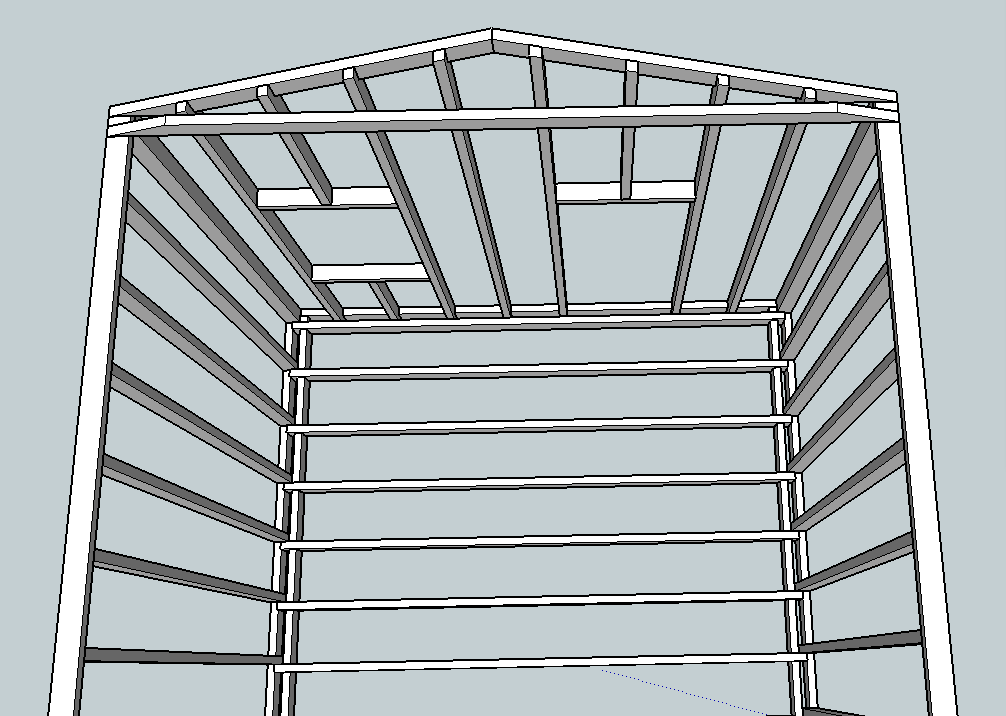
Balloon Frame 3D Model
Figure 1: Balloon Frame 3D Model

This method of framing was radical for its time. Started around the 1830s and steadily gaining in popularity through the end of the 19th century Balloon framing ushered in a new generation of building supplies and builders who benefited from and drove the advent of ever cheaper machine made nails, consistent milled lumber, and more efficient transportation methods (Rail box-cars etc). Beyond the technological advancements in the materials production and transportation this building method caught on quickly as buildings framed in this manner could be built cheaply with non-skilled labor and common nails and tools, thus farmers and do-it-yourselfers could build what they needed with a far shallower learning curve when compared to all the advanced joinery traditional timber framing required. This was invaluable to frontier areas where traditional carpenters and joiners were in short supply.

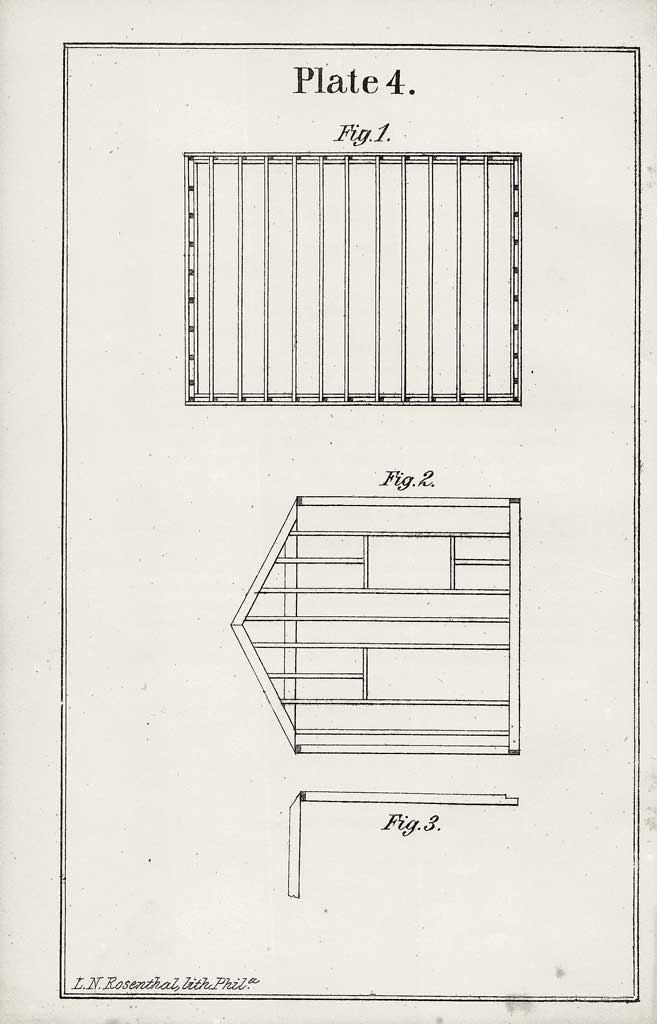
Bell's Carpentry Made Easy Plate 4
Figure 2: Bell’s Carpentry Made Easy Plate 4

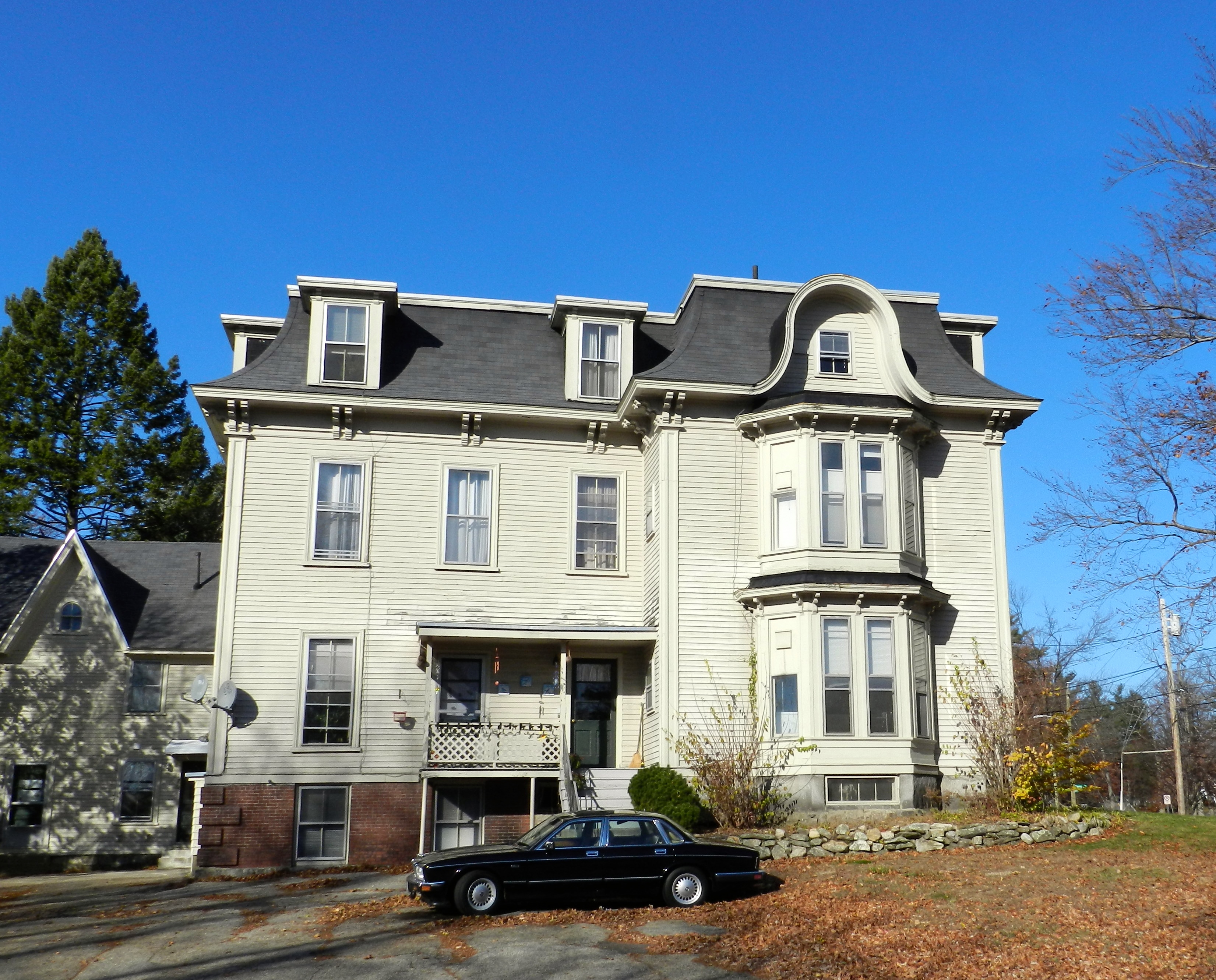
In the mid-west and plains states in particular you see a lot of balloon framed houses during this period as they had good access to the mills producing these building materials, a desire to quickly build and expand existing buildings and in some areas a dearth of heavy timber needed to build in the older styles. Even in more populated areas back east you’ll see many of the Shingle Style and Victorian homes and Triple-Deckers were framed this way, though certainly some more austere farm houses of this period were also framed in this manner as it was an economical way to build. If you look carefully at some of the design details you can see how tastes and designs changed to make use of the dominant building supplies of the time. You’ll see higher ceiling heights, various bump outs, towers etc that were more easily executed with this style of framing and in keeping with the prevailing styles of the day. (See Figure 3)

Mansard Victorian in Manchester NH
Figure 3: Mansard Victorian in Manchester NH

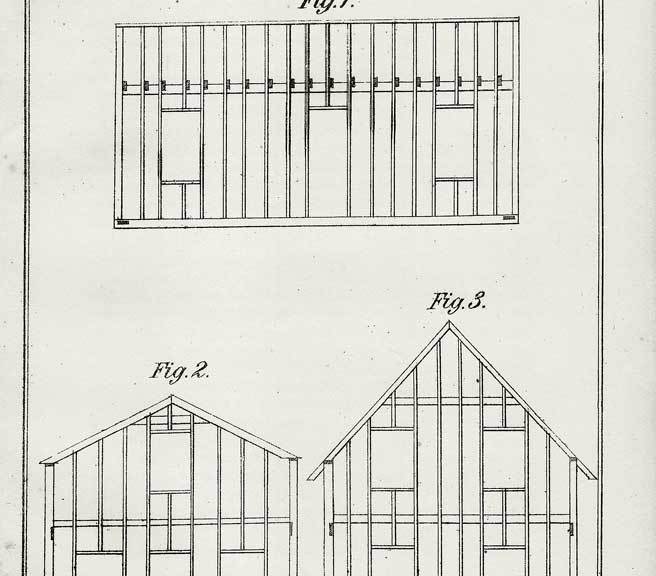
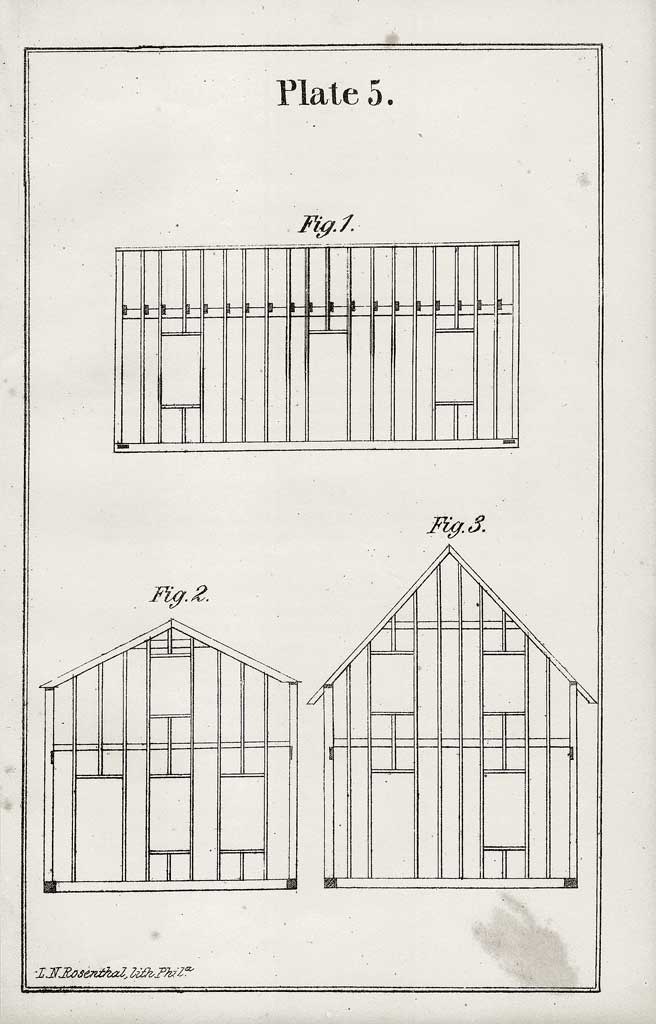
Balloon framing made use of common sized lumber coming from mills — the first real large scale use of 2x4s, 2x8s, 1x10s etc in framing a building and marked a transition from the heavy timbered buildings of the east coast of America and the ‘Old World’ that preceded it. In the earlier part of this period a 2×4 was actually 2″x4″ in some areas as opposed to the ‘nominal’ sizes we have today wherein a 2×4 is 1.5″x3.5″ by the time it makes it to a modern lumberyard, but that is a post for another day. The weight of the building was dispersed across a series of smaller consistent studs as opposed to a few heavy posts. Also notable was the fact that the studs ran from sill to plate, thus requiring the 2nd and 3rd floors to be ‘hung’ from the studs via ledger or ‘ribbon’ boards. (See Figures 2 and 4)

Bell's Carpentry Made Easy Plate 5
Figure 4: Bell’s Carpentry Made Easy Plate 5

A great period resource for information about Balloon Framing is William Bell’s “Carpentry Made Easy: The Science and Art of Framing”. While Bell was not the first author to extol the virtues of Balloon Framing he may have been one of the most prolific. His ‘Carpentry Made Easy’ book was published continuously from 1858-1904. 46 years is quiet a testament to the information he provided. The book’s longevity is largely due to how the information is provided. Bell starts with a detailed section on basic math and geometry for carpenters and the moves into framing. He covers Balloon Framing for homes and modest sized buildings and moves on to heavy timber framing for industrial buildings, bridges, spires and the like. Bell was a trained carpenter and joiner and speaks the reader in a clear and concise way that was agreeable to most carpenters. Bell goes into technical detail but did so in such a way that any reasonably skilled carpenter could take this information and apply it to the project at hand. His words still resonate well today — in fact using his descriptions I was able to build a detailed 3D model in Sketch-Up based on his instructions for how to build a Balloon Framed structure. (See Figures 1 and 5). I’m sure that many a house carpenter had a dog-eared copy of this book in their toolbox and regularly referred to it over the years.

How fast did this transition happen?

Like most major shifts in an industry the transition from Heavy Timber Framing to Balloon Framing did not happen over night. The word had to get out, it had to be evaluated, the supplies had to be ready and a host of macro-economic pressures had to come together in order to facilitate this change — a strong need to build economical housing for an exploding population etc. Like most things, some isolated or rural areas clung to the old ways for longer periods and some areas were more willing to try out these new techniques. Even cutting over in terms of technique was an evolutionary change. If you look closely at Figure 4 above you’ll see that the house shown there has Balloon Framed walls with a heavy timbered sill, which the author notes as the preferred way to go if heavy timber is available, as opposed to Figure 2 which shows a more traditional balloon framed sill made from 2x framing elements.

In broad terms this building method started in the 1830s, crescendo-ed during the 1880s-1930s giving way to modern Platform Framing which was an evolutionary advancement that built upon the strengths and lessons of this movement. Balloon Framing and it’s relative efficiencies greatly improved the living conditions of many Americans and others of modest means and the burgeoning middle class.

Balloon Frame Cutaway 3D Model
Figure 5: Balloon Frame Cutaway 3D Model To Show Joinery

Why did Balloon Framing disappear? Disadvantages and Demise

With Balloon Framing, you framed an entire wall at once from sill to top plate, thus requiring longer framing members. Once the wall was standing you needed to have ladders and scaffolding in order to ‘hang’ the upper floors from the ledger plates and studs. This required more labor compared to modern platform framing where each level builds upon the lower level, thus requiring less labor, scaffolding and smaller framing members.

In some larger Balloon Framed buildings you’d see some sagging towards central walls due to differential shrinking of the framing members — joists resting on ledger boards will move a different amount when compared to joists nailed into the side of as stud. This kind of differential can add up in a larger building and took time to manifest itself. (See Wikipedia here for a more detailed explanation)

While the above items are negatives for this system of framing the final nail in it’s coffin was how it performs in a fire. The inter-stud wall cavities that run from sill to plate worked like a chimney flue and helped to rapidly spread fire throughout a Balloon Framed building. To counter this, fire blocking can be installed between each floor, but this was labor consuming to install and not quite as good as the fire resistance you’ll see in a Platform Framed building. Even today when filling out an application for homeowners insurance you’ll often see questions related to this kind of framing.

What replaced Balloon Framing?

Around the 1930s the death toll and property loss data was starting to add up and folks looked to rectify the situation. The solution was Platform Framing. In a nutshell you’d build a platform of sill, joists, rim joists and sub-flooring, use this as a platform to build the walls for one floor, you’d tilt up and nail off the walls, then build another platform on top of that until you top out your building. This method required less labor, shorter framing members and by breaking up the wall cavities at each floor provided better fire resistance.  After World War II the post war building boom accelerated the need for even more housing and faster build completion times. At this time we started to see the introduction of studs 16″ to accommodate sheet goods (Plywood and later OSB) in regular sizes as a replacement for more labor and material intensive traditional sheathing. And in a similar manner vinyl siting replaced genuine clapboards etc etc until you get to present day building materials and practices.

Conclusion

We don’t often see or hear much about Balloon Framing today as it has fallen out of favor in the building community, but it’s impact can be felt today in any Platform Framed structure that benefited from all the lessons learned by this earlier incarnation of efficient home building. I hope that the next time you are examining the framing of a Balloon Framed structure you’ll take a look and see what lessons it can teach you.

Take care,
-Bill

P.S. If you’d like to read William Bell’s “Carpentry Made Easy: The Science and Art of Framing” (1858) you can get a copy from the Toolemera Press here. It was a great read with interesting sections on timber framing, compound roof joinery, bridge-building, spire making and other interesting building topics above and beyond the Balloon Framing and carpenter’s geometry I mention in this article.

** Plates 4 and 5 of from Bell’s Book are provided via Gary Roberts of the Toolemera Press and used with his permission.

Treenails, Trunnels, Pins and Pegs

Treenails, Trunnels, Pins and Pegs — all terms used to describe the wooden nail-like fastener used in timber frame construction. I needed to make a large number of them for an upcoming project and thought you might also enjoy seeing what it takes to make these deceptively simple looking pins.

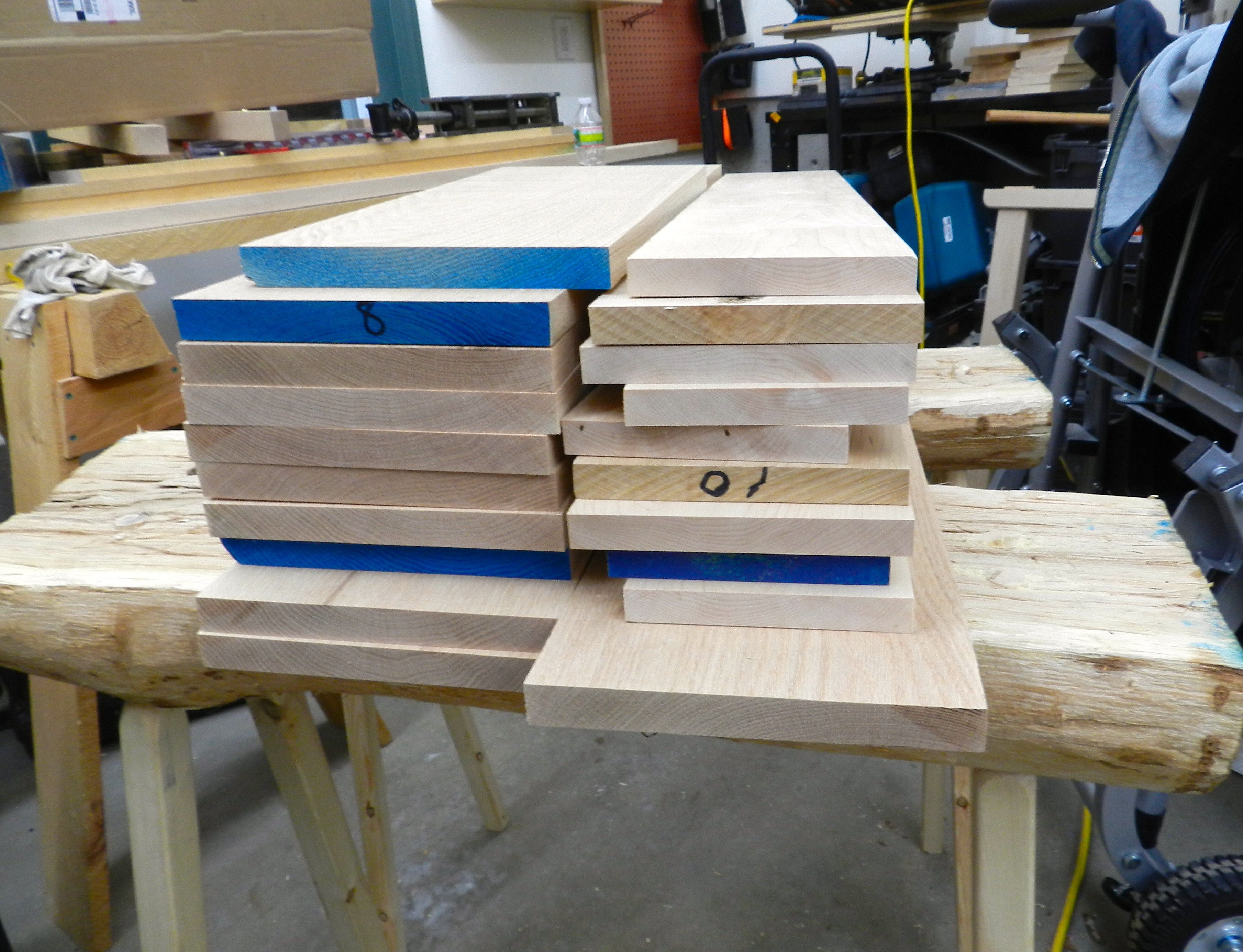
White Oak and Hard Maple stock ripped, thickness planed and jointed
(1) White Oak and Hard Maple stock ripped, thickness planed and jointed

Where did all those names come from?

Like most things that predate modern recorded history I’ve read many conflicting theories on where these terms came from, so what I relay here is based on my own experiences in this field; your mileage may vary. Timber framing dates back thousands of years and can be found in early civilizations around the world in many different forms. What all these structures had in common was the joining of heavy timbers using traditional joinery and large mortise an tenon joints that were pinned together using large wood fasteners.

These fasteners are known by a lot of colloquial names, the most common of which I describe in this post. Most literally treenails (or trenails in some places) is the term for nails made from a tree. Trunnels is derived from the pronunciation of treenails and at times reserved for larger treenails used in very large buildings or ships, sometimes even wedged so they do not back out. Pegs tends to be a more modern term for treenails and pins tends to be used for smaller scale work though many timber framers I know today use it regularly. Having said all this I’ve heard all of these terms used inter-changeably at times by both novices and seasoned professionals, so feel free to use the term(s) that best suit your work and locale.

The bottom line is ‘a pin by any other name will hold your building together just as well.‘ (provided you heed my tips below 😉 )

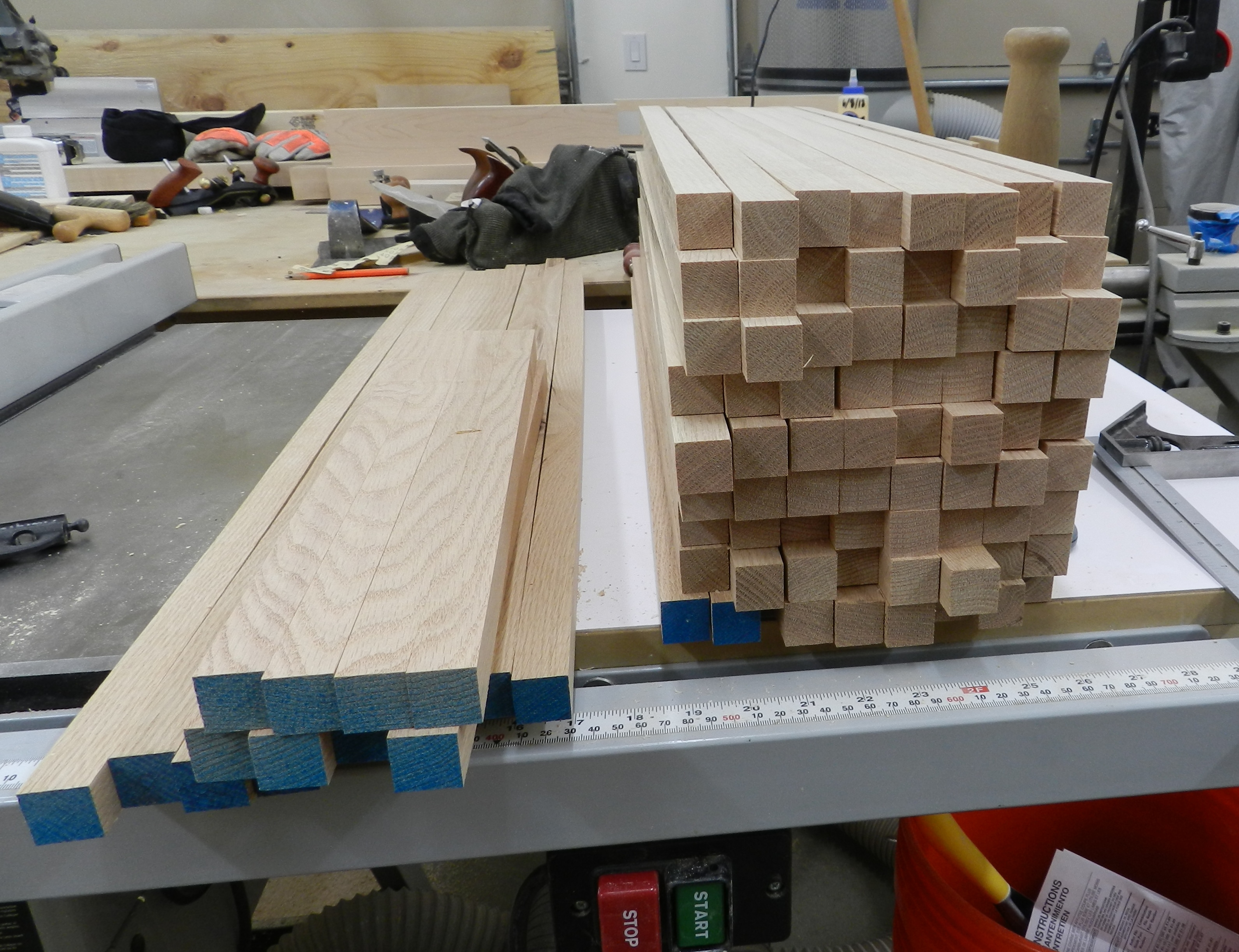
Stock ripped down into square blanks
(2) Stock ripped down into square blanks

How do you go about making these pins?

Traditionally pins were split out of green wood, shaved down with a draw knife and shave horse and allowed to season. Then touched up again when dry. Since I have to make a few hundred of these, being a practical modern joiner I will make use of my table saw and some high quality kiln dried lumber. Most of the stresses in a timber frame are carried by the joints and not the pins, and white oak is very resistant to shearing forces so I am not worried about the wood not being split out for this usage. (I’m building a square rule, late 19th century style frame from milled eastern white pine, so by that point the pins likely were made the same way I go about it)

For the scale of timber framed buildings I generally work on — homes, barns and sheds, I’m usually using a 7/8″ ships auger bit to drill holes for pins. Most tenons I work with are generally 1.5″-2″ thick eastern white pine and based on experience and reference tables I’ve found this size to work well for me.

I learned to timber frame while at NBSS and with that my framing has a proclivity for historic precedents. The historic buildings I work on all had octagoned pegs which worked well for hundreds of years and can be made more easily when compared to the expensive turned pegs you see some modern supply houses offer for upwards of $2 each. For a draw bored joint, I feel the octagon pegs look better and hold better compared to the CNC turned pins. (More on that later)

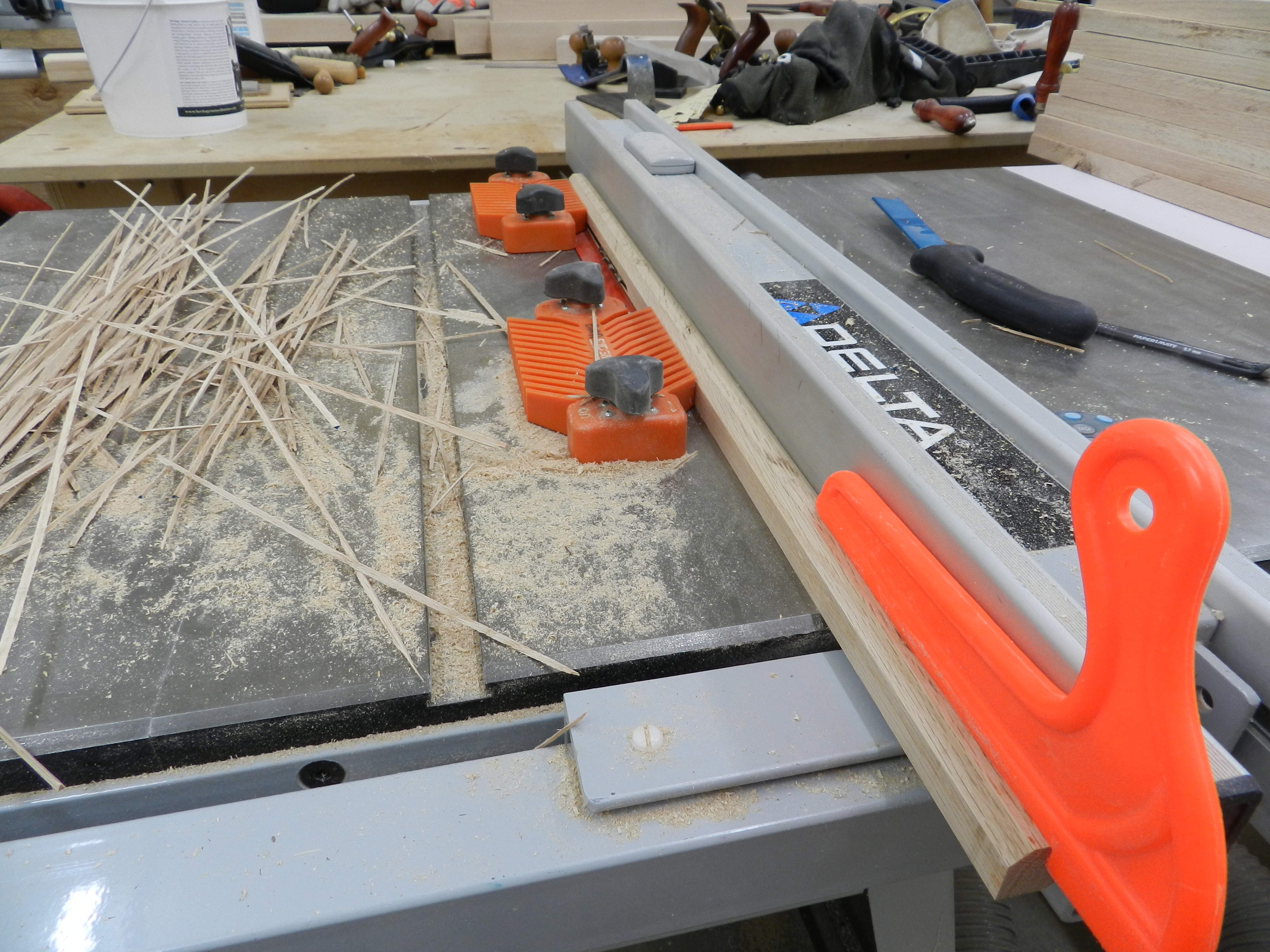
Making octagons out of the square blanks
(3) Making octagons out of the square blanks

1.) I start off by milling down my rough 4/4 white oak stock to be 7/8″ thick, then I joint an edge on each board (See photo 1). I then crosscut each board to be about 30-3/8″ long. (Each of these boards should yield 3 sets of 10″ long pegs)

2.) Next I rip each of those boards into 7/8″ square sticks (See photo 2)

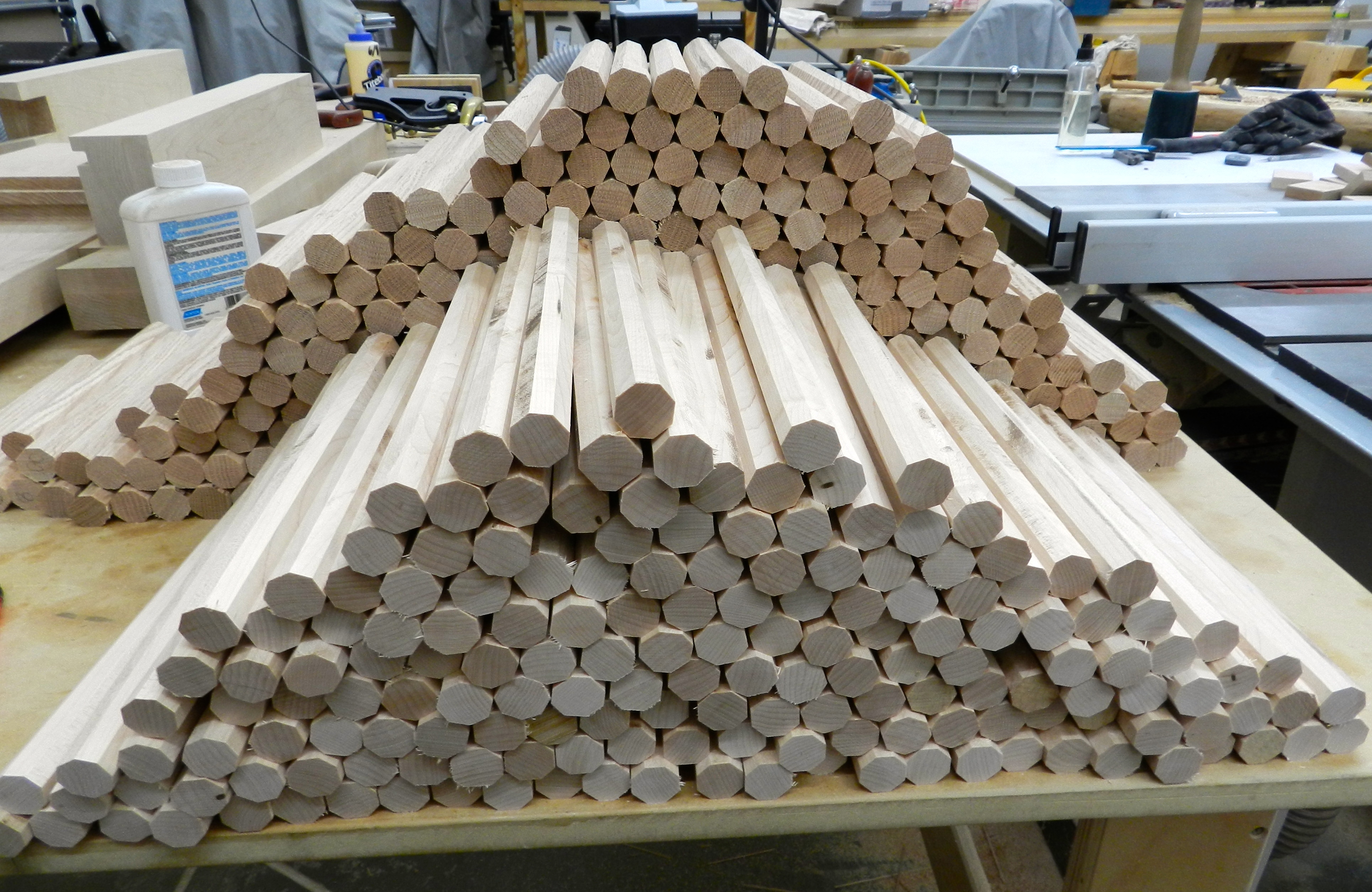
3.) Tilt the blade on your table to 45″ and turn each of those square blanks into an octagon. The use of feather-boards will help you be consistent. (See photo 3)

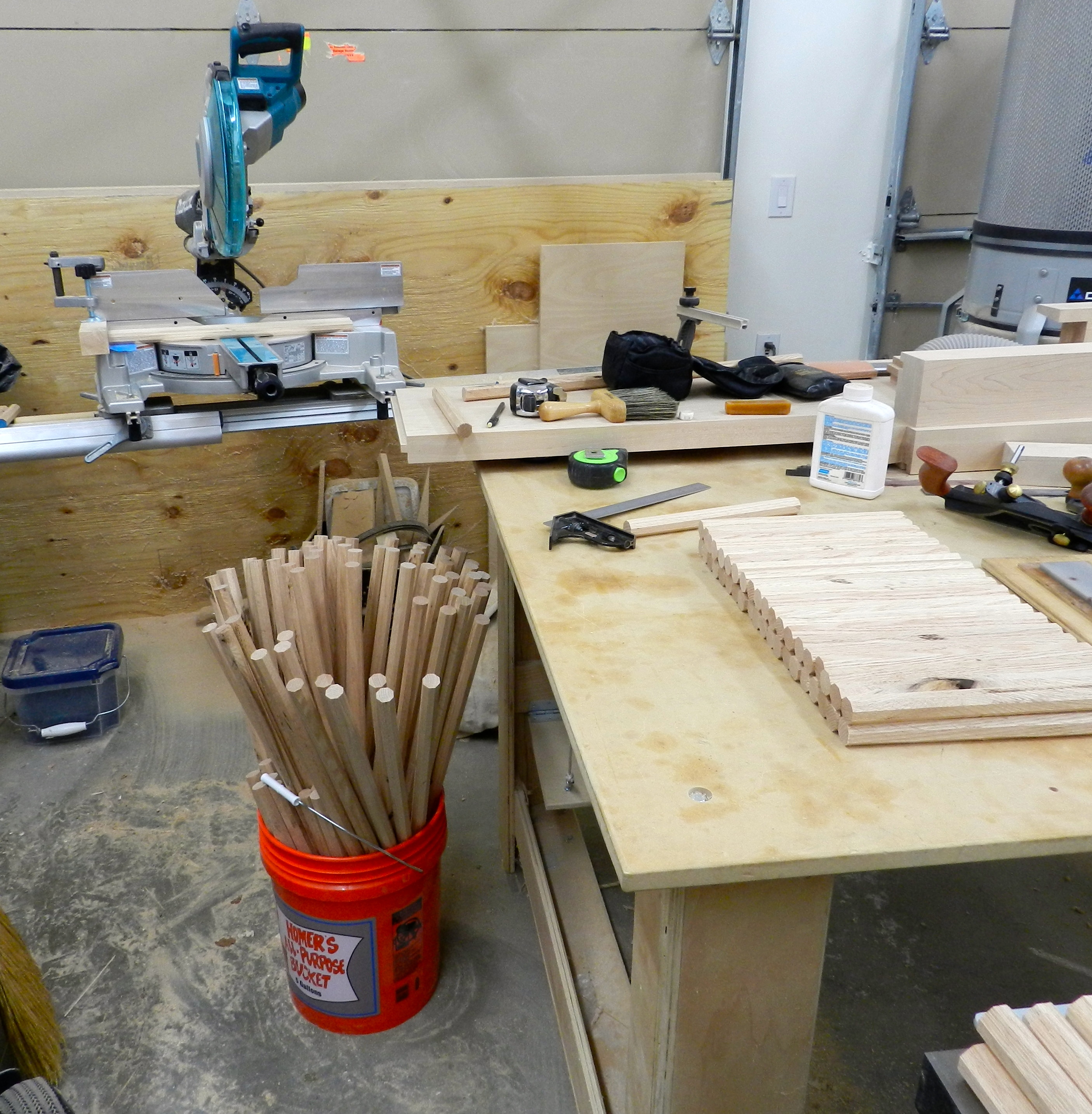
Chopping several blanks at a time on the chop saw using a stop block
(4) Chopping several blanks at a time on the chop saw using a stop block

4.) I set a stop block on the chop saw at 10″ and gang chop (cut several at a time) for the sake of efficiency (See photo 4)

248 Oak Treenails and 166 Hard Maple Try Pins
(5) 248 Oak Treenails and 166 Hard Maple Try Pins

5.) At this point you’ll quickly see how many pin blanks it takes to make even a modest building. (In this case a 12’x24′ large shed/small barn) (See photo 5)

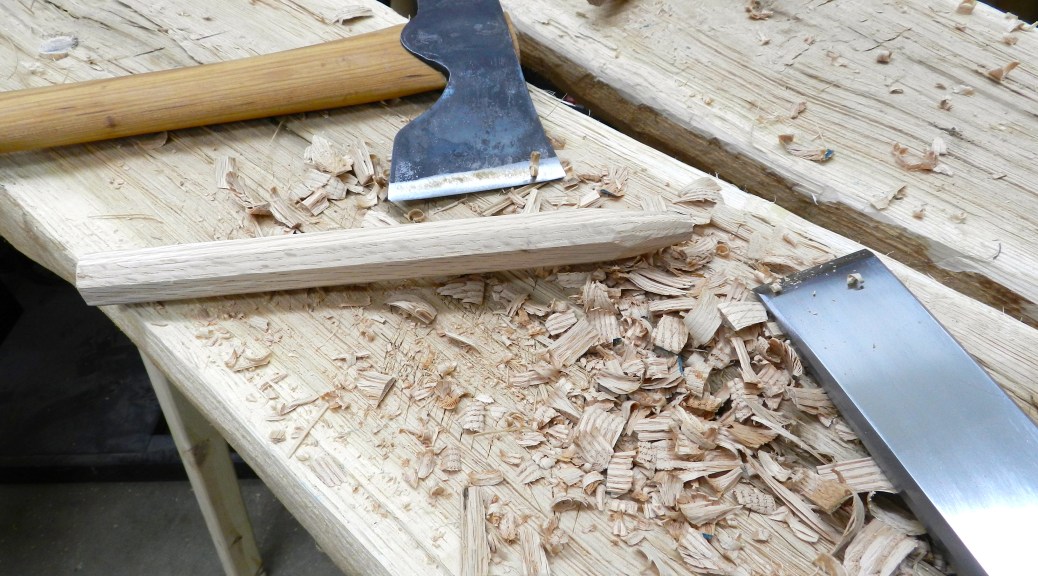
Using the hewing bench, carpenter's axe and timber framing chisel to taper the ends of each pin
(6) Using the hewing bench, carpenter’s axe and timber framing chisel to taper the ends of each pin

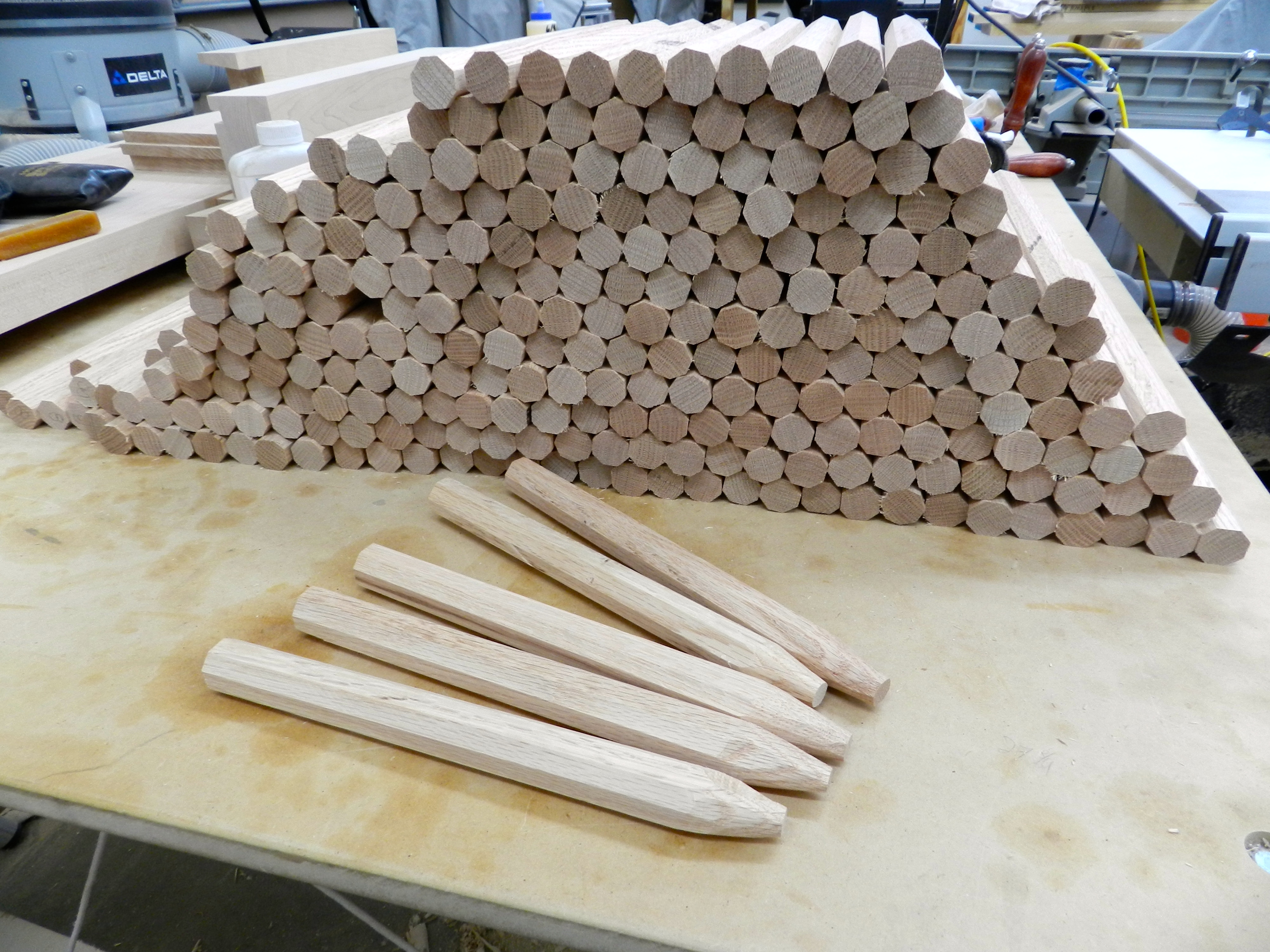
6.) Now it’s over to the hewing bench to taper the leading ends of the pin blanks. I usually rough off the wood with my capenter’s axe and touch things up with a timber framing chisel. I find it helps to get the cut started with the tool and bang them both (peg and tool) in unison on the hewing bench. The downward momentum drives the tool through the wood with a minimal expenditure of energy — important when you have a few hundred of these to complete.

Completed pins
(7) Completed pins

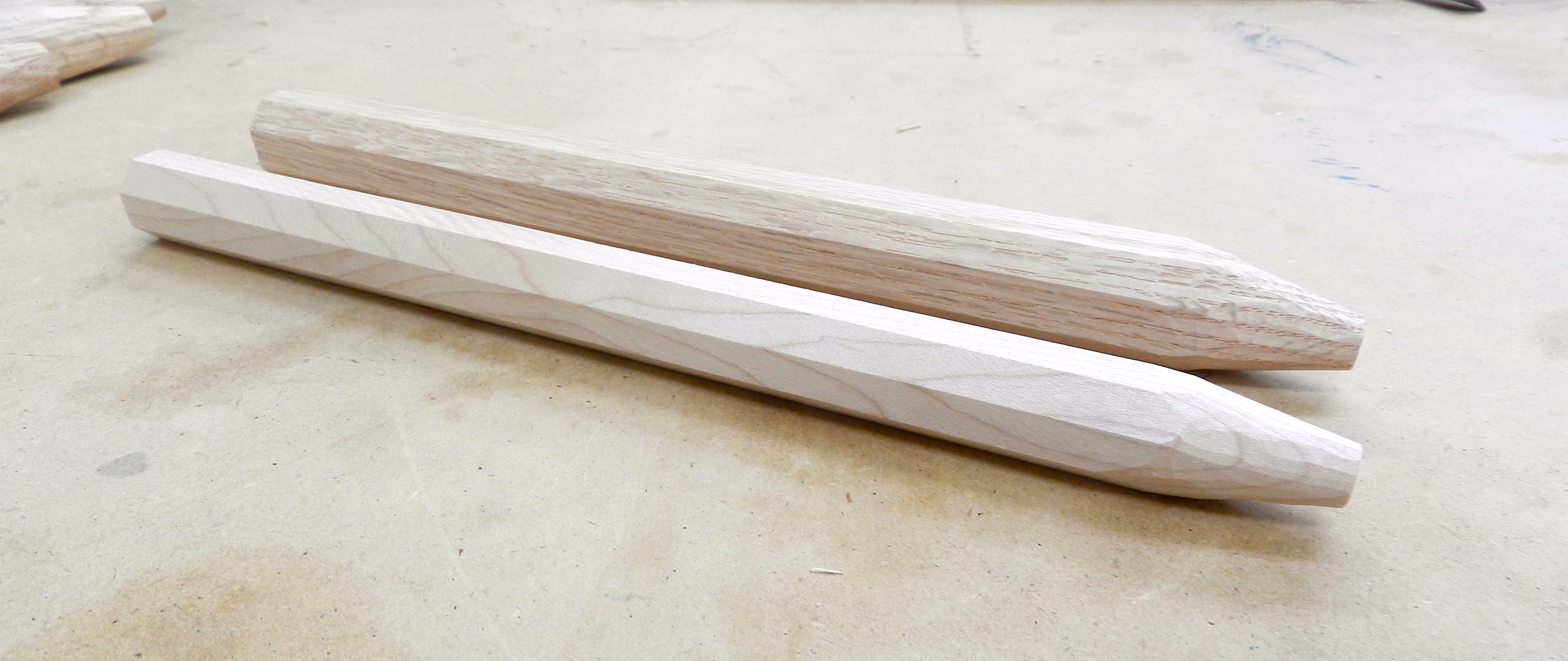
7.) I usually taper the first 2″ or so of the pin. You do not need to be overly concerned with trying to make the pins look like a sharpened pencil. You just need to knock off the corners to help guide the pin through the draw-bored joint.  Anything beyond that is to suit the design aesthetic you are going for. (Some folks will want to cut the ends off a pin in the house, so all the more reason to only do what you need to do with them)

Foreground -- 3/4" Hard Maple Try Pins; Background 7/8" White Oak Treenails
(8) Foreground — 3/4″ Hard Maple Try Pins; Background 7/8″ White Oak Treenails

8.) Sit back and enjoy your work. Take a deep breath and repeat steps 1-7 all over again to make try pins. Try pins are slightly thinner pins used when test fitting your timber frame. I make them from hard maple for two reasons — I can visually differentiate them from the oak and the smooth hard maple is easily removed when the test fitting is complete. For this frame using 7/8″ Oak pins I make the try pins from 3/4″ hard maple stock. They are made the same way as their larger brethren.

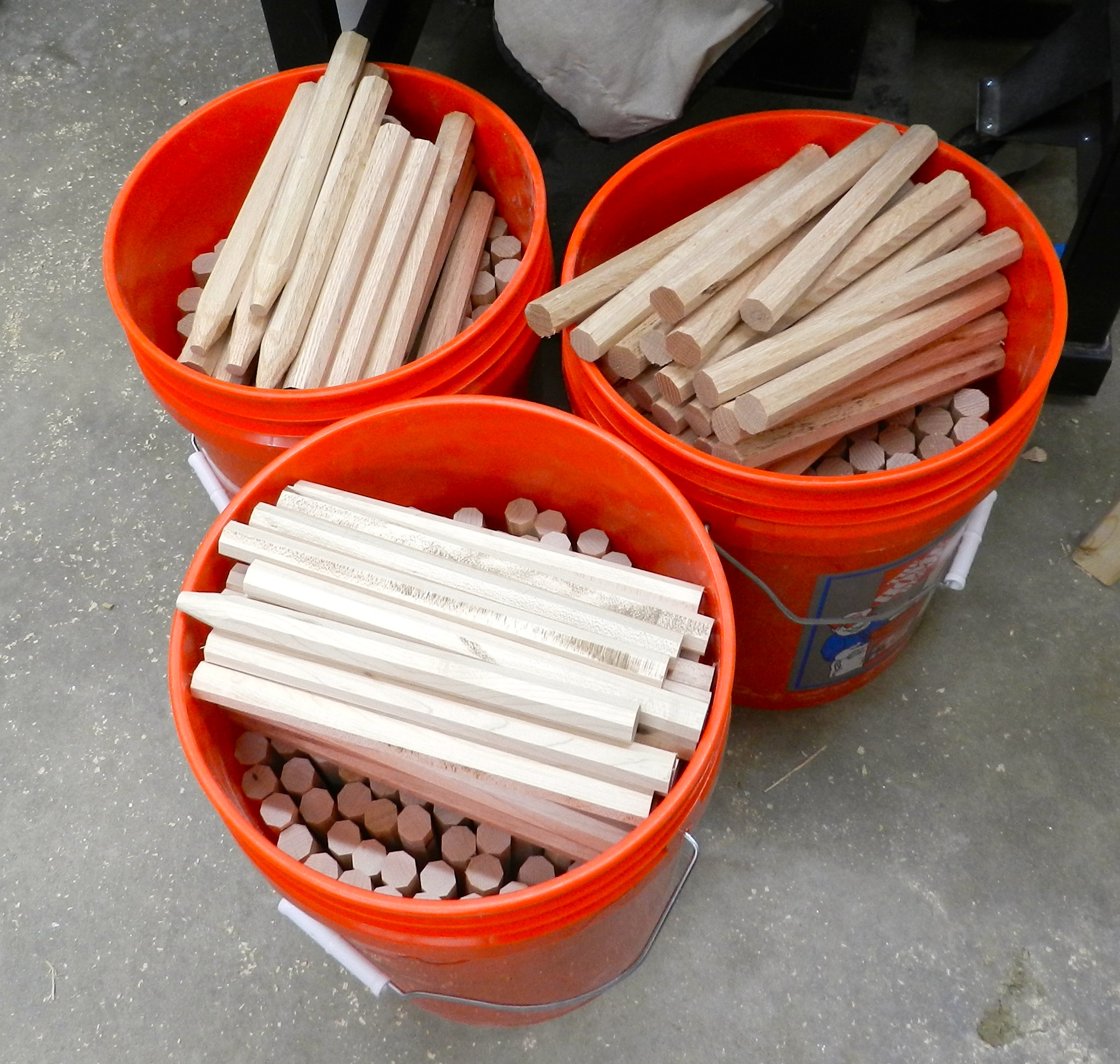
Full buckets of pins

Why are they octagons?

By making a 7/8″ octagon pin and driving it into a 7/8″ round hole the corners will bite into the wood and keep the the pin securely seated.  (The diagonals across the 7/8″ octagon are slightly longer than 7/8″.) This is why you want to use smaller try-pins during test fitting, this way you are not deforming/stretching the holes before the frame is raised.

Driving in the pegs
Driving in the pegs

Tips for a high quality timber framing pin:

  • Use kiln dried pins with a green wood frame. Use green pins with a dried frame
  • I use most often use White Oak pins with green Eastern White Pine frames
  • I use Hard Maple Try Pins during test fittings (try pins should be 1/8″ smaller than your final pins)
  • Octagon your pin stock so that it properly bites into the joint
  • Taper the ends of your pins so they will easily enter the draw bored joints
  • Don’t stress too much about the tapering
  • Avoid the machine turned pins — I dislike the look, the cost (~$2 each), holding power, fact that they are not historical etc
Many pegs in a timber frame

Where can I learn more about timber framing?

  • Join the Timber Framer’s Guild (www.tfguild.org) and read the many good publications they have
  • Read any of the books by Jack Sobon, Ted Benson or Ed Levin on the topic of Timber Framing
  • Take a class in timber framing at The North Bennet Street School (with Rich Friberg or me), or at the Heartwood School in Western MA

The next time you are in a barn or timber framed building I hope that you will take a moment to examine the pins holding the joinery together.

-Bill

Hewing Bench Revisited (Already)

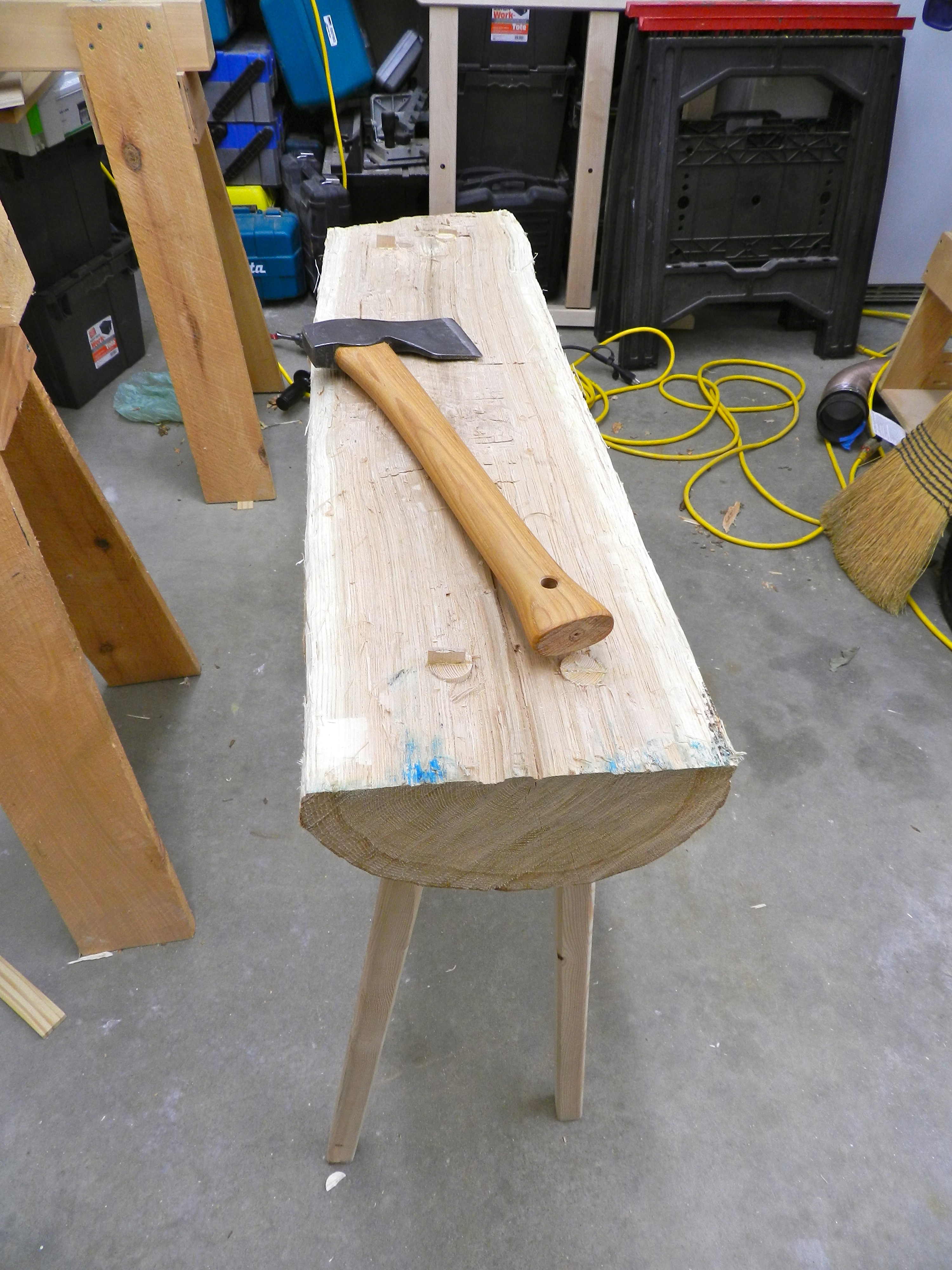
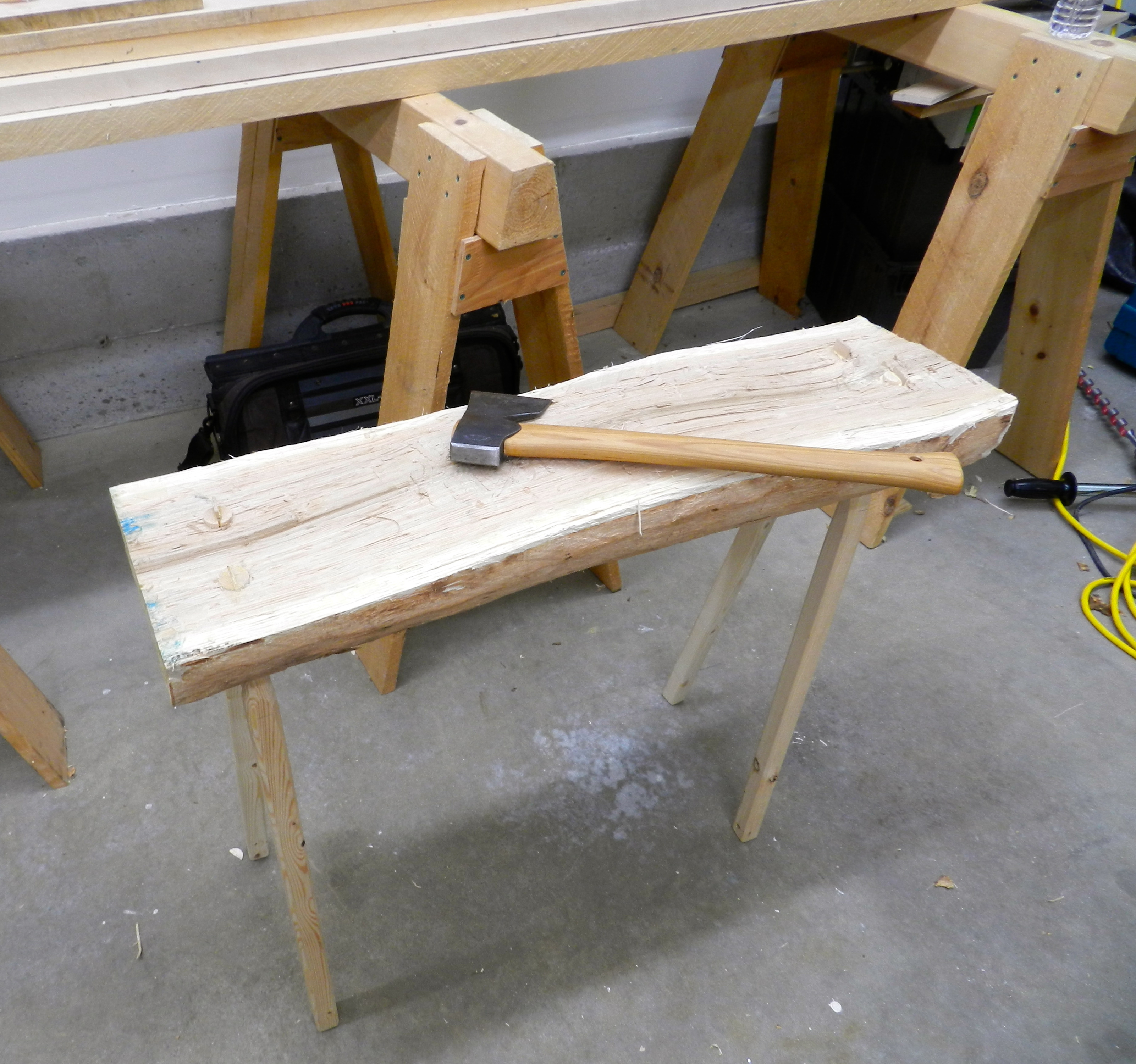
After living with my new hewing bench for a few weeks I finally got around to using the other half of the log. I’m glad things worked out this way as I made some modest improvements based on our time together.

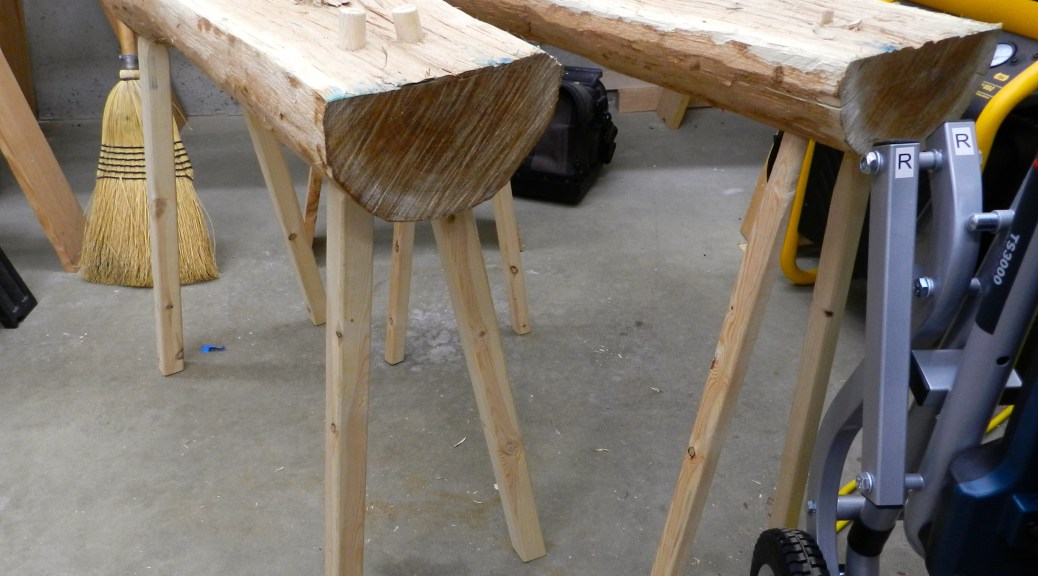
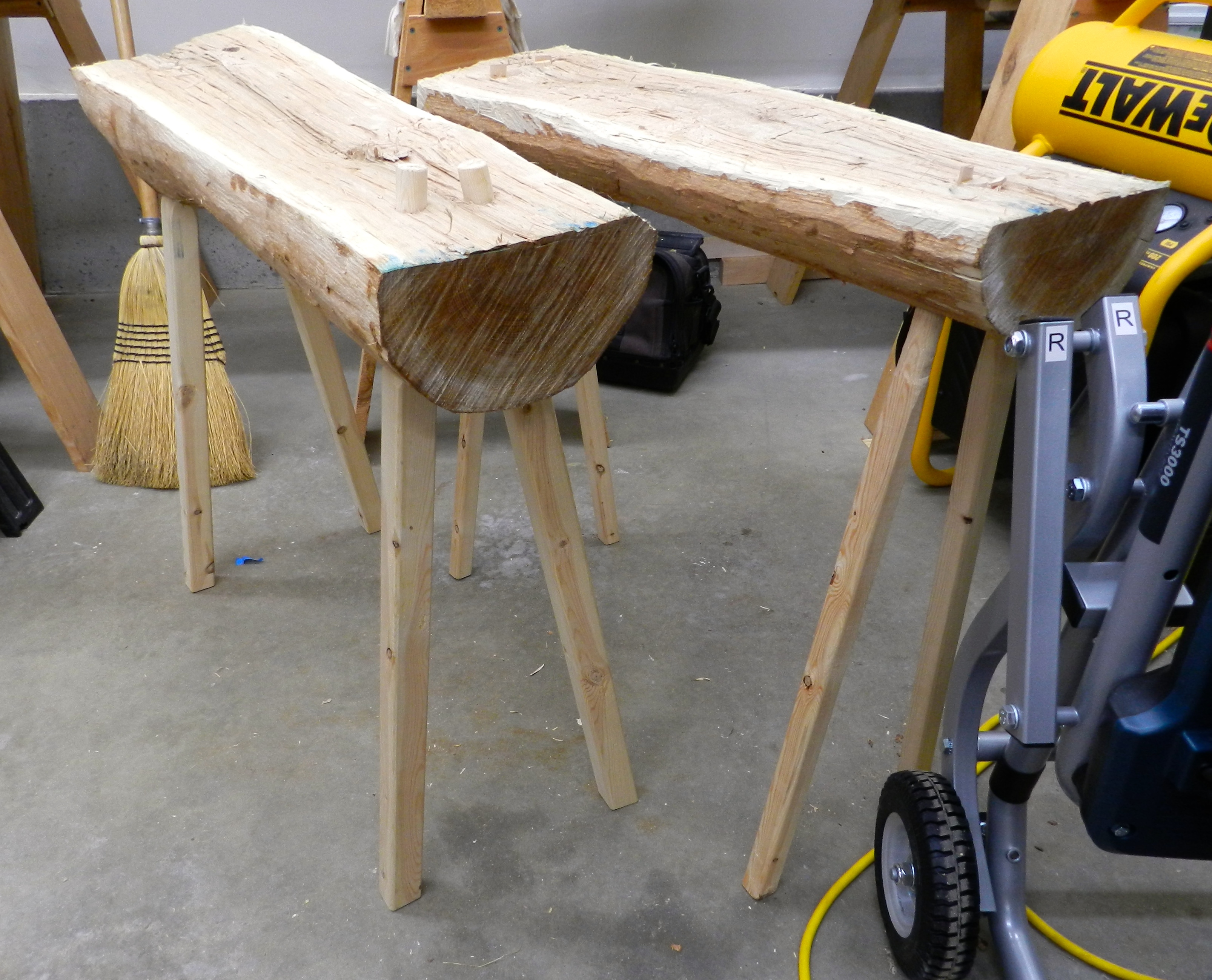
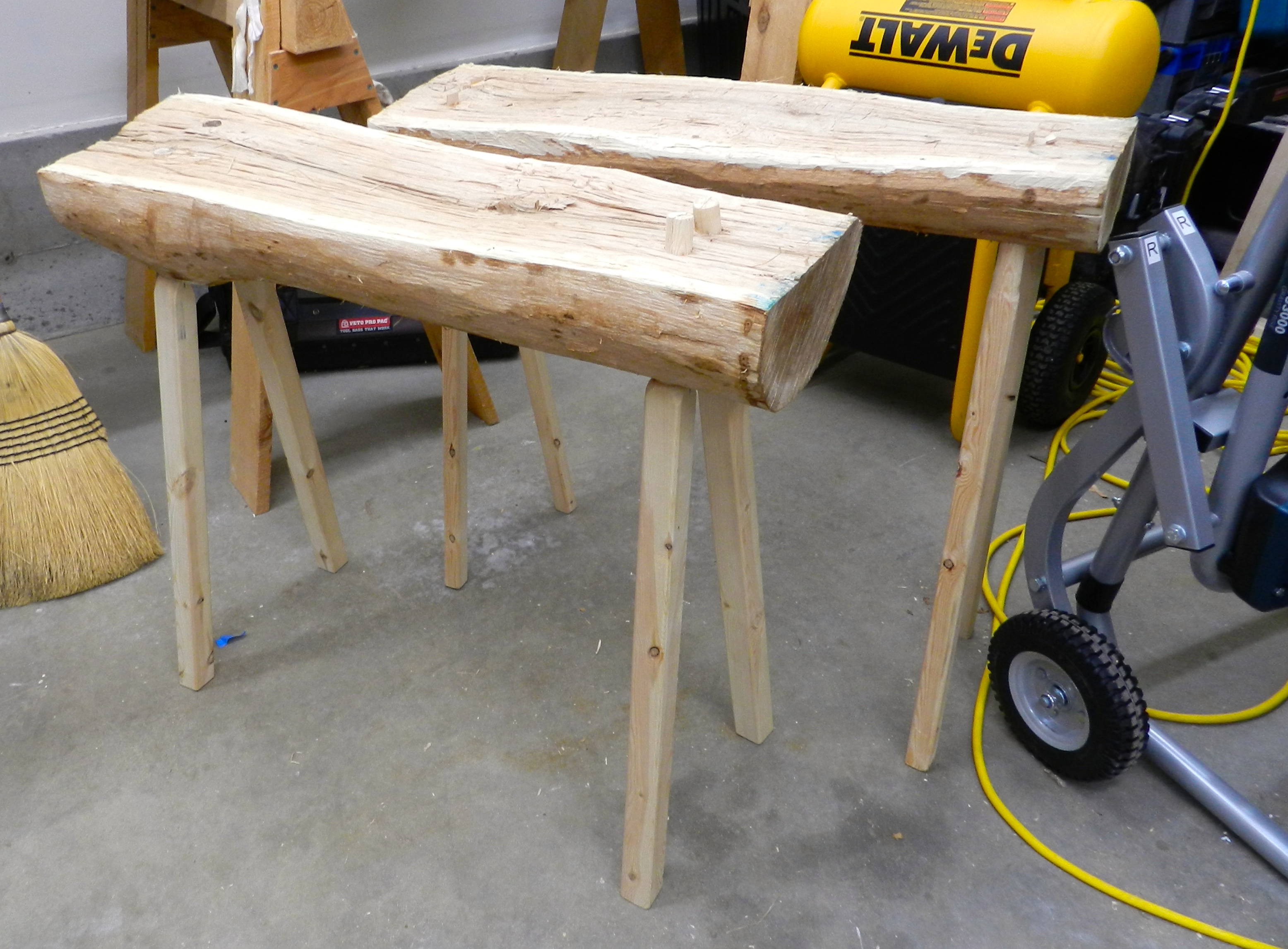
Original bench on the right, revised model on the left

The original bench was fairly solid — it could hold me standing on it and didn’t bounce around when I would strike it in a downward motion — but when I’d do something heavy and lateral I could feel what felt like a tiny bit of flex in the the legs.

Turning thicker legs

At the time I ripped down a 2×3 to make the legs roughly sized to the 1″ ship auger bit which was the largest I had on hand, but I worried about the 1-1/8″ legs being too spindly. The mental image of the legs being too spindly haunted me, so for this second time out I decided to rectify that issue.

Removing the bark from the half log

Improvements:

  • Thicker legs (1-1/2″ square) with a more pronounced shoulders (this way the legs don’t add to any unnecessary wedging/splitting pressure and no matter how much hammering takes place on top of the bench the legs are maxed out in how deep they will go into the top of the bench)
  • Legs splayed in both directions to be that much more stable
Leveling the legs
Leveling the legs

Beyond the modest improvements called out above, I otherwise built it the same way as the first hewing bench. (Wedged tenons, wax sealed end grain, leveled legs etc)

Completed benches. They can also work well as a pair of saw horses.

The Verdict:
The new bench is rock solid and will be a workhorse in the shop. The new legs are nice and stiff. Having a pair of these benches in the shop has already come in handy as you’ll see in the next post.

Take care,
-Bill

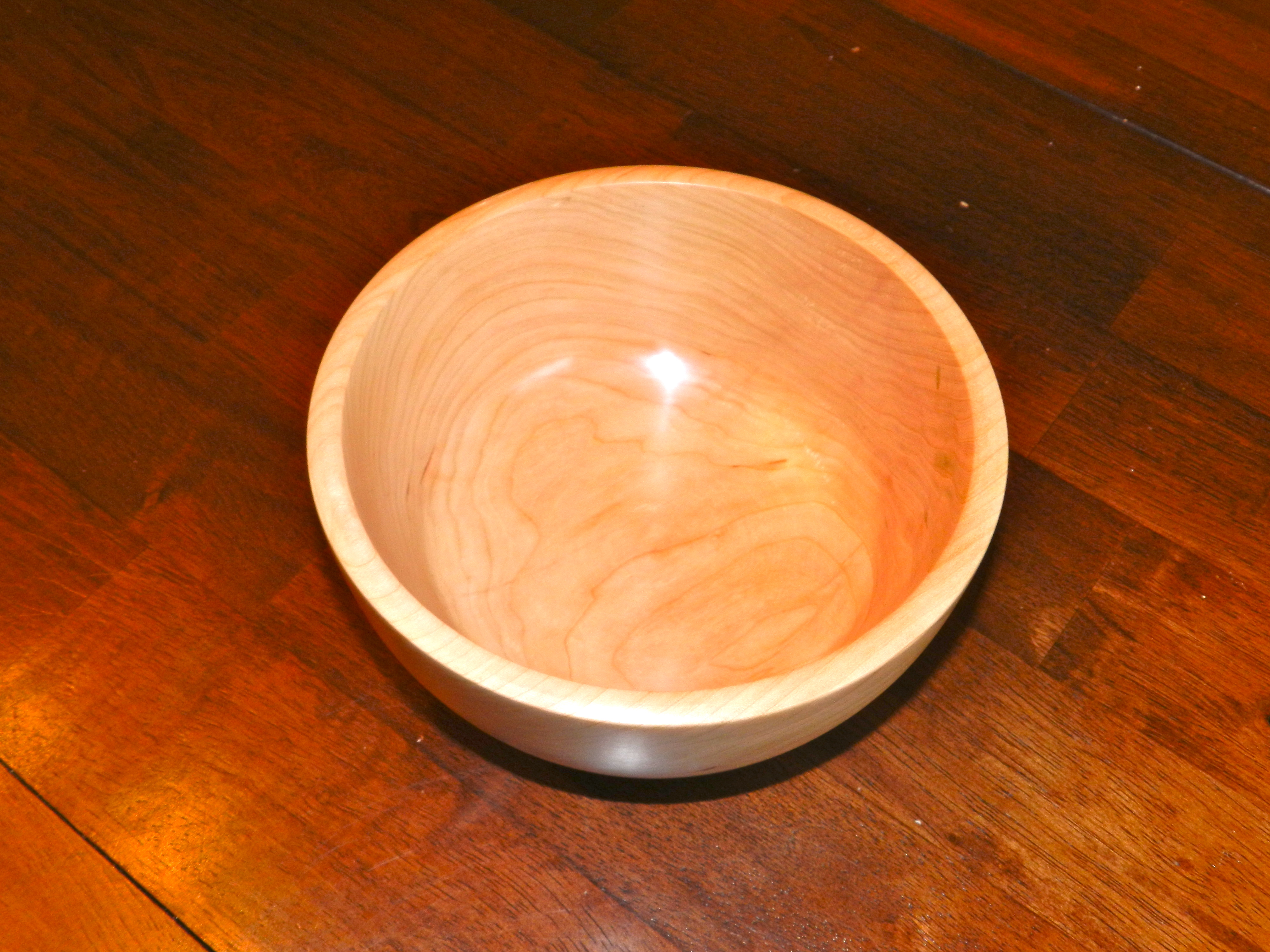
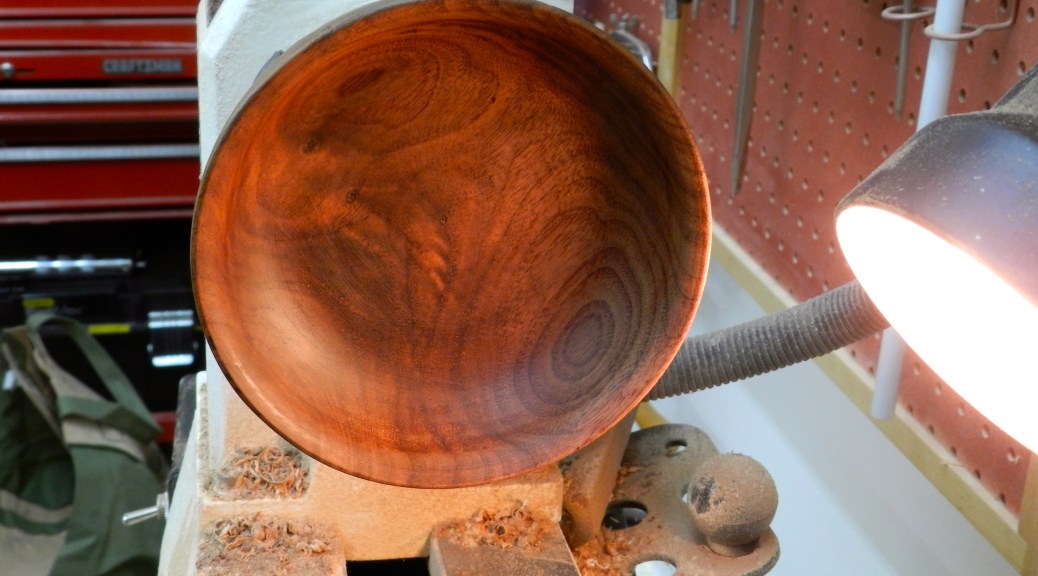
Turned Cherry Bowl

In woodworking we often spend an incredible amount of time and energy trying to make things rectilinear. Most trees I see do not have a lot of square edges on them to start yet many woodworkers have trouble thinking in the round.  Lately I’ve been doing some more green woodworking and wood turning and have been enjoying the explorations of different forms and techniques. When turning free form work I love how the wood speaks to me and tells me what shape it would like to be.

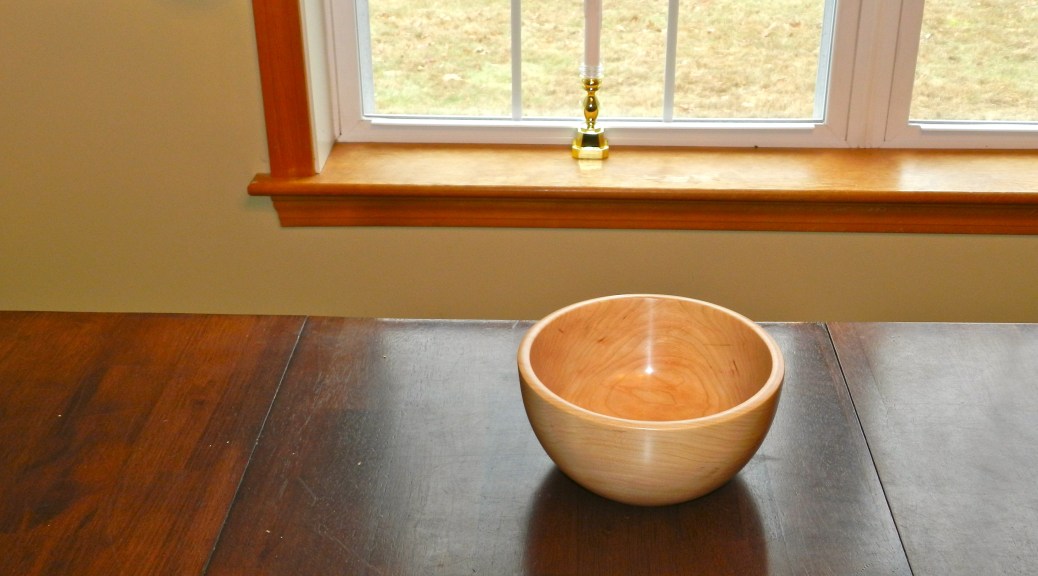
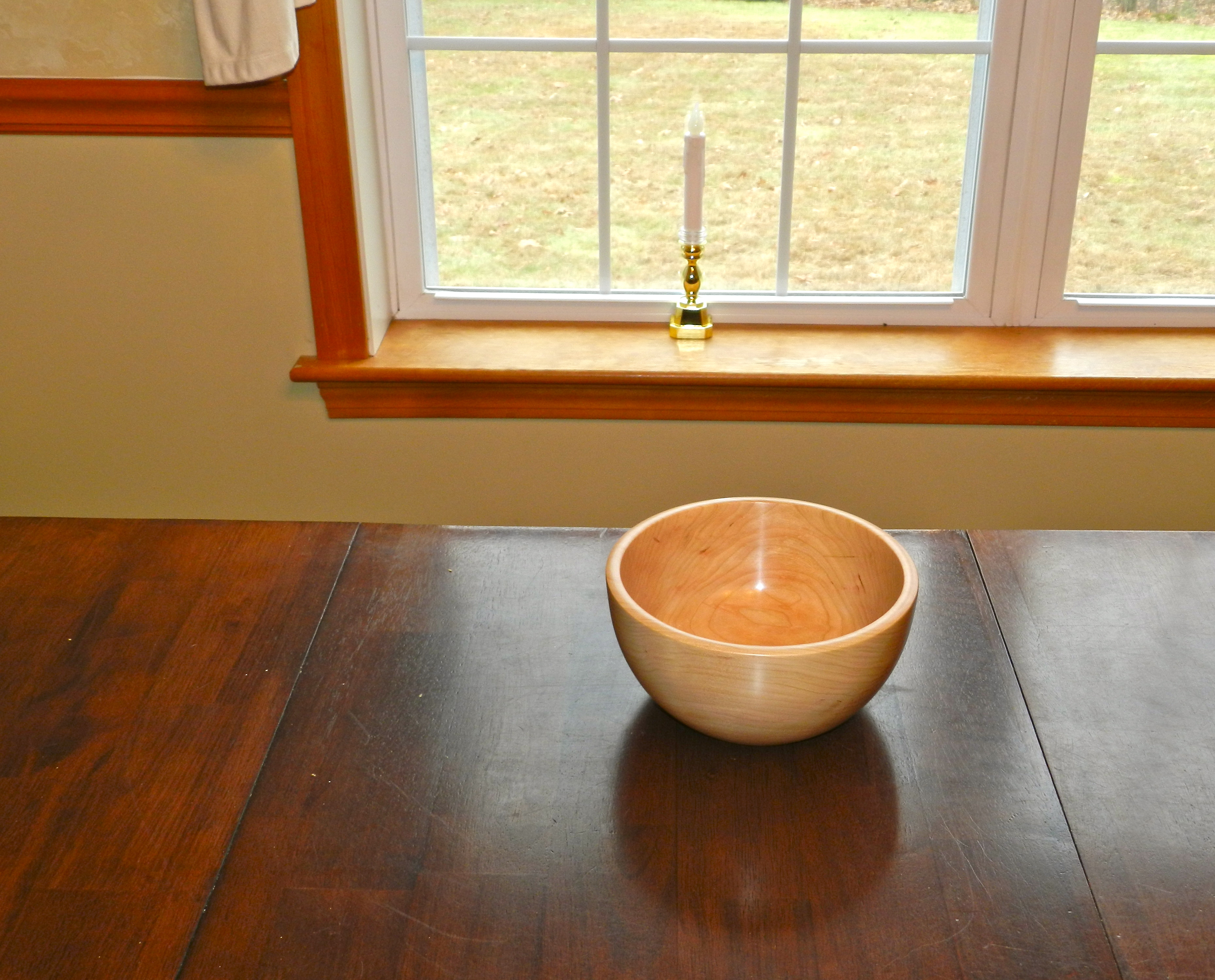
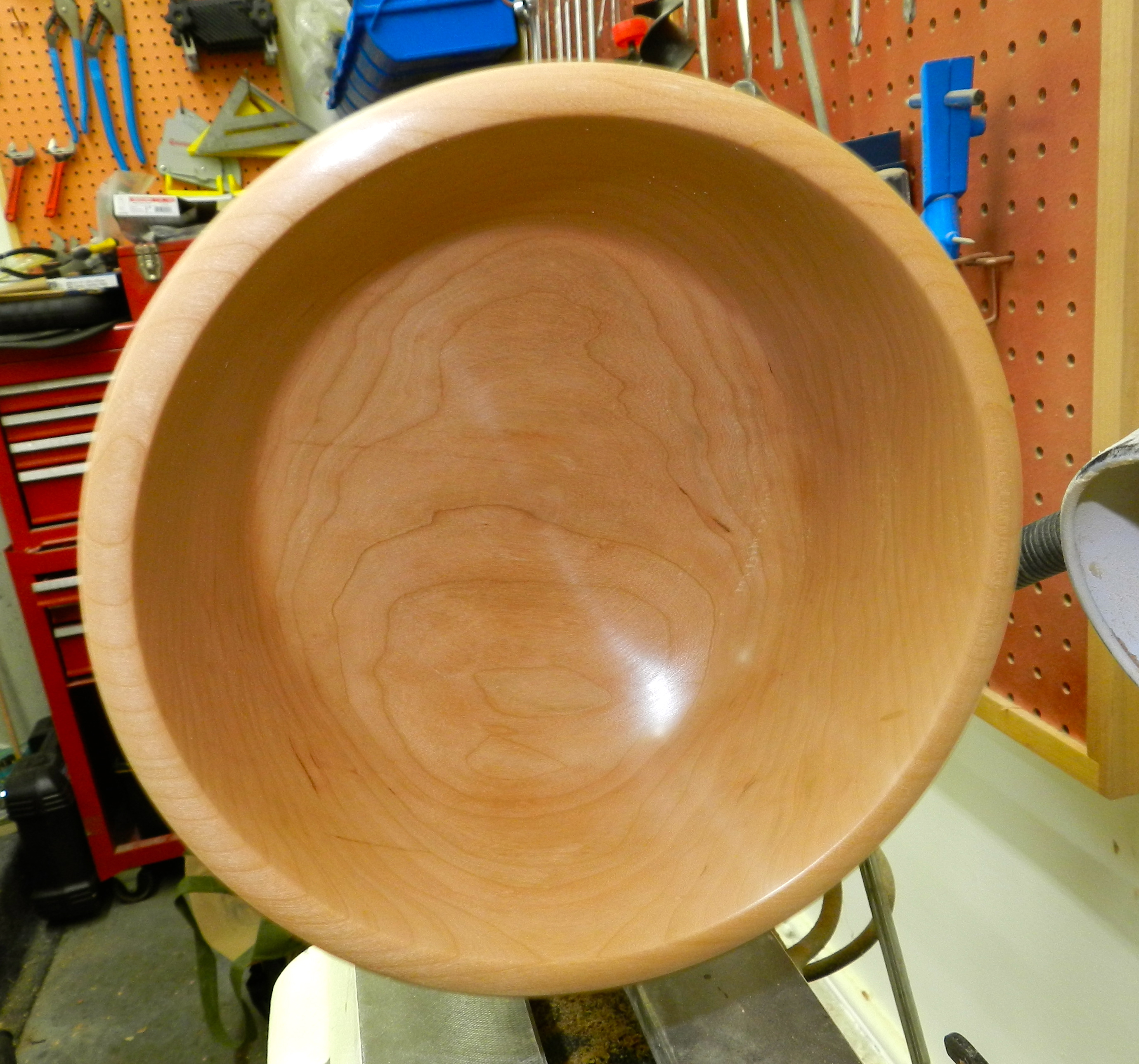
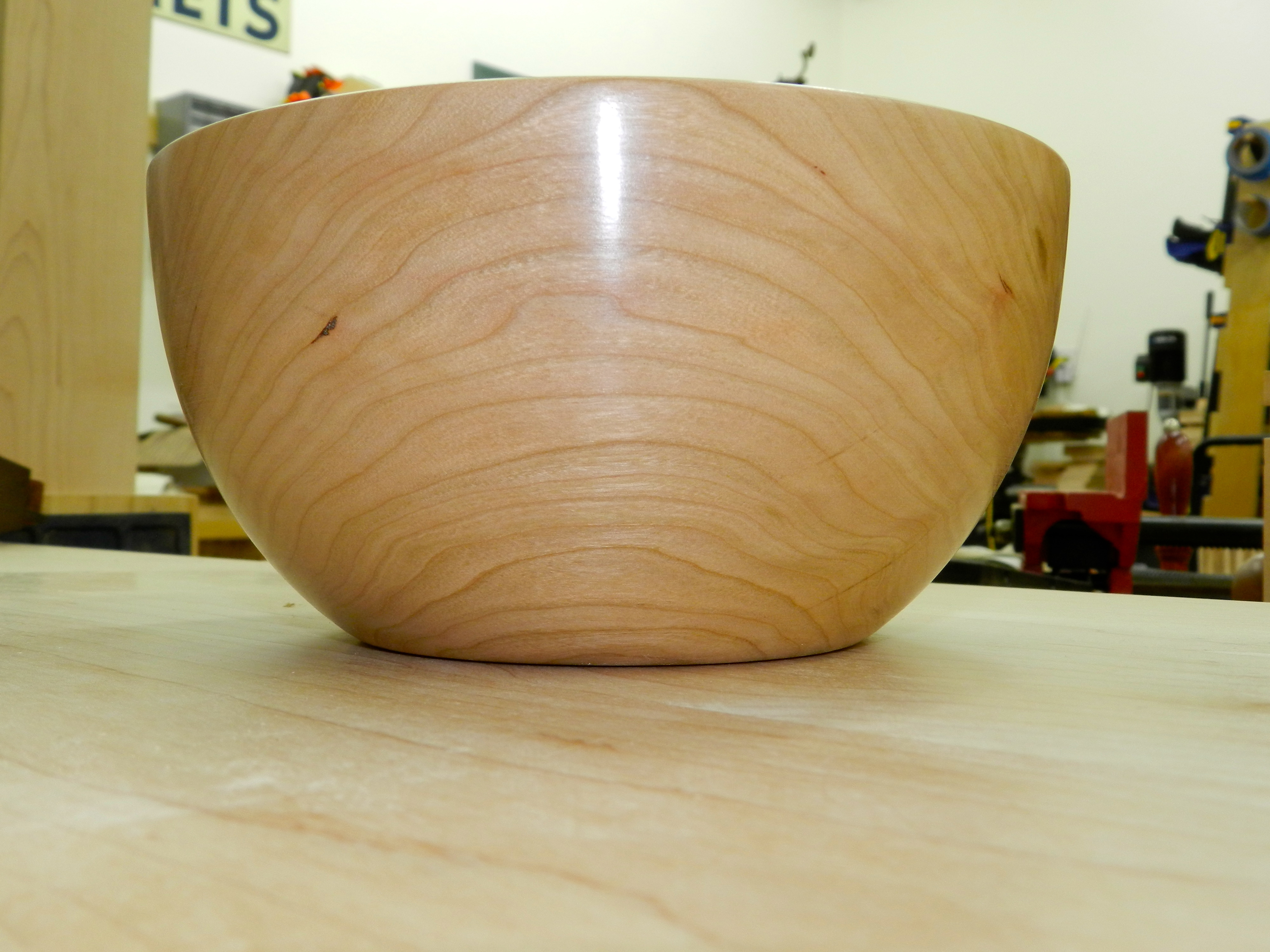
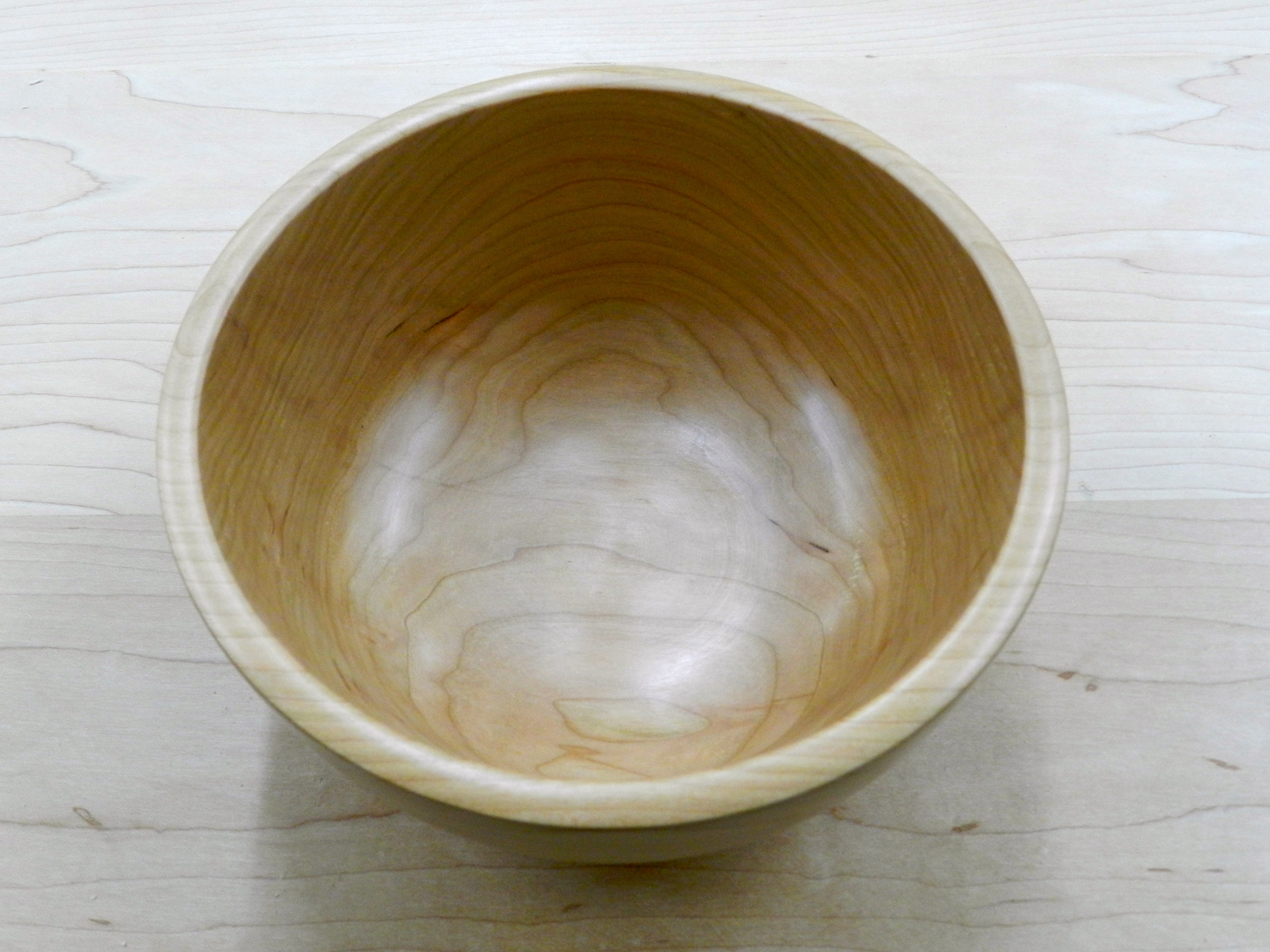
The cherry bowl below was a change from the very traditional colonial forms and delicate/thin shapes I spend a lot of time working with. I wanted to make a deep bowl with simple lines to let the grain and color speak for itself. I think mentally I was picturing something Asian inspired, though this piece could be at home on a very traditional table.

Completed bowl
Completed bowl

Recently I had a weekend out in the shop and turned this bowl as a thank-you gift for a good friend. Below is a quick chronicle of the process:

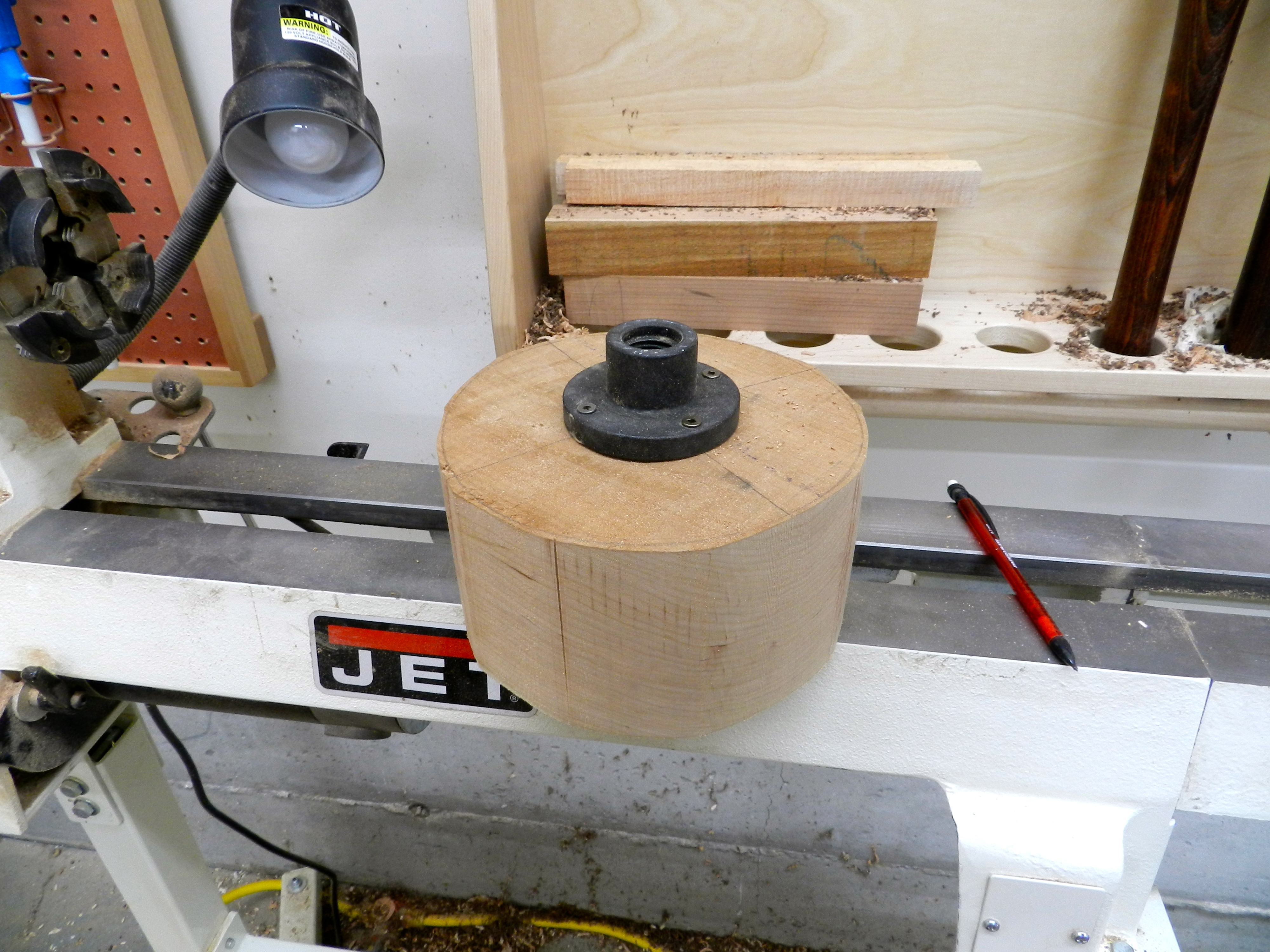
Bowl blank cut out on band saw and mounted to faceplate

I had a nice bit of 16/4 Cherry in my shop for a long waiting for it’s time to transform into a bowl. Using a compass I marked out the largest circle I could get out of the blank, cut it roughly round on the band saw and mounted it to a faceplate for the lathe.

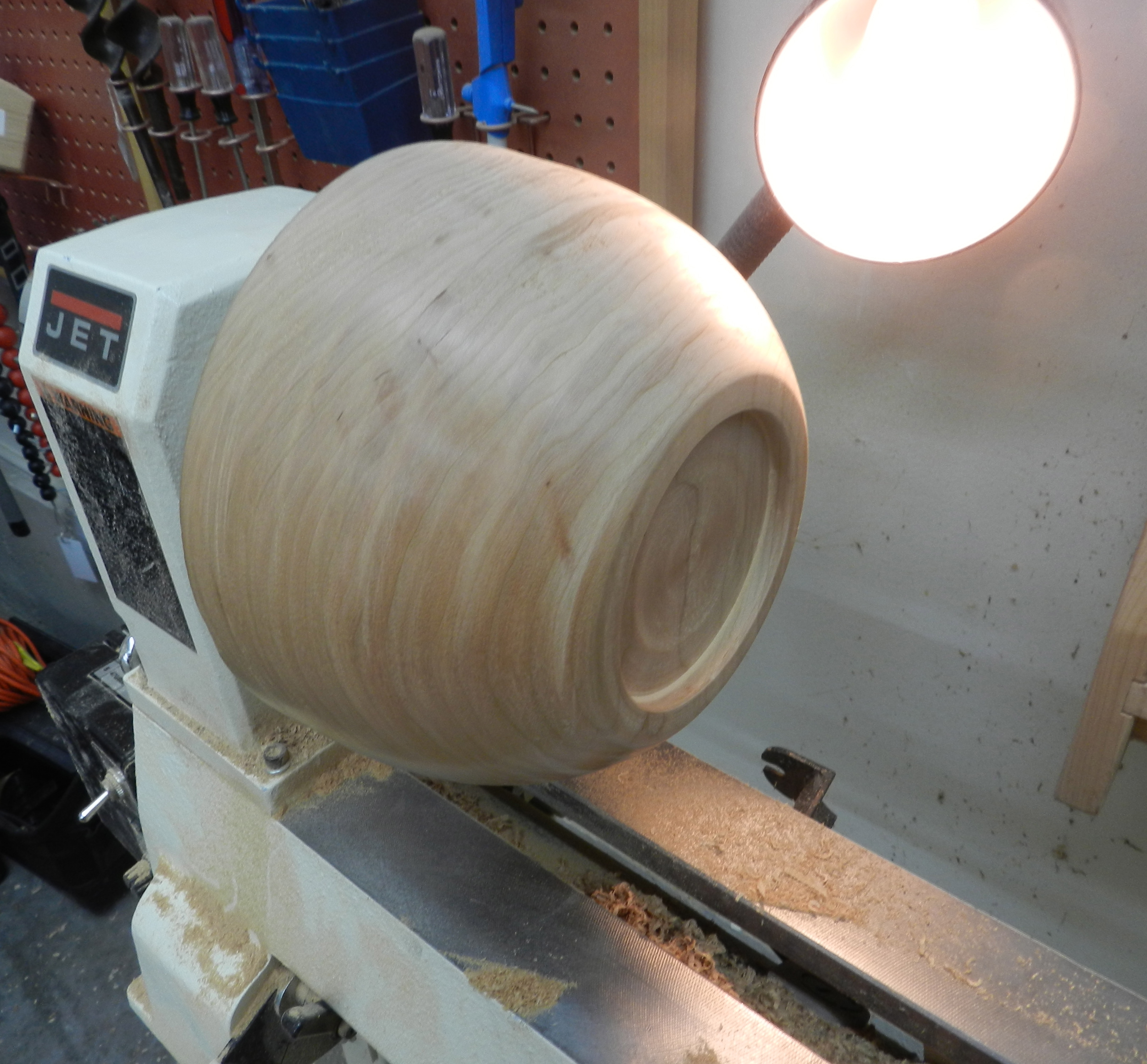
Turned outside of the bowl.

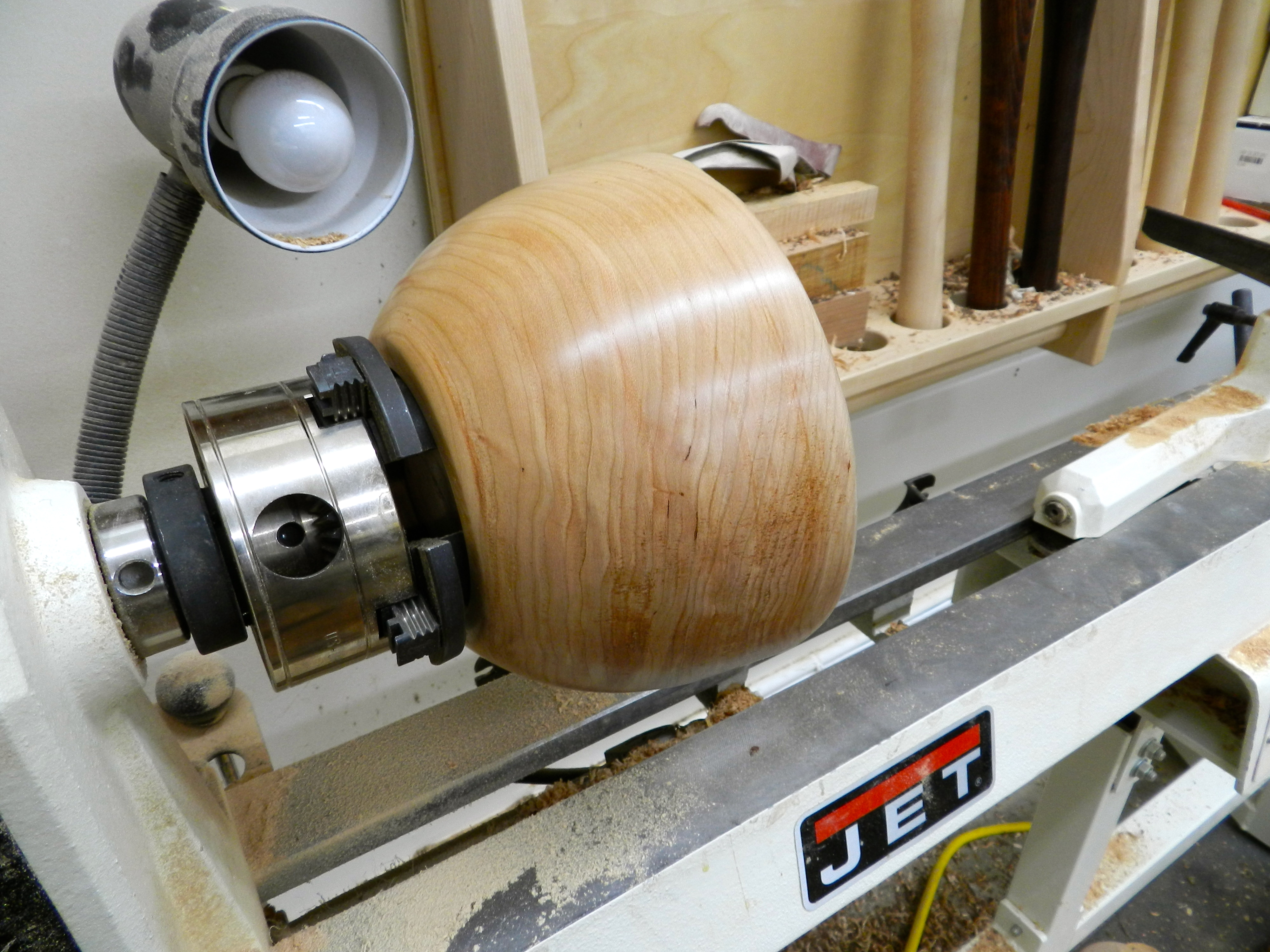
Once mounted on the headstock I turned the bowl round and formed the exterior shape of the bowl. For this bowl I wanted to try something different, so rather than turning a tenon which would decrease the external depth of bowl I could get from the blank I relieve the bottom of the bowl so that the bowl chuck could expand to hold the bowl rather than clamping down on a round tenon.

Bowl reversed and in the bowl chuck

Once I got the outside of the bowl shaped the way I wanted it, I reversed the bowl and mounted it in the bowl chuck. Next I  hollow out the bowl being careful to not go too deep and blow out the bottom or sides of the bowl.

Applying the finish while on the lathe

With the bowl still on the lathe I was able to apply finish to the bowl which helps speed up the process. As the bowl gets polished up, you can really see how the figure of the wood pops.

Close up detail
Close up detail

This bowl is finished with tung oil and wax.

Grain detail of the turned Cherry Bowl

Freshly turned the cherry looks pretty light on top of my maple bench, but with time and exposure to daylight it will darken up nicely and take on the warmer color you expect from cherry.

Bottom Detail
Bottom Detail

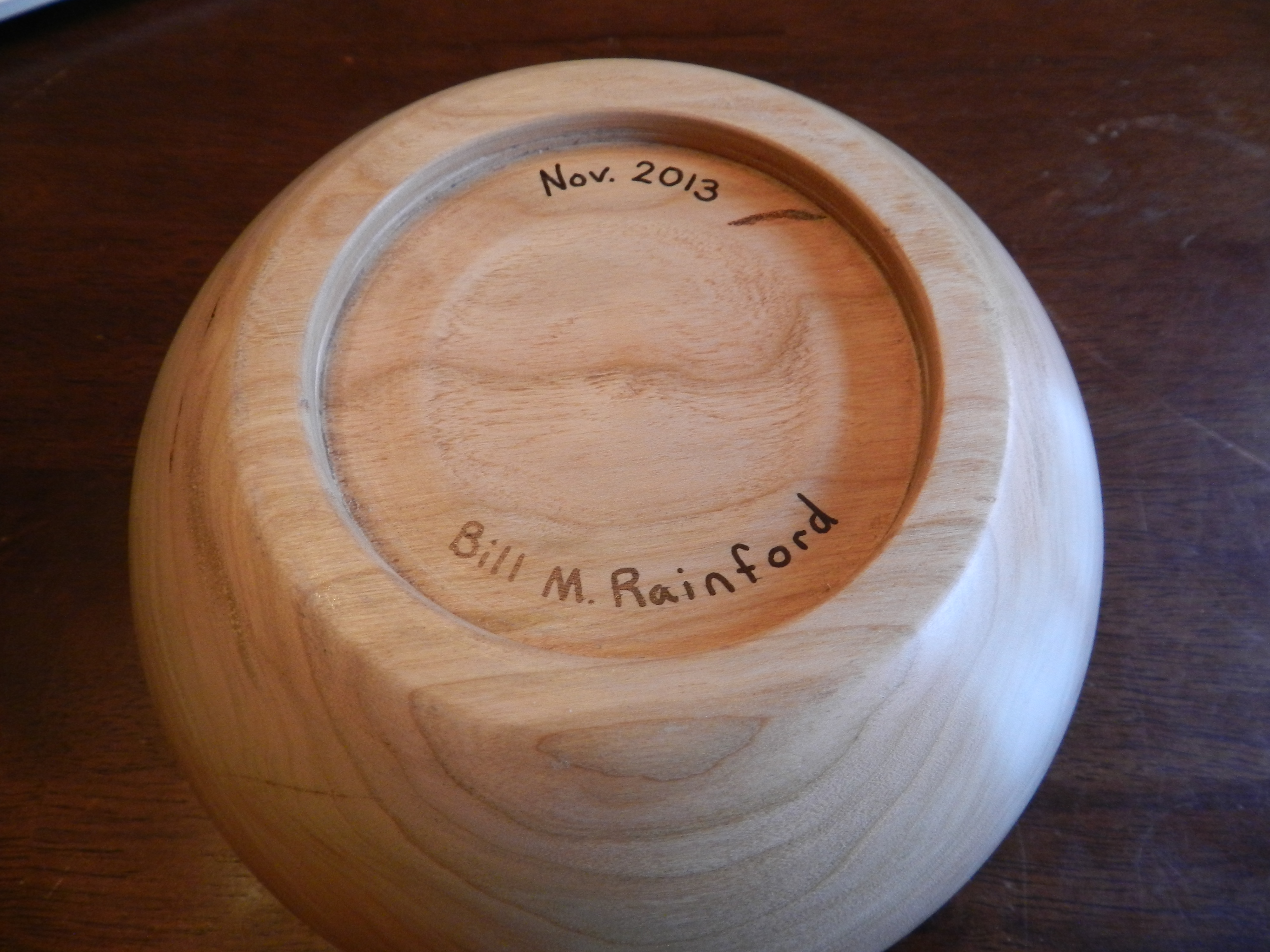
I learned to turn from Alan Lacer and Rich Friberg and one thing they both taught me was to add little details to surprise or delight folks who took the time to inspect what you made. On the bottom of this bowl I varied the surface under the bowl to give more visual and tactile interest.

Turned Cherry Bowl
Turned Cherry Bowl

I  am happy with the results and hope this sturdy little bowl has a good life.

Take care,
-Bill

The Humble Hewing Bench

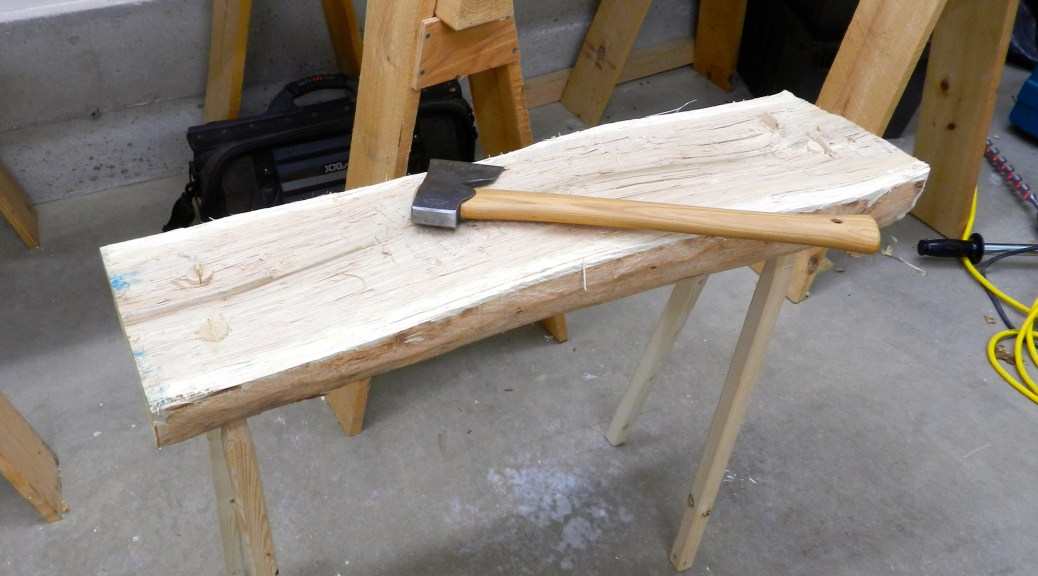
If you’ve watched Roy Underhill on the Woodwright’s Shop with any regularity then no doubt you’ve seen him using a hewing bench. It’s a great little bench made from half a log on 4 modest legs.  Roy’s used it for hewing, trimming, holding, sitting and many other common shop uses. It’s a project you can complete in an afternoon and will serve you well for many years in the shop.

Why would anyone really want this rough little bench?

If you do any sort of green woodworking it’s nice to have a place you can quickly hew a blank in the shop with a hatchet or similar small ax. When the ax hits the long grain of the bench it will not dig in the way it would if you were using the end grain of a stump or similar log section. (It also protects the reference surfaces of your real workbench) For tapering the end of treenails, splitting wood or roughing a green turning blank  it has been a priceless addition to the workshop.  It also makes a nice place to sit when people visit the shop. 😉

How do I make one of these benches?

Like any good Roy anecdote it starts with “First you find a tree….”

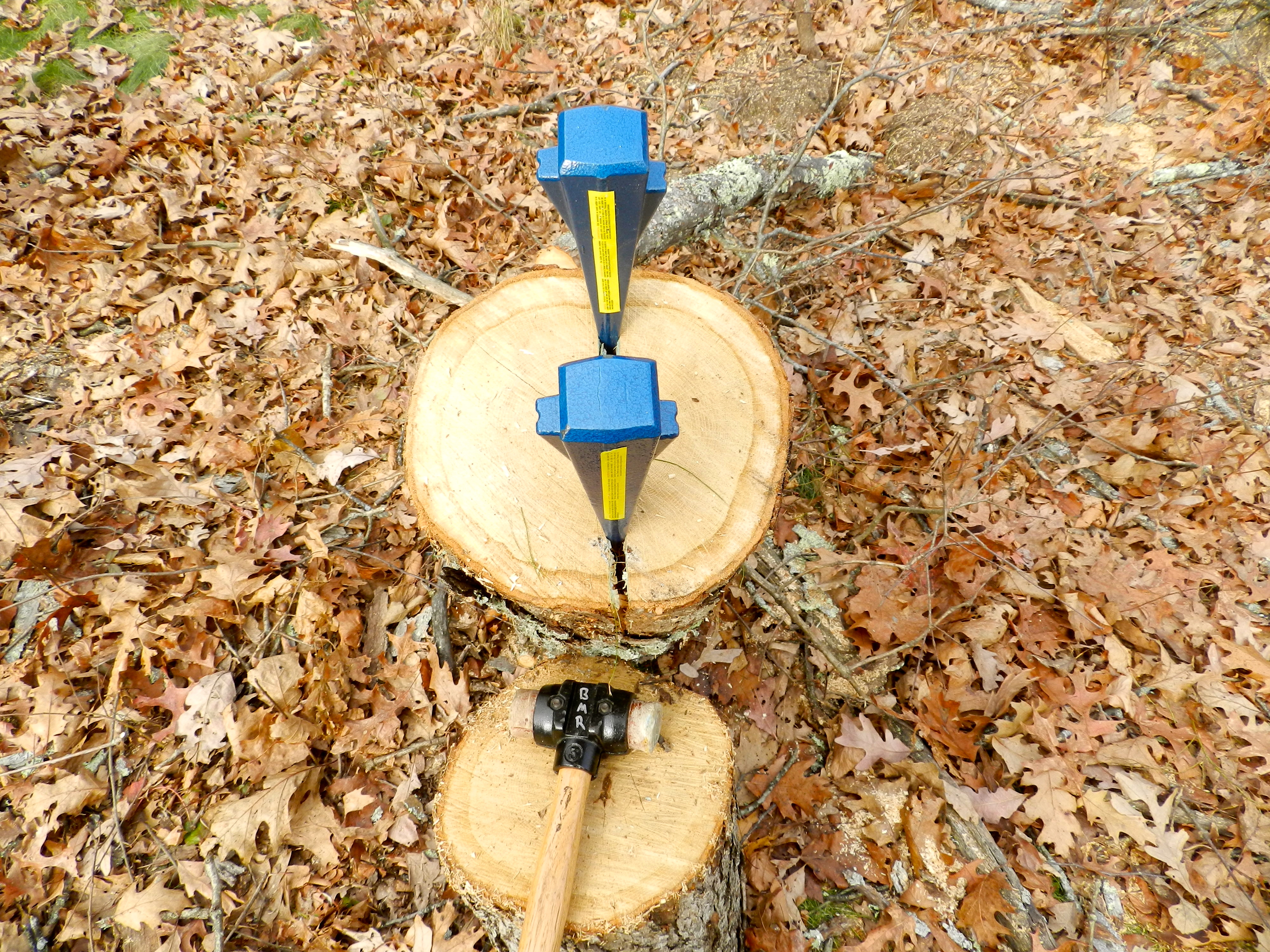
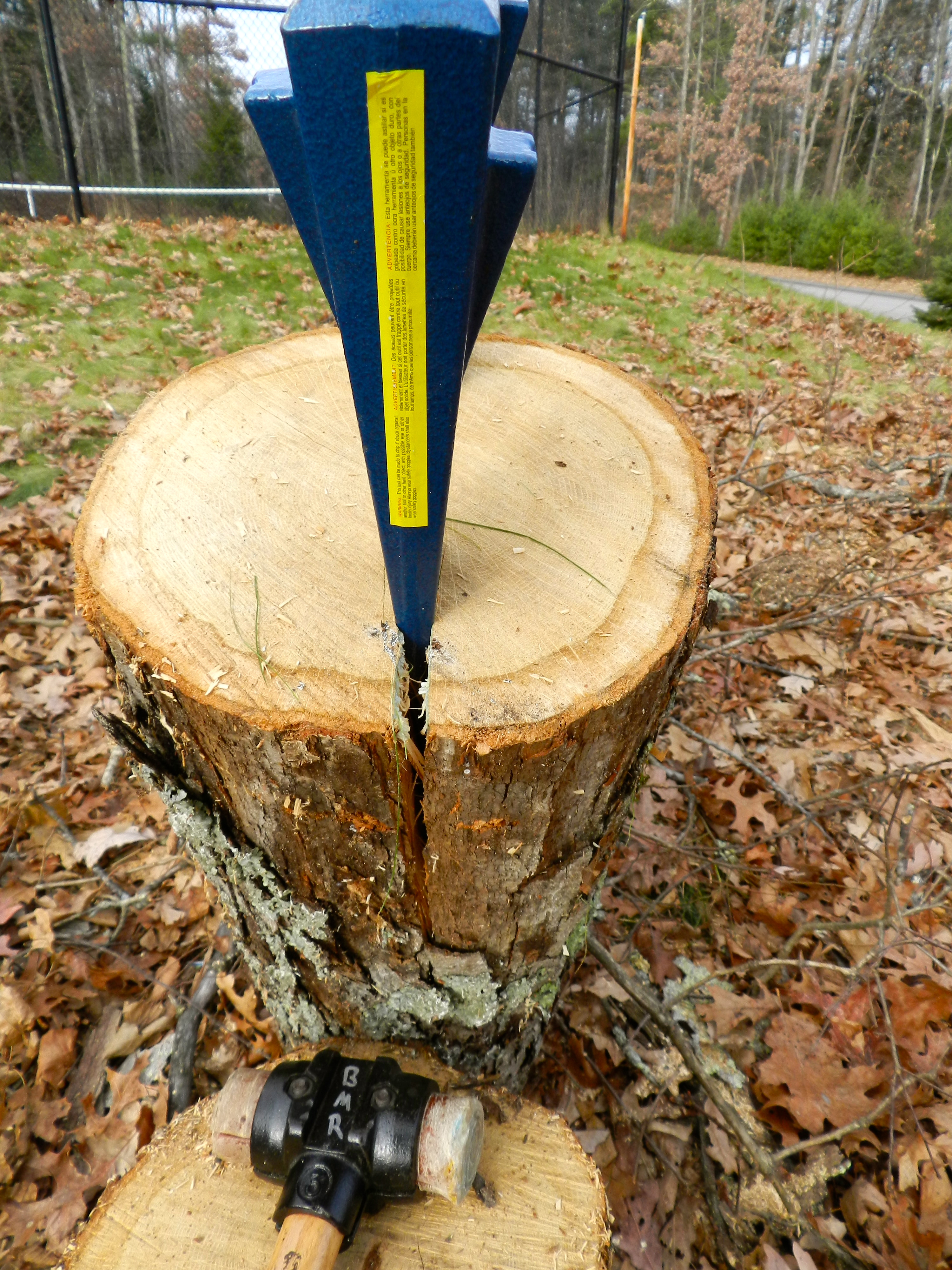
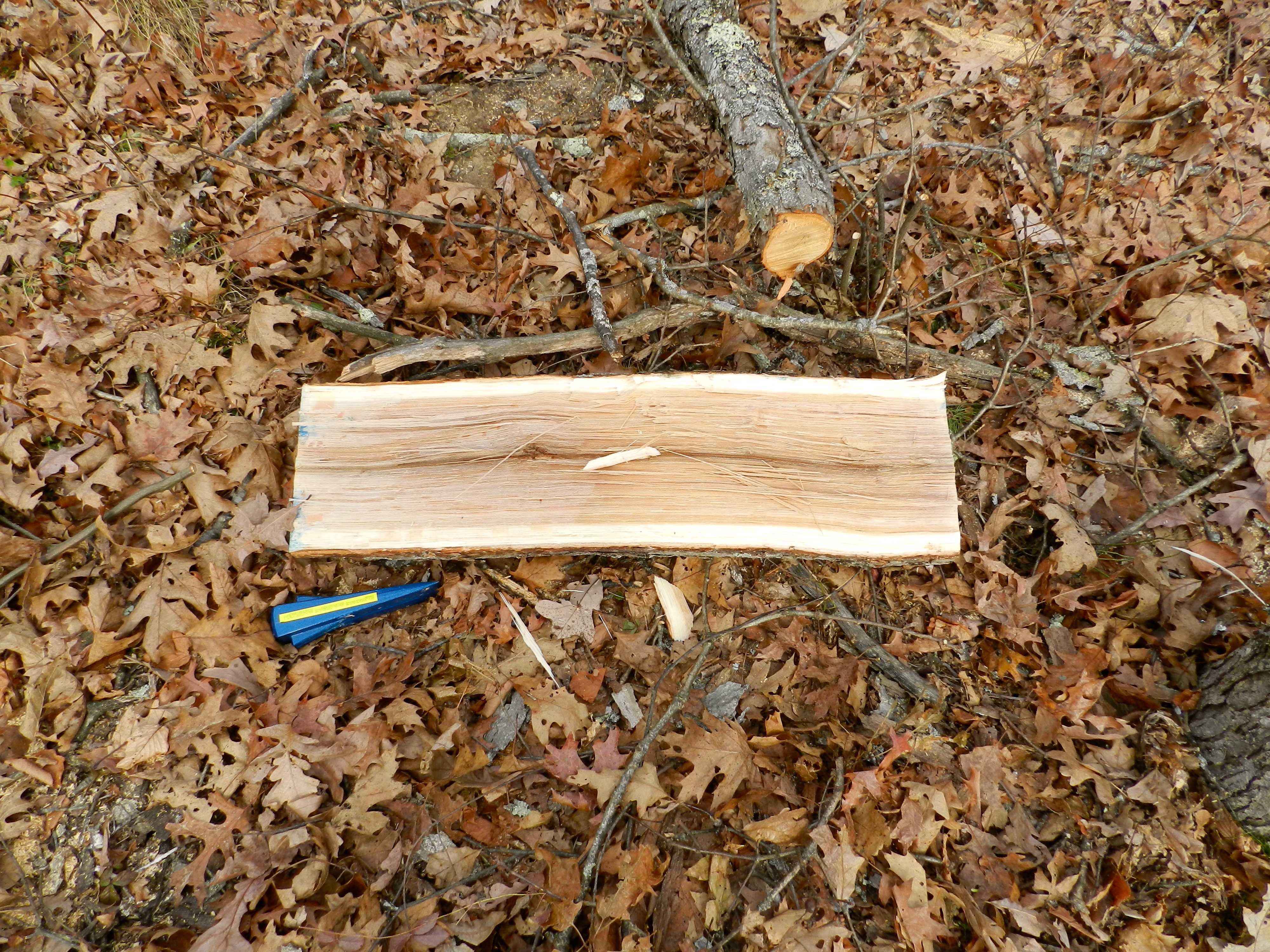
Splitting the oak log with metal wedges and a heavy leather faced mallet

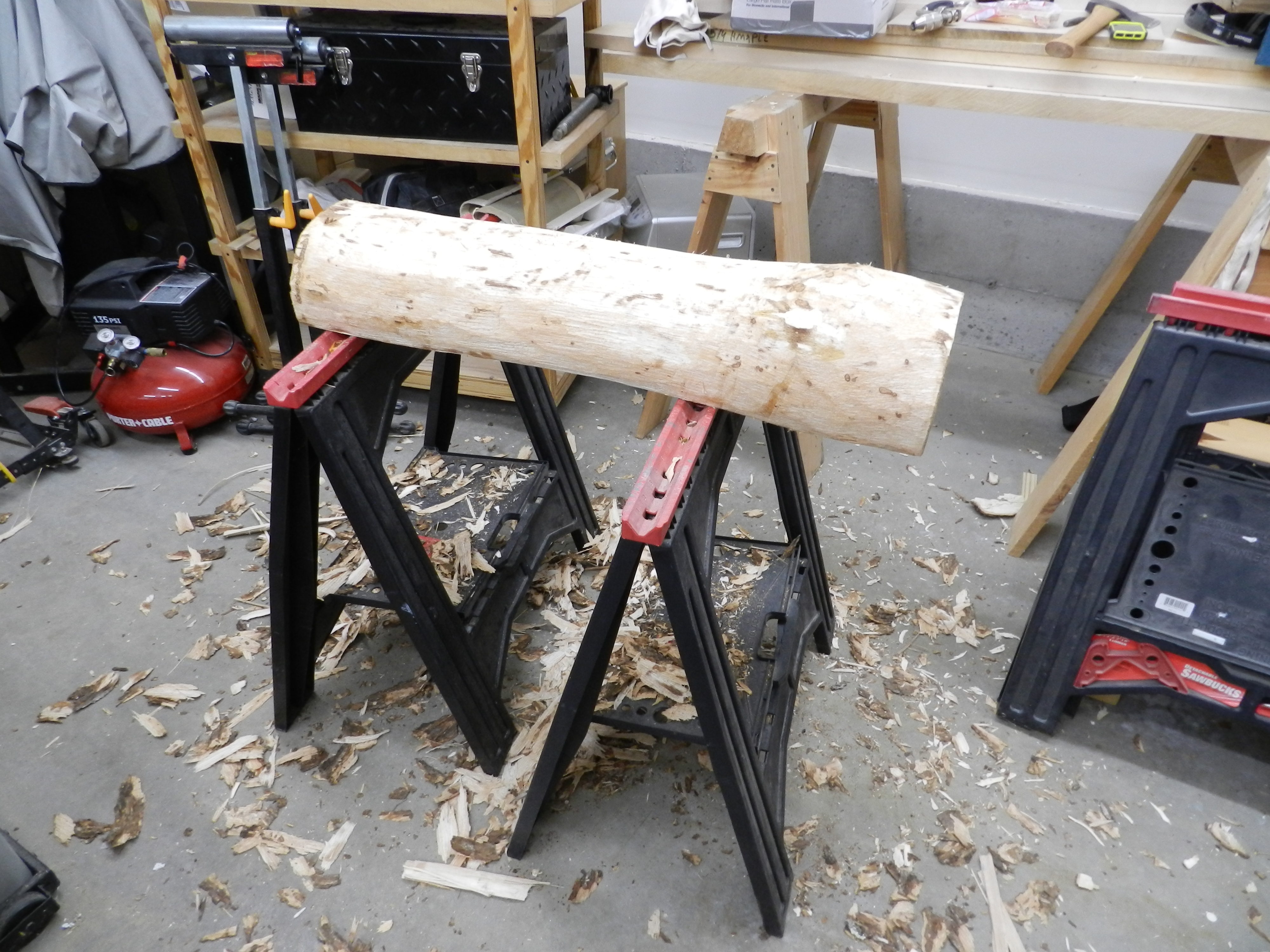
In this case I took a 12-15″ wide and 30″ long section of white oak from a large tree I recently felled in my yard. This tree was over 130 years old so the growth rings are nice and tight. Using metal wedges and a large leather faced mallet I use for my timber framing I split the log in half.

Watch to make sure the split runs the way you want down the log

If the wedges alone cannot do the whole job of splitting for you, a froe can help it along.

Log split in half. You can clearly see the heartwood and the sapwood

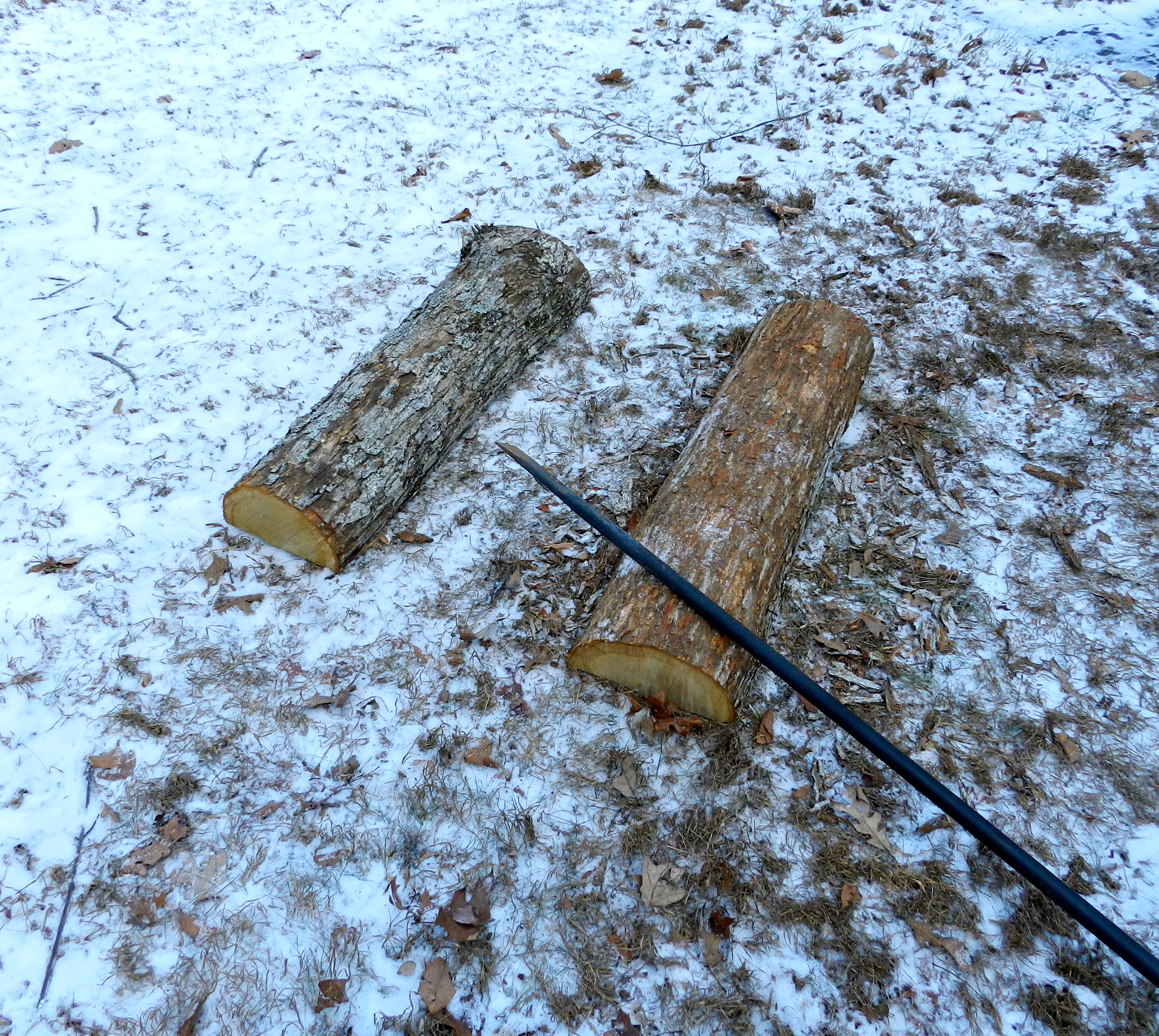
After letting the slabs sit for a few days, it was time to de-bark the logs. If you don’t have a dedicated de-barking spud you can use any tough metal roughly chisel shaped tool or ax. In this case I used a 16lb post hold digger as shown below.

De-barking the log on the right. A metal post hole digging bar makes a good impromptu barking spud.

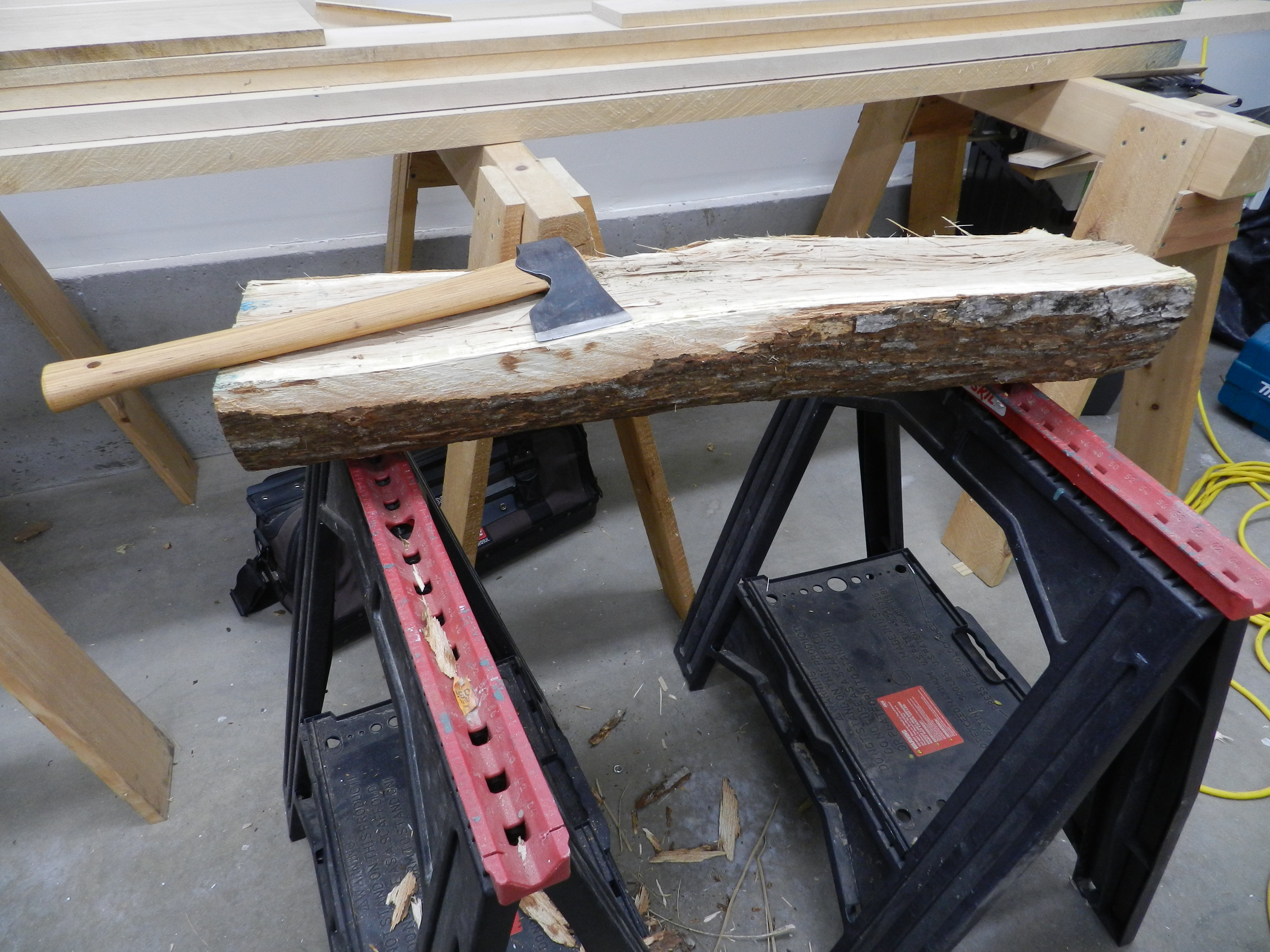
Back again in the shop I squared up the edges of the log with a hatchet. Being a green piece of wood this razor sharp ax made quick work of it.

Square up the edges with a hatchet

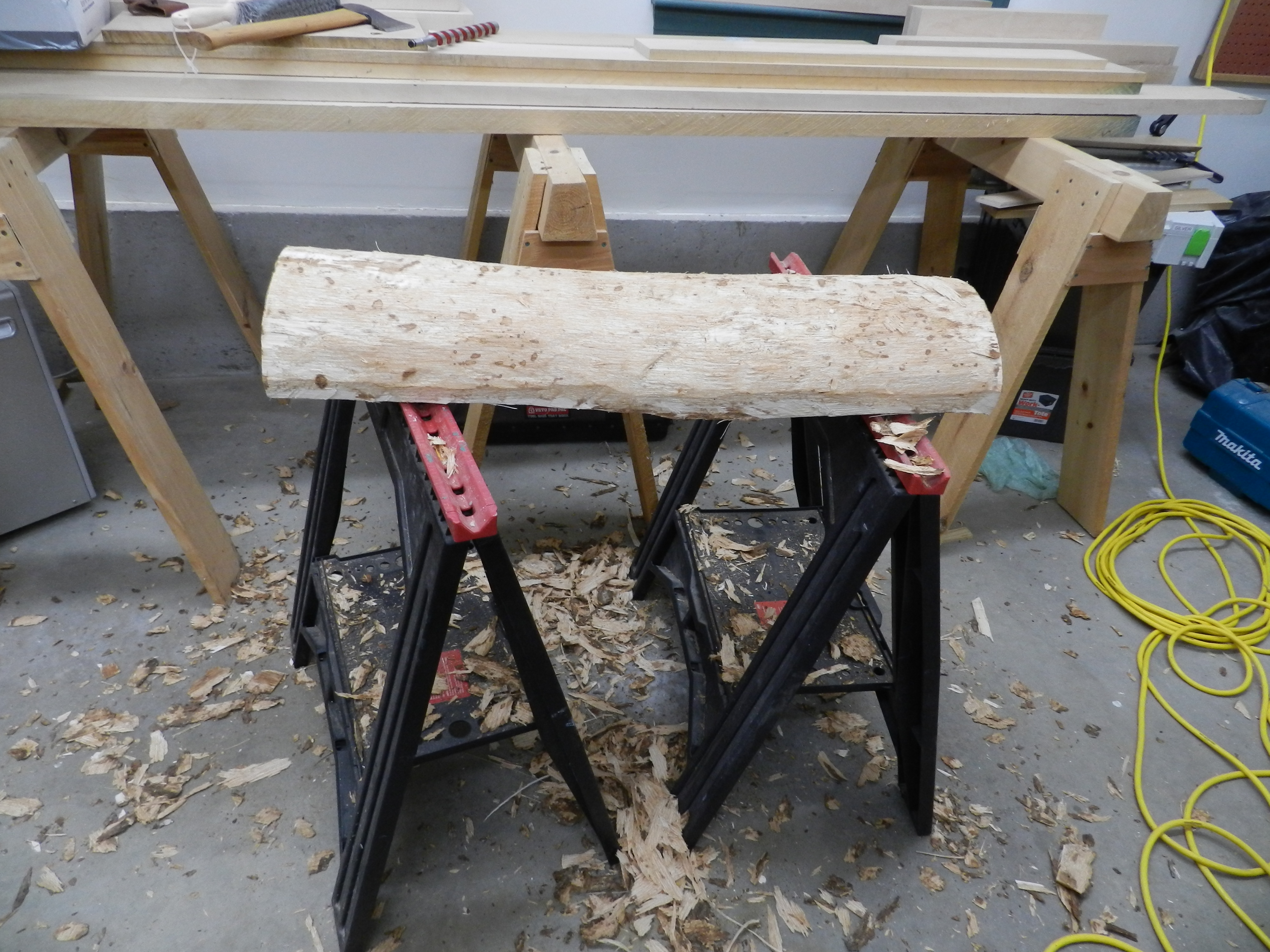
I flipped the log over and removed any remaining bark.

Remove any remaining bark with the hatchet

Now time for the legs…

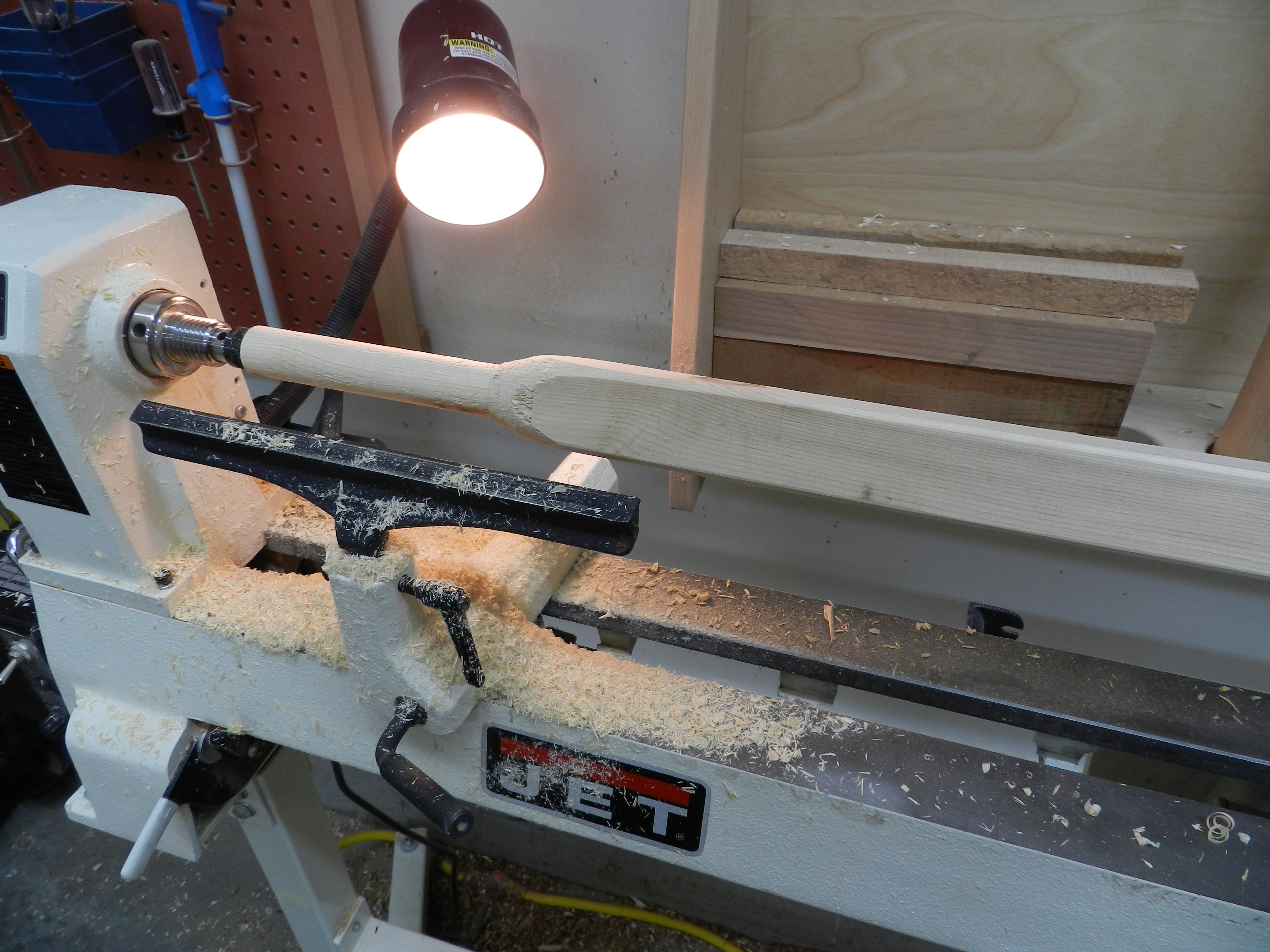
Ideally you want to split out some 1.5 inch diameter legs. In my case it was snowing and I didn’t have suitable wood on hand to do that, plus the largest ship auger bit I had on hand was 1″. I ripped down some nice straight grained 2x3s I had on hand to 1 1/4″ by 30″ long. I put them on the lathe and turned down the top 6″ to 1″ diameter. I then used a block plane to chamfer the edges.

Split or rip some leg stock. Drill holes with an auger and set your legs

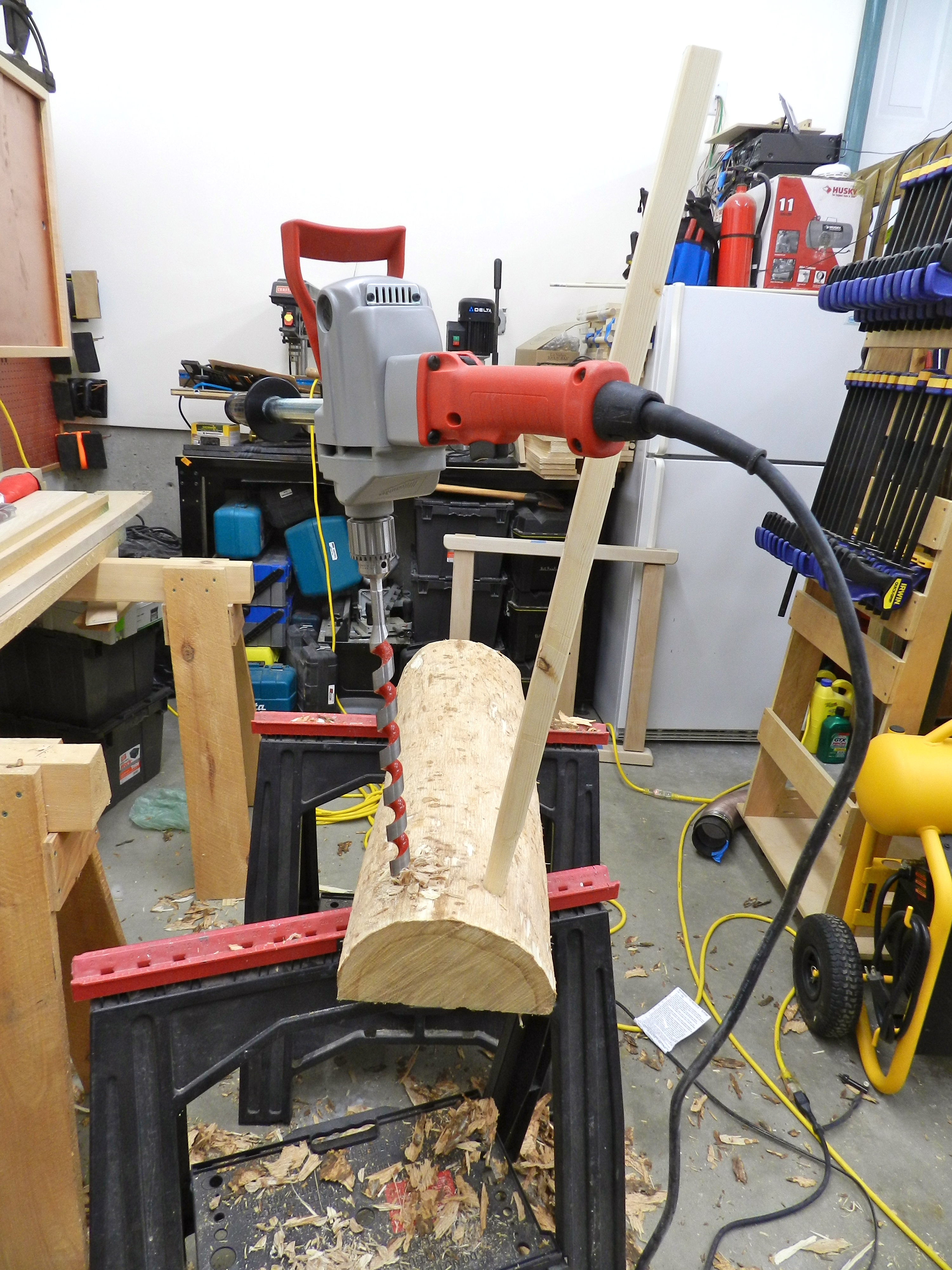
Using a ship auger bit I bored a through hole into the log to allow the legs to splay a bit in both directions. After you set the first leg you’ll want to visually reference that first leg when drilling the next leg. Repeat this process for all 4 legs. After test fitting you’ll want to cut a kerf in the end of each tenon and re-install the legs. Make sure those kerfs are perpendicular to the grain of the log so you don’t split it with the wedges. Then glue and wedge the tenons. If you have ever built a windsor chair, this is a cruder version of the same process you’d use to fit the legs and level the feet.

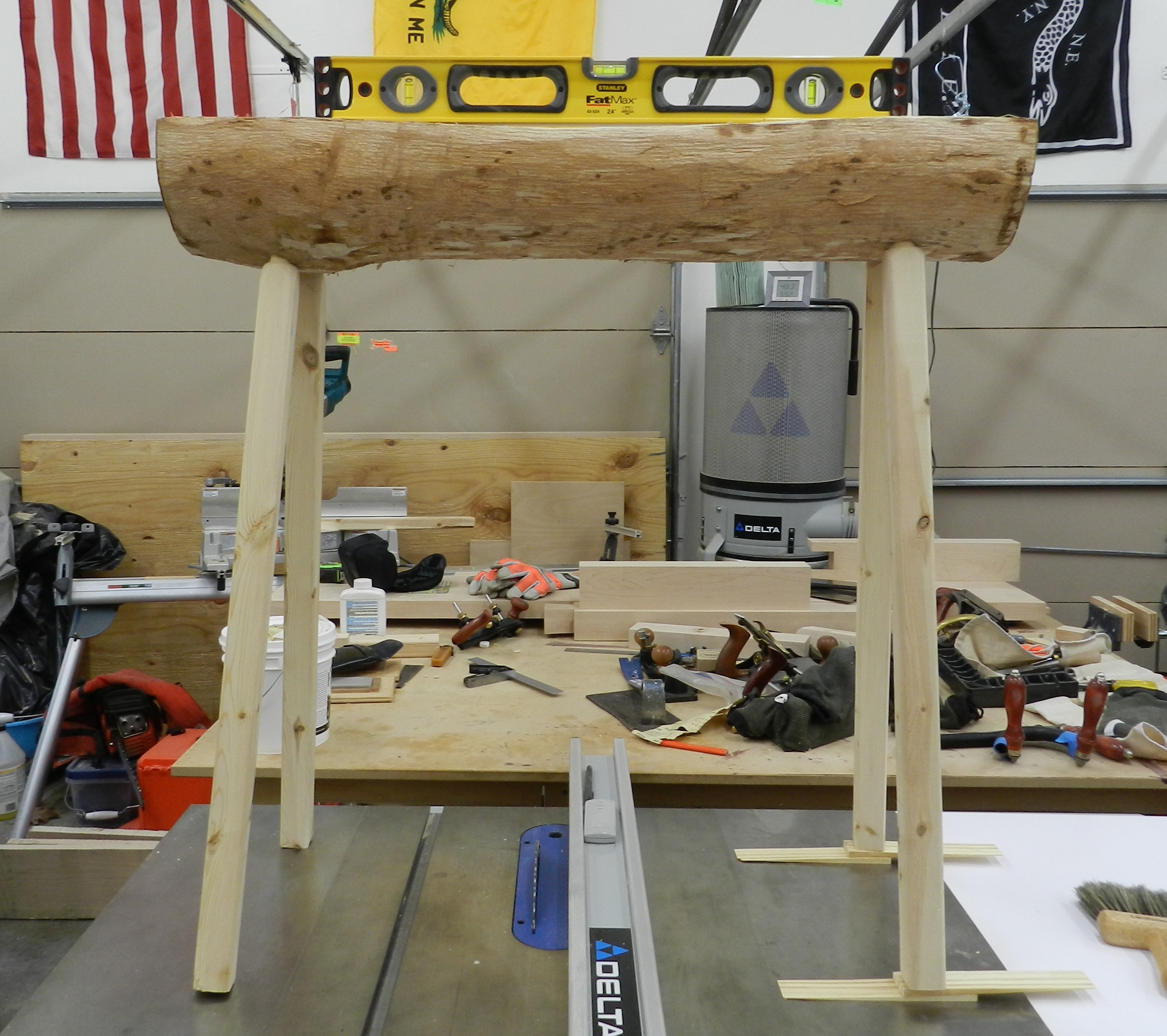
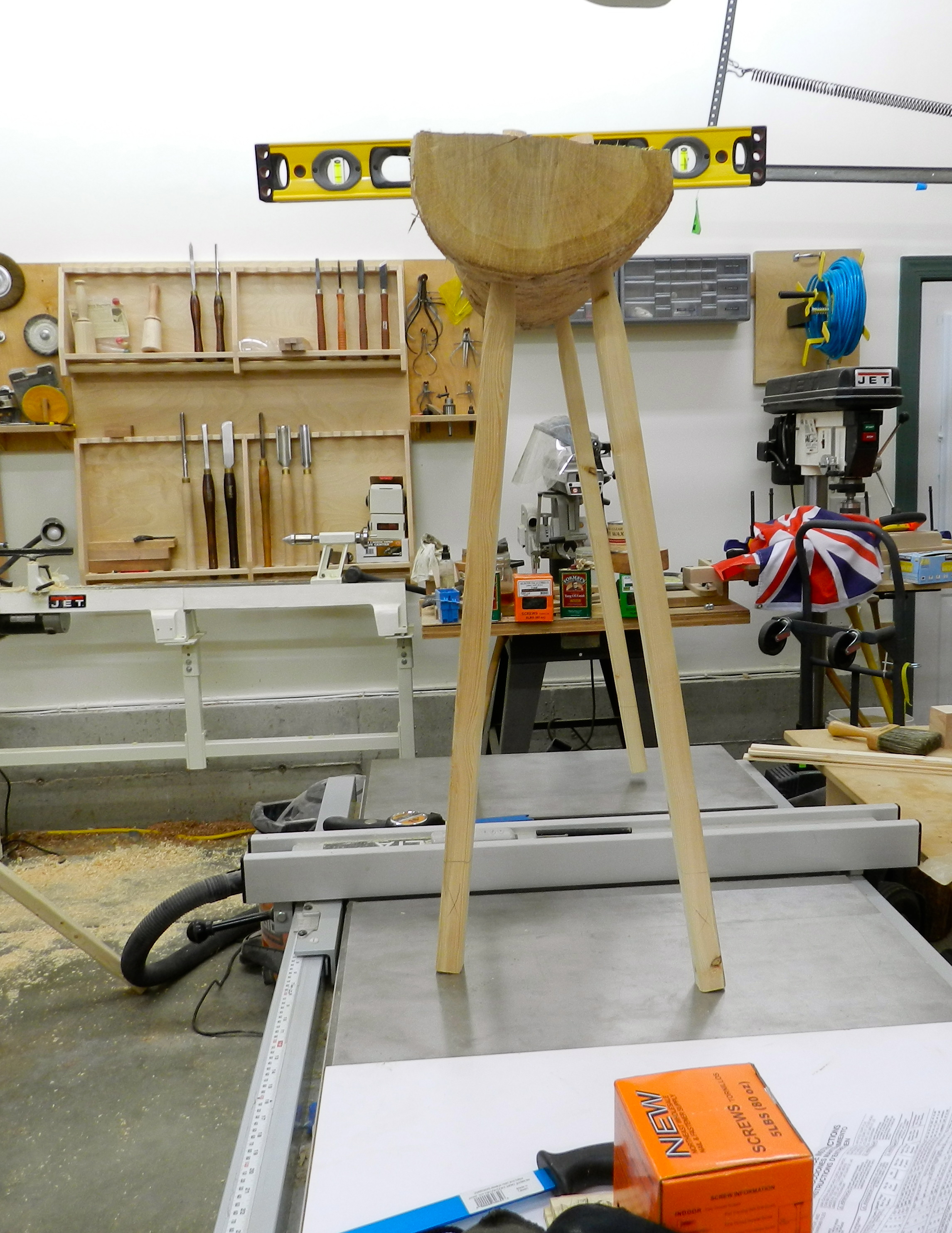
Test fit on a level surface like a table saw

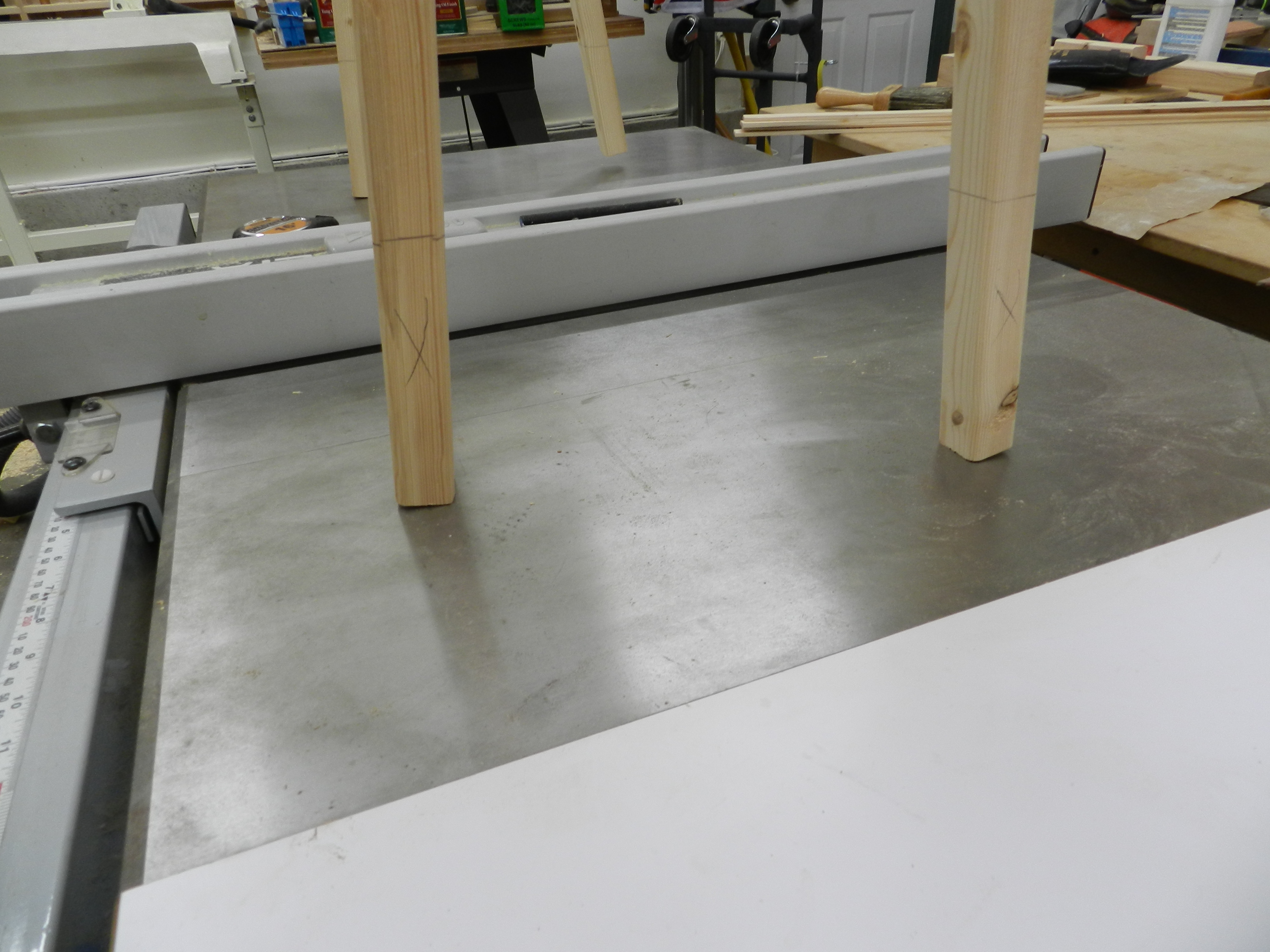
With the legs installed I put the bench on a known level surface, in this case my table saw. Using a compass or similar tool mark higher up on the legs and cut them where you marked them. Then chamfer the ends of the feet and you’re almost done.

Mark what you want to remove to reduce the height and level the feet

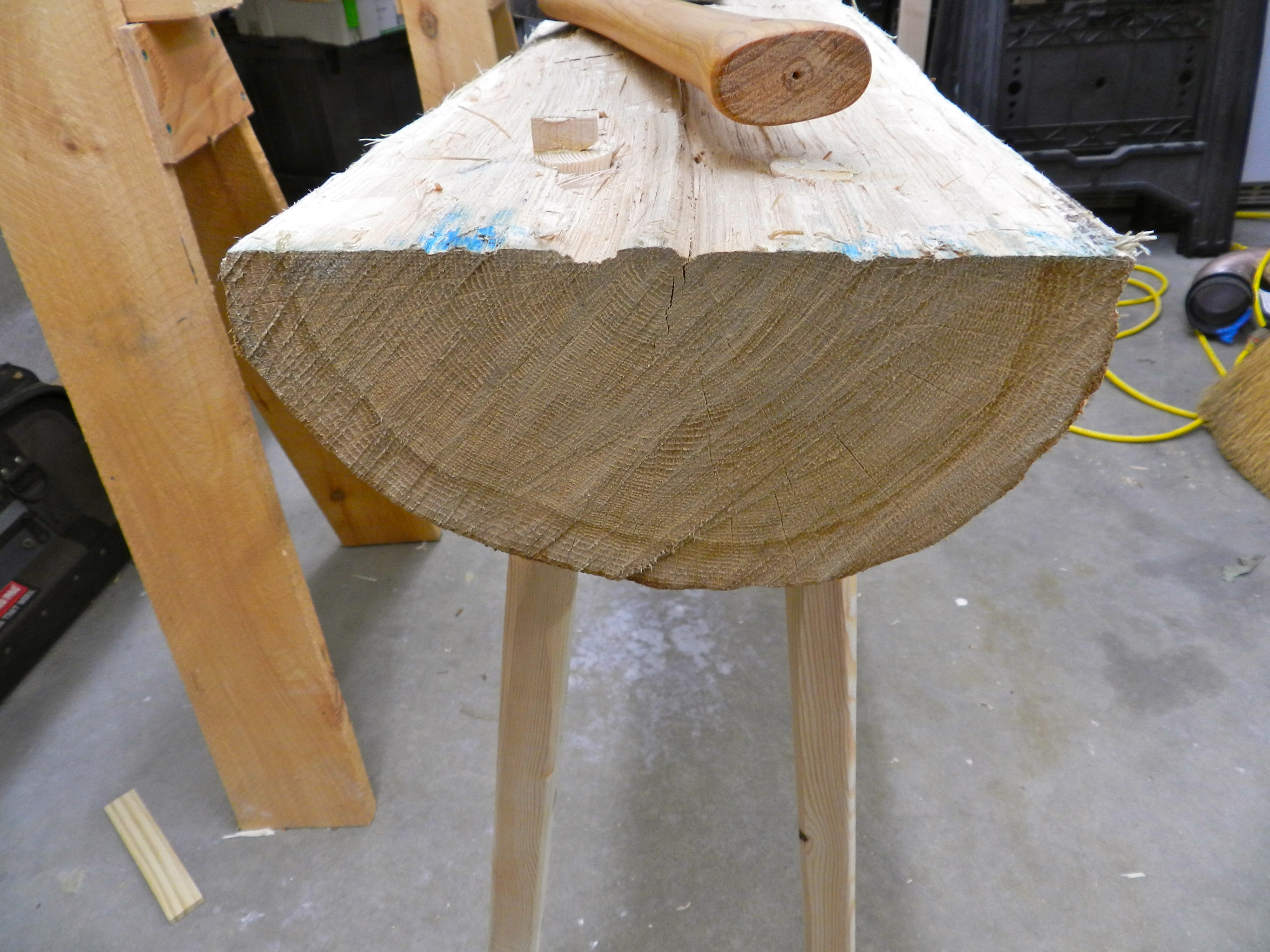
Next I applied some end grain sealer (from Land Ark/Heritage Finishes) to reduce the likelihood of splitting in my heated shop. I also trimmed off the wedges and tenons.

Seal the end grain to reduce checking

Now the bench is read for use in the shop. This bench, with it’s delicate looking legs, can hold me standing on it, so it should have no problem handling my in shop hewing needs.

Trim the leg stumps and the wedges

Shown here is a Gransfors Bruks hand made Swedish ax. This carpenter’s hatchet is my goto ax for small trimming work and is sharpened to the point of being able to shave with it. The poll (the other business end) of this ax is hardened and can be used like a hammer. The handle is carefully tapered to fit in the hand and without looking you know when your hand is at the end of the handle. The notch under the bit allows you to use this ax much like a large chisel or plane and can yield impressive results. I used this to quickly level bits of the bench surface.

Enjoy your new hewing bench

For short cash, a few tools and an afternoon in the shop this project is well worth the effort.

Take care,
-Bill

Working in the round…

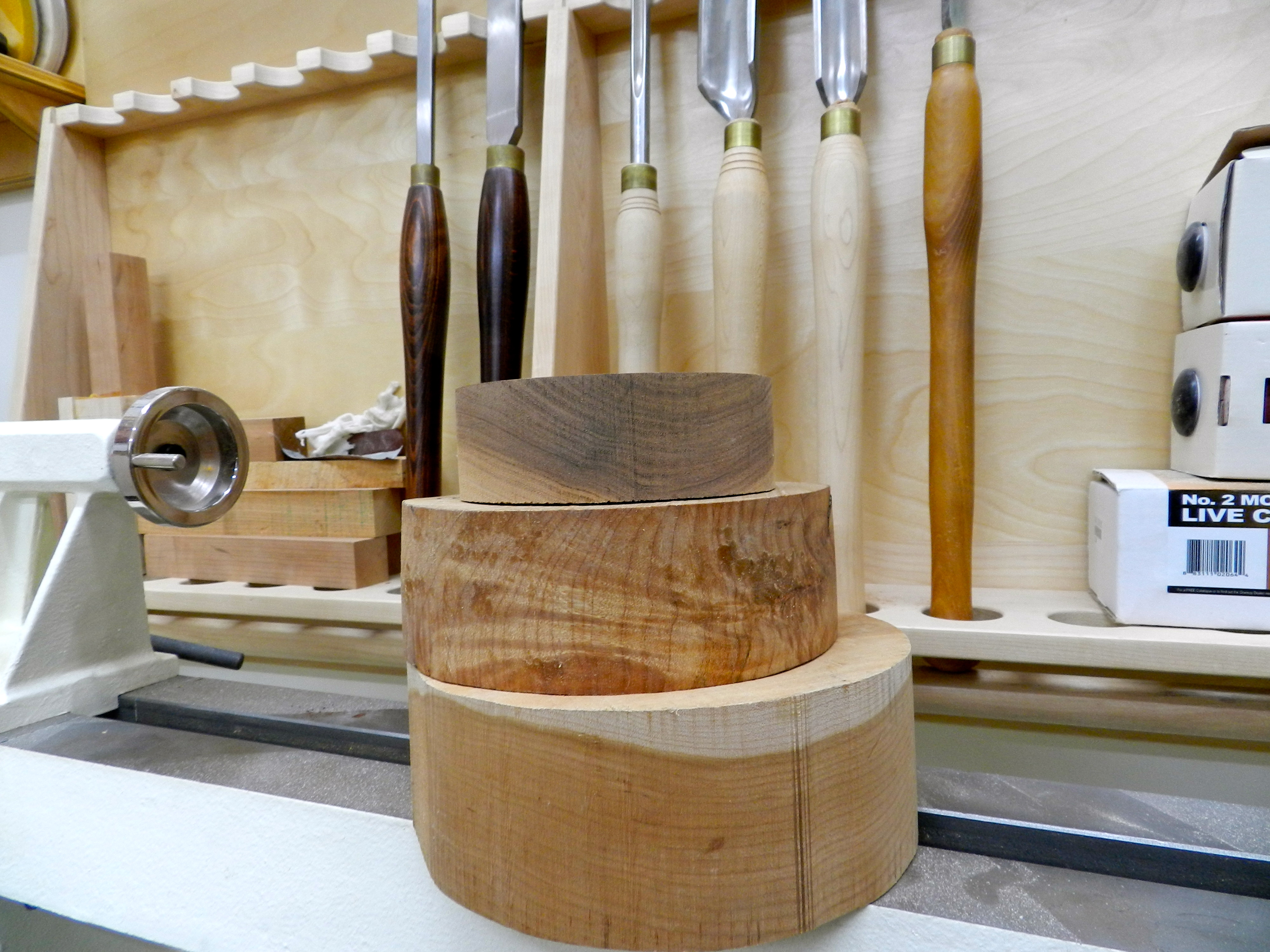
Bowl blanks waiting to be turned

Yesterday I had a rare day off and some time to work in my shop. With the holidays and cold weather fast approaching I am trying to get through my mile long TODO list. One of the items on my list was to make good use of some turning blanks I had on hand. (Last weekend I cleaned up the basement and organized my wood rack so now things are nice and neat)

Mallet blank
Mallet blank

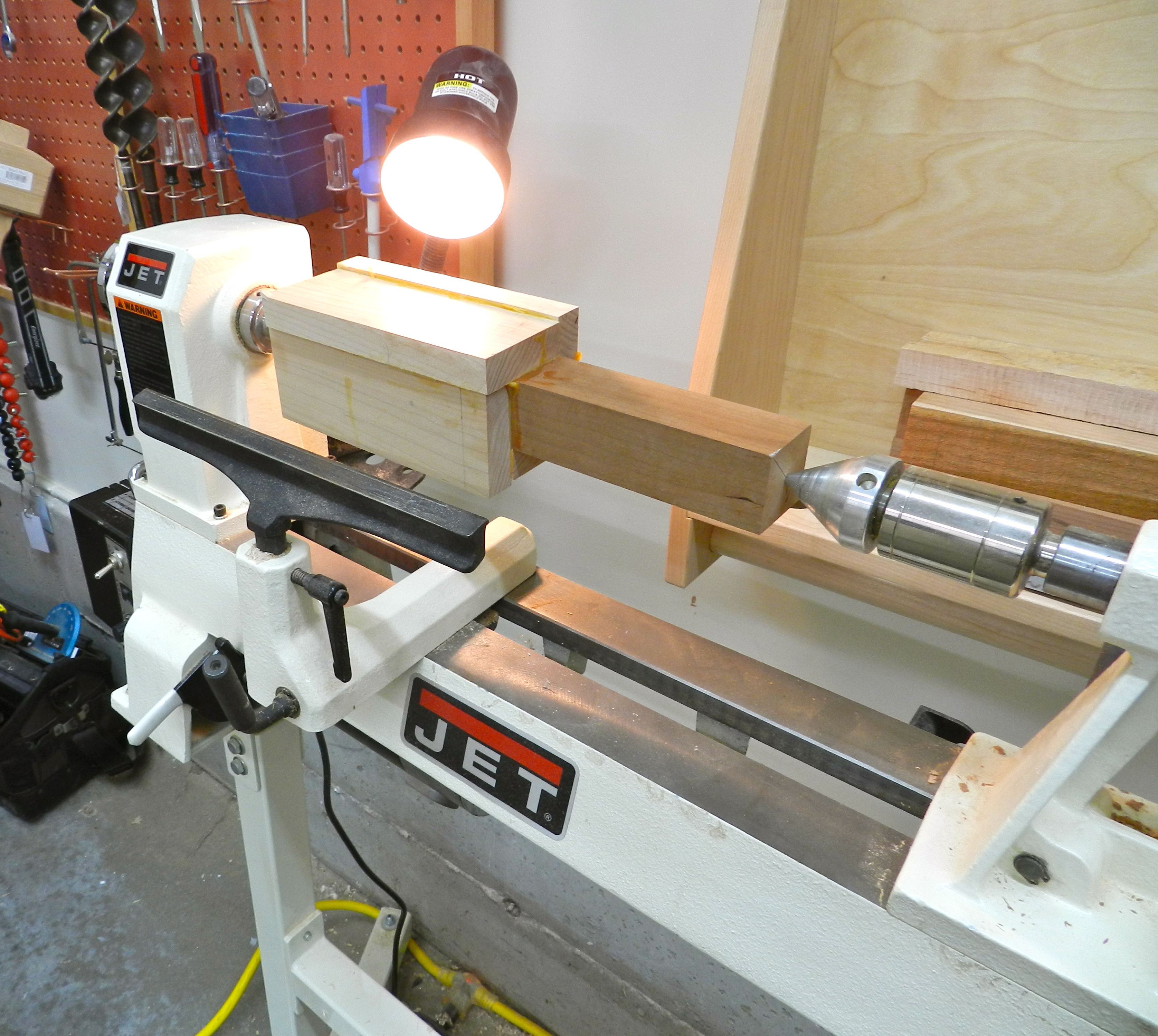
Before tearing into a bowl blank I wanted to warm up with a spindle project and I’ve had a nice mallet blank sitting in my tool rack for the last year (literally).

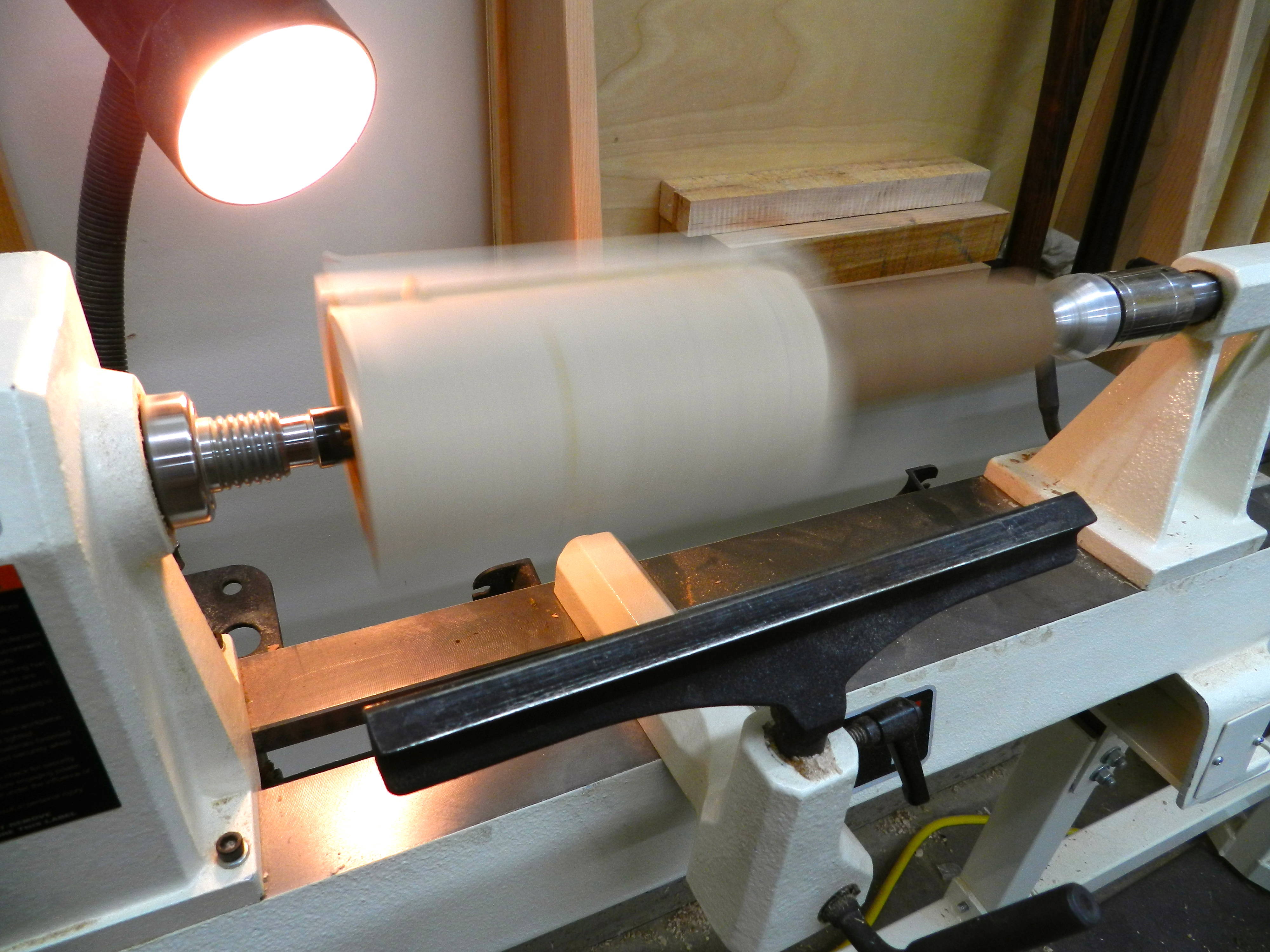
Turning the mallet
Turning the mallet

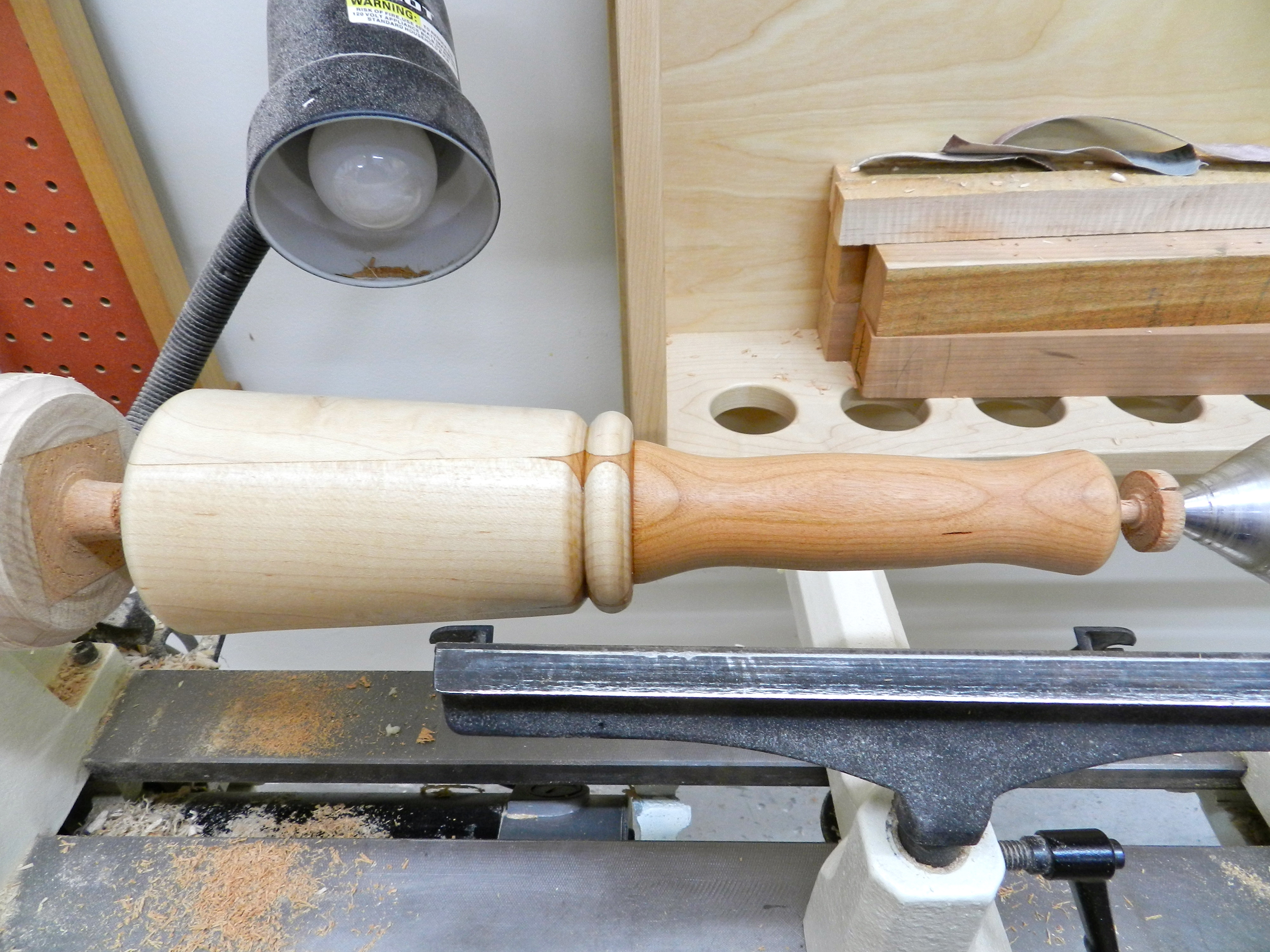
You may recognize this style mallet from an earlier post I made last year on my blog here. The handle is made from cherry and the striking face is quarter-sawn hard maple. The concept here is that a mallet made from a single piece of wood usually loses some of the long grain sections that come flying off over its service life. By using quarter-sawn wood on all 4 sides you are not exposing any of the grain that is likely going to fly off. This also assumes that the Titebond glue joint is stronger than any movement in the handle.  We’ll see how well this one lasts in my own shop. (The first one was a gift for a friend)

Finished Mallet
Finished Mallet

A few changes I made in the design is I made the top a tiny bit concave so I can stand the mallet on its end and I simplified the handle a bit as it will likely have a hard life in the shop. I do however really like how the bead makes a pattern with the contrasting wood species.

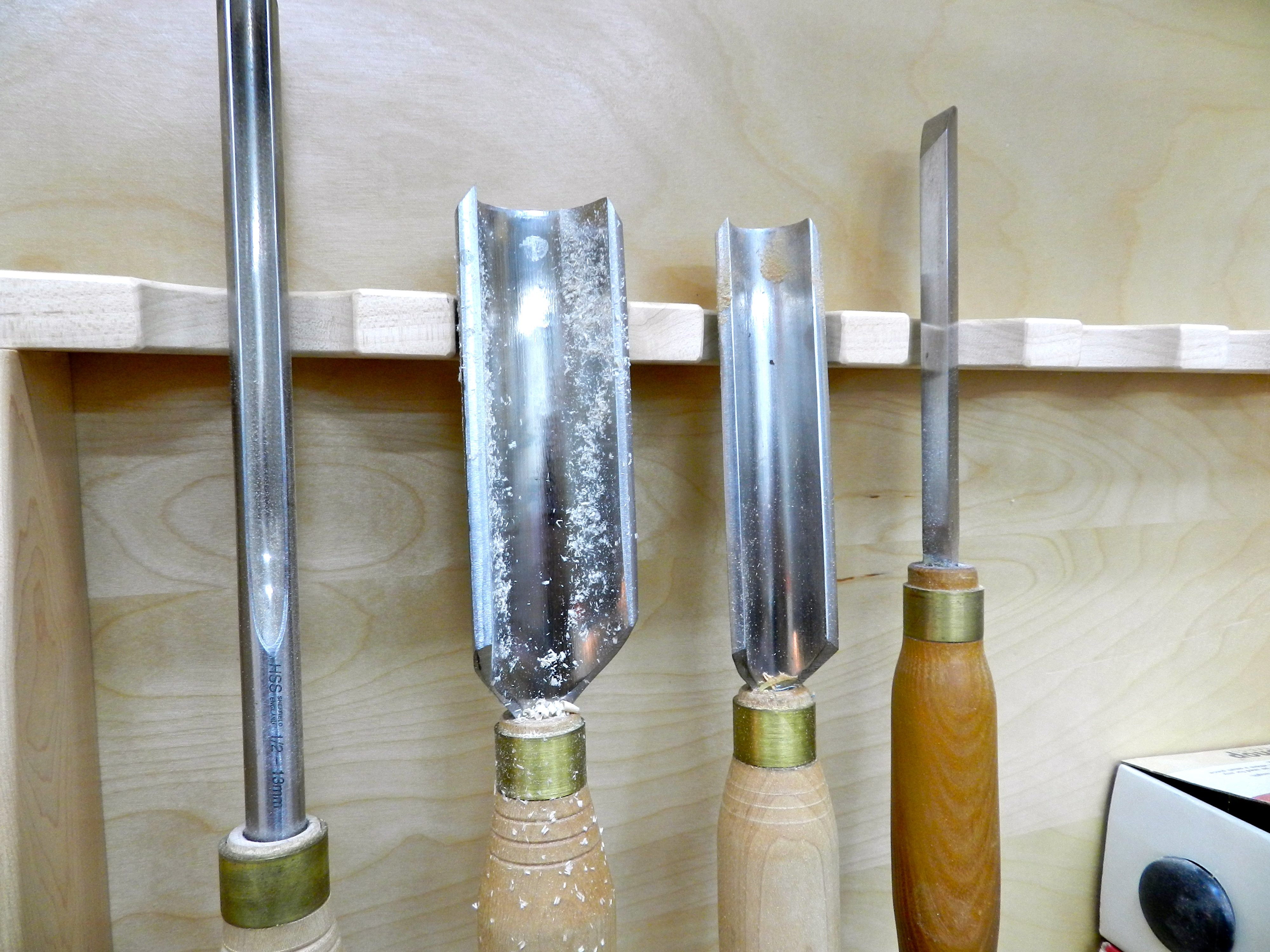
Turning tools in the rack

Now that the tools are all warmed up, it’s time to start making some bowls.

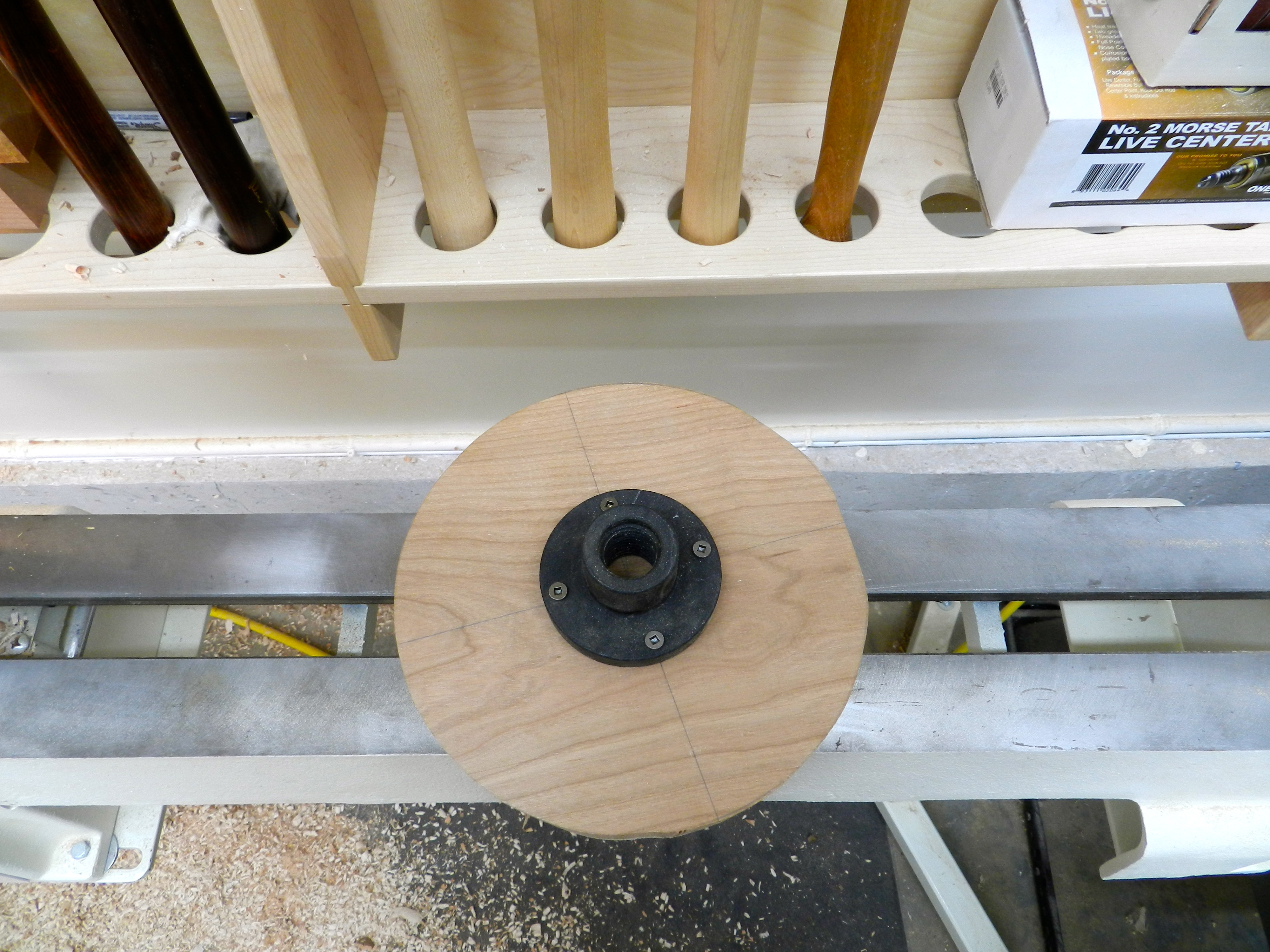
Bowl blank mounted on a face plate

After roughing the blanks round on the band saw I secure the blank to a faceplate using good quality wood screws. (The screw holes disappear as that wood is removed from the inside of the bowl)

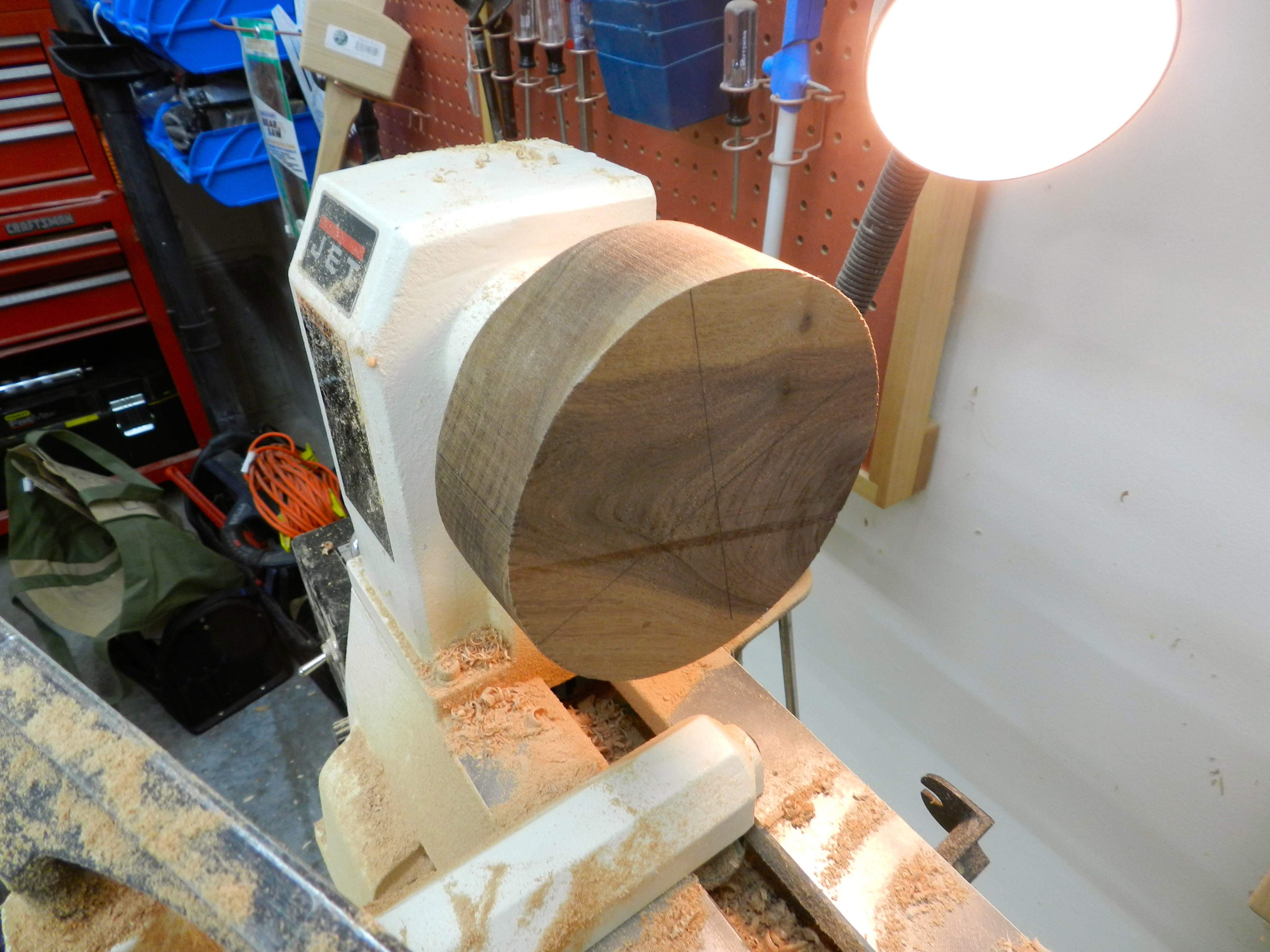
Bowl blank ready for turning

The first step is to turn the bottom of the bowl. I elected to make a chunky Asian feeling bowl from a small walnut blank I had on hand.

Turning the bottom and making a foot for the bowl chuck to grab onto

The bowl chuck grabs onto the foot (or base) of the bowl and allows me to hollow out the inside of the bowl.

Hollowing the bowl, knee deep in shavings
Hollowing the bowl, ankle deep in shavings

You know it’s a good day at the lathe when you are completely covered in shavings and standing ankle deep in shavings.

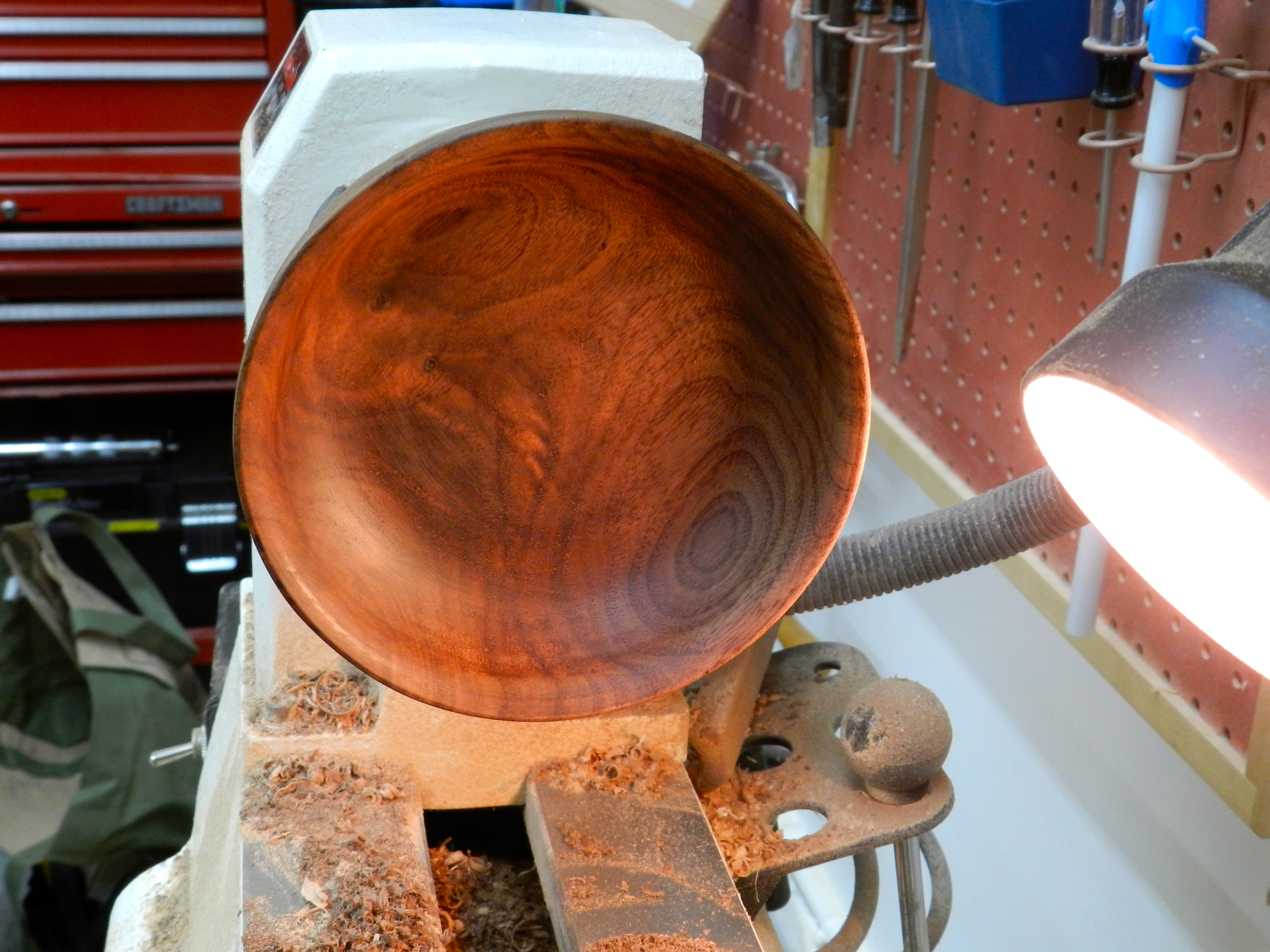
Hollowed out bowl, finishing the edge detail

Once I got the wall thickness and profile into a form I liked, I apply the finish right on the lathe. This allows for easier buffing etc.

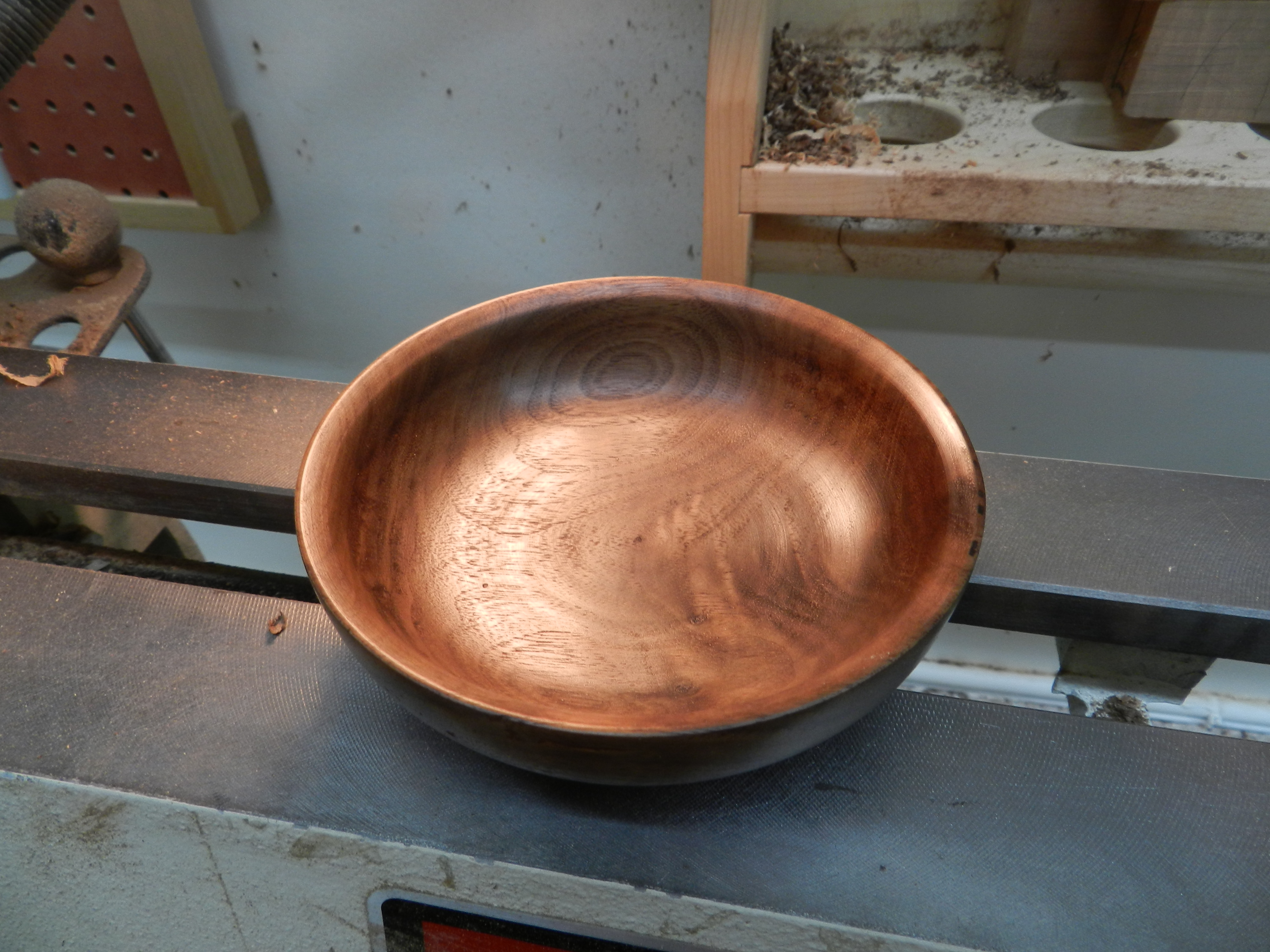
Finished bowl
Finished bowl

I liked the figure of this piece and how it came out.

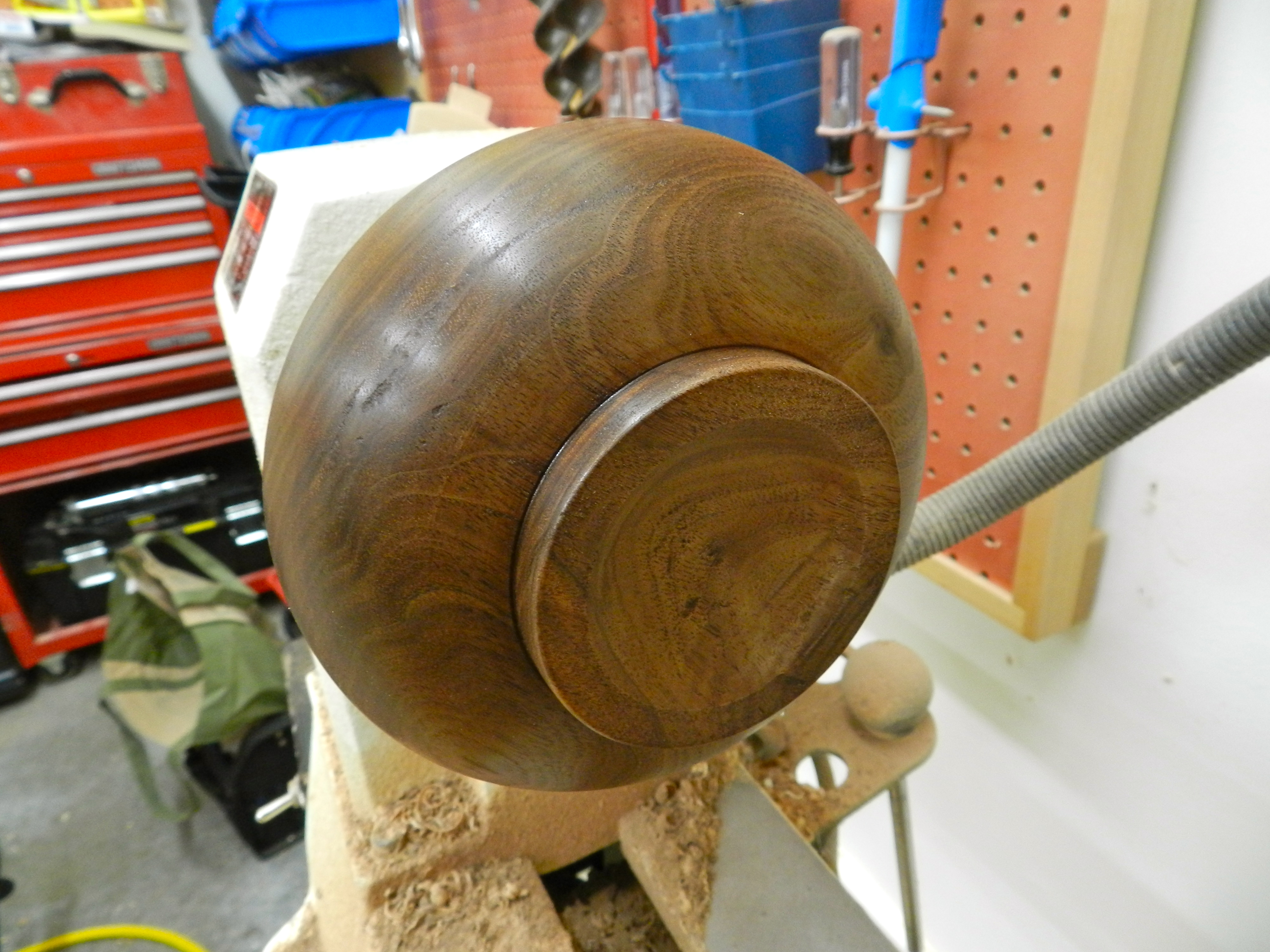
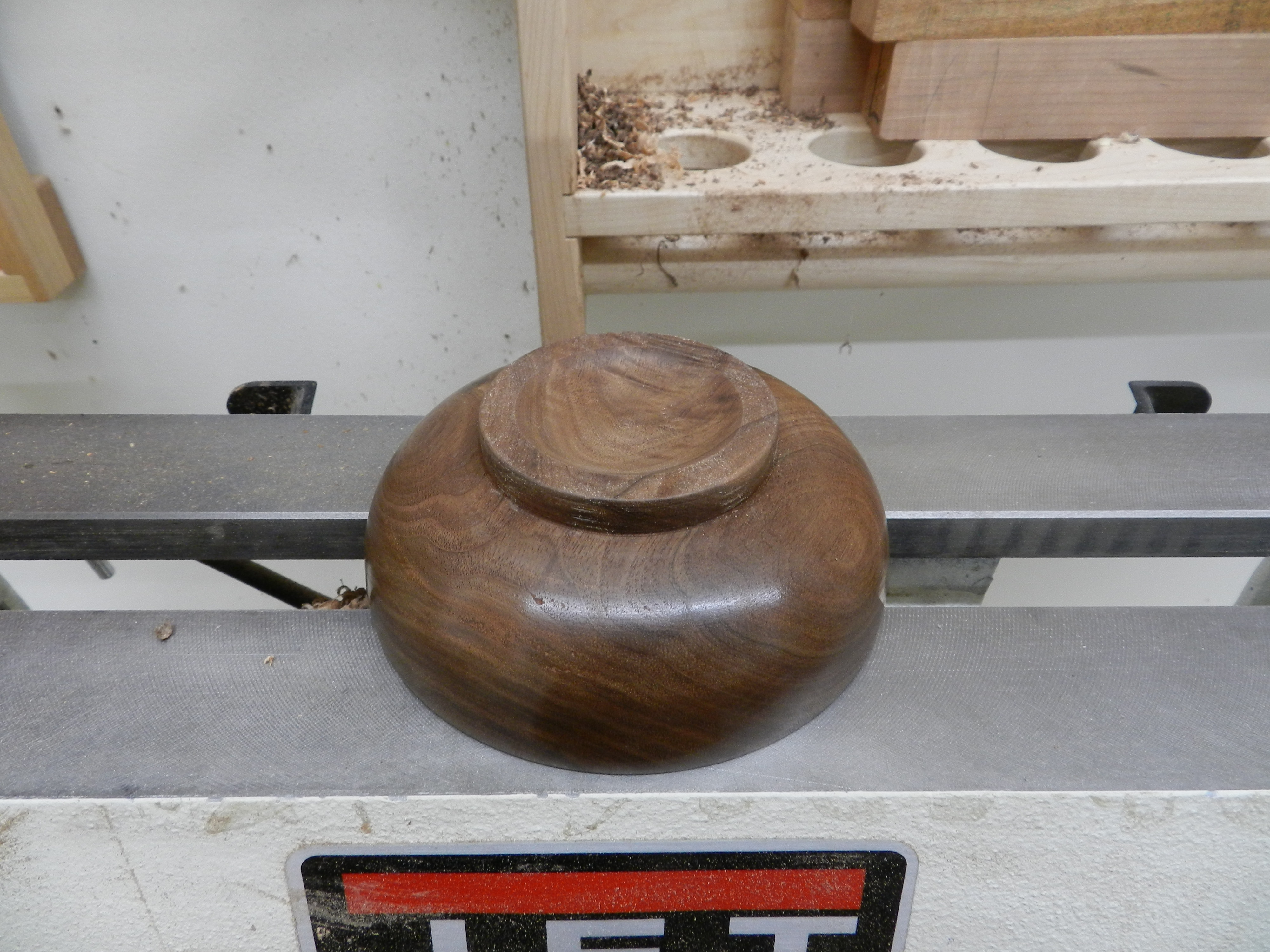
Underside of bowl
Underside of bowl

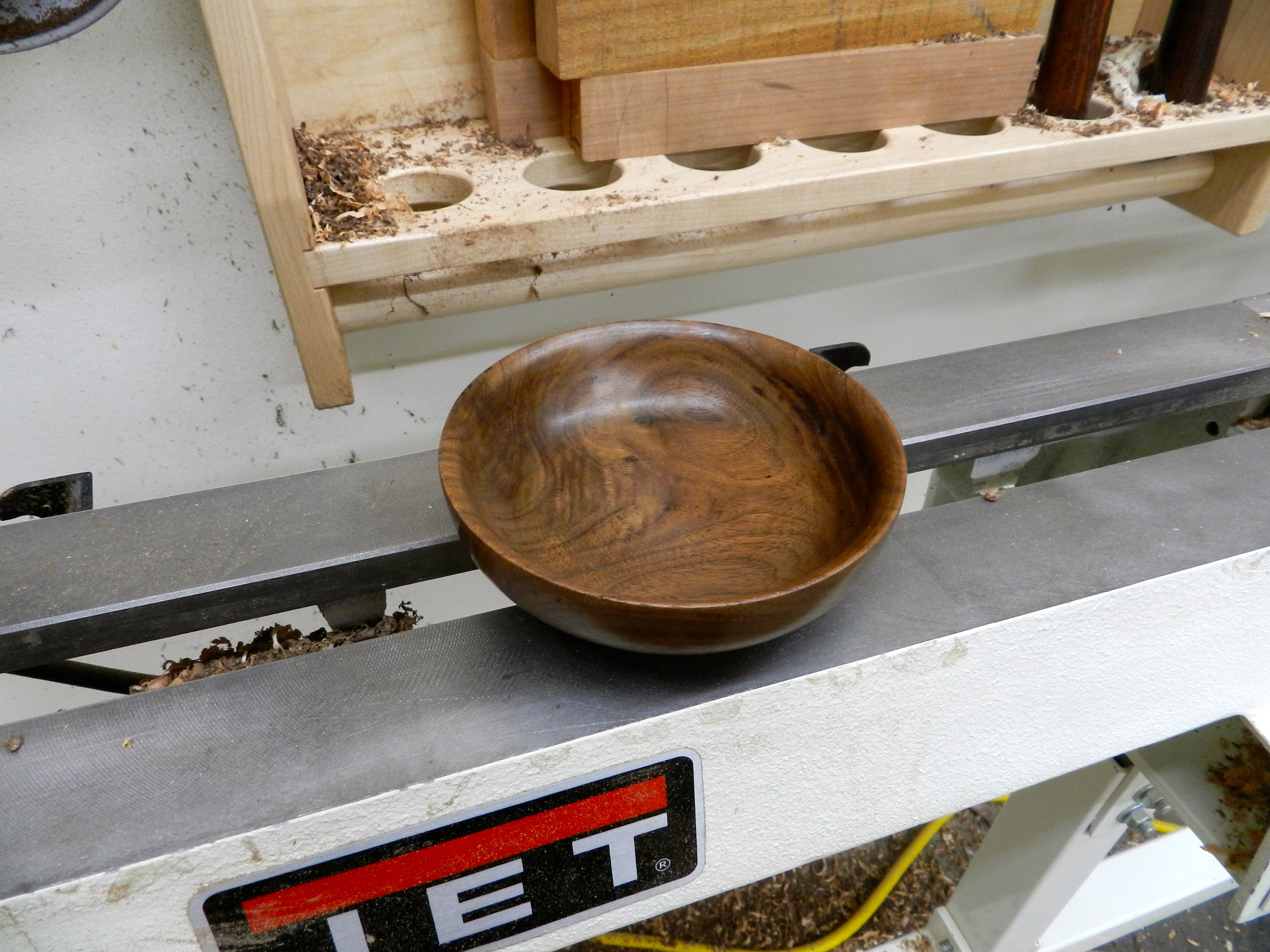
The bowl is finished with Tung Oil and Wax and likely will be a place for my wife to put her keys or watch or similar items at the end of a day.

Turned walnut bowl. Finished with tung oil and wax

On a cold day like today, I hope that you will get out to the workshop and make something new.  Time for me to get back into the shop myself….

Take care,
-Bill

The thoughts one thinks while sawing a tree…

“The Oriental philosophy of contemplation involves forsaking all work; the European does his meditating while relaxing from work, but the American seems to think things out best while working. So the stone walls of New England may be thought of as monuments to the thoughts that occurred while they were being built, for those were the days of great decisions and profound planning. The thoughts one thinks while sawing a tree or making a stone wall are surprising. It is almost as if the mind becomes ashamed of the work the body is doing and starts doing a little “showing off” by itself. Lincoln said he did some of his deepest thinking while splitting rails. The plain farmer of two hundred years ago was weaving the fabric of a new nation and although there are no marble statues to his patriotism now, there are still his stone walls.” — Eric Sloane American Barns and Covered Bridges, 1954

Oak trees in the way of my barn...
Oak trees in the way of my barn…

I live on a heavily wooded street in New Hampshire that is lined with stone walls. As I pass them each day I think about what it took to clear all this land and build those walls. While most of the neighborhood is covered with second and third growth trees that were not actively managed, and new housing developments,  there are still a few pockets of small family farms with cleared farmland that looks like an idealistic painting of yesteryear and reminds us how this was all farmland about 100 years ago.  As the leaves changed this season I found it amusing to see tourists snapping pictures in front of some of these farms with their stone walls and weathered barns. In the book referenced above Sloane encouraged his readers to keep an eye out for early barns also made several interesting observations about stone walls. They were designed to keep animals in and not to keep humans out. When a wall fell over you had all the stones needed to rebuild it as opposed to a wooden fence that could have rotted away. I like the sense of inviting simplicity, using what you had on hand and building for the long term.

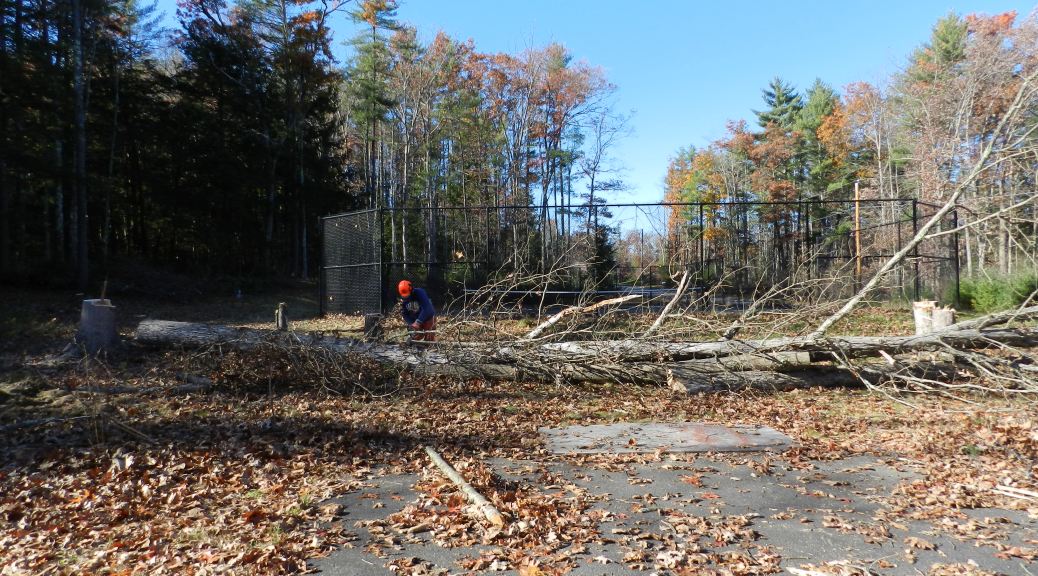
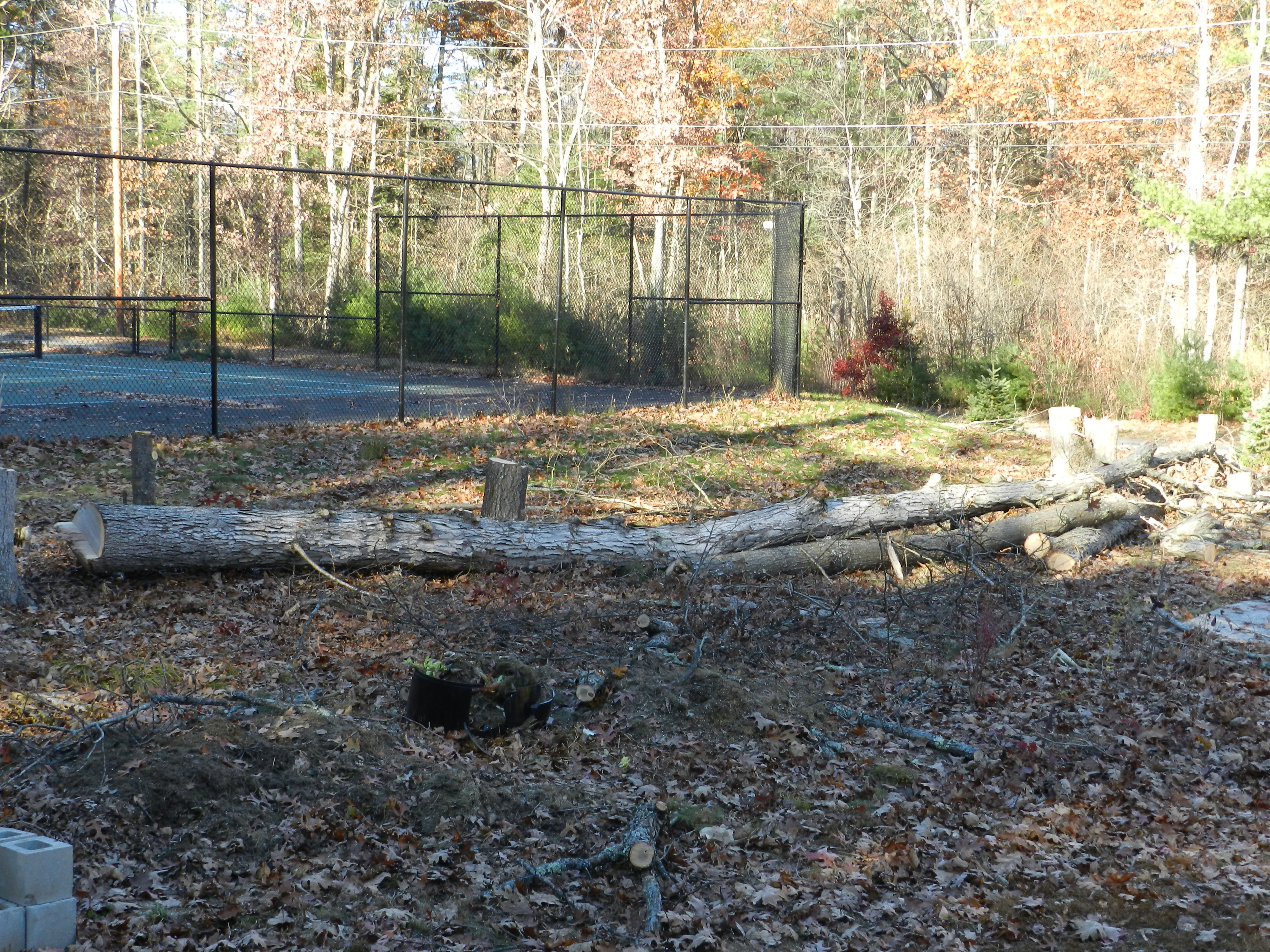
I recently set out to clear some trees out of my backyard and make room for a 12’x24′ timber framed shed/small barn to store extra wood and yard equipment. I’ve cleared about 35 trees so far, knocked off a bucket list item — taking down a full size tree with a felling axe, and still have a few more to go.

Felling oak trees
Felling oak trees

Safety Tip:

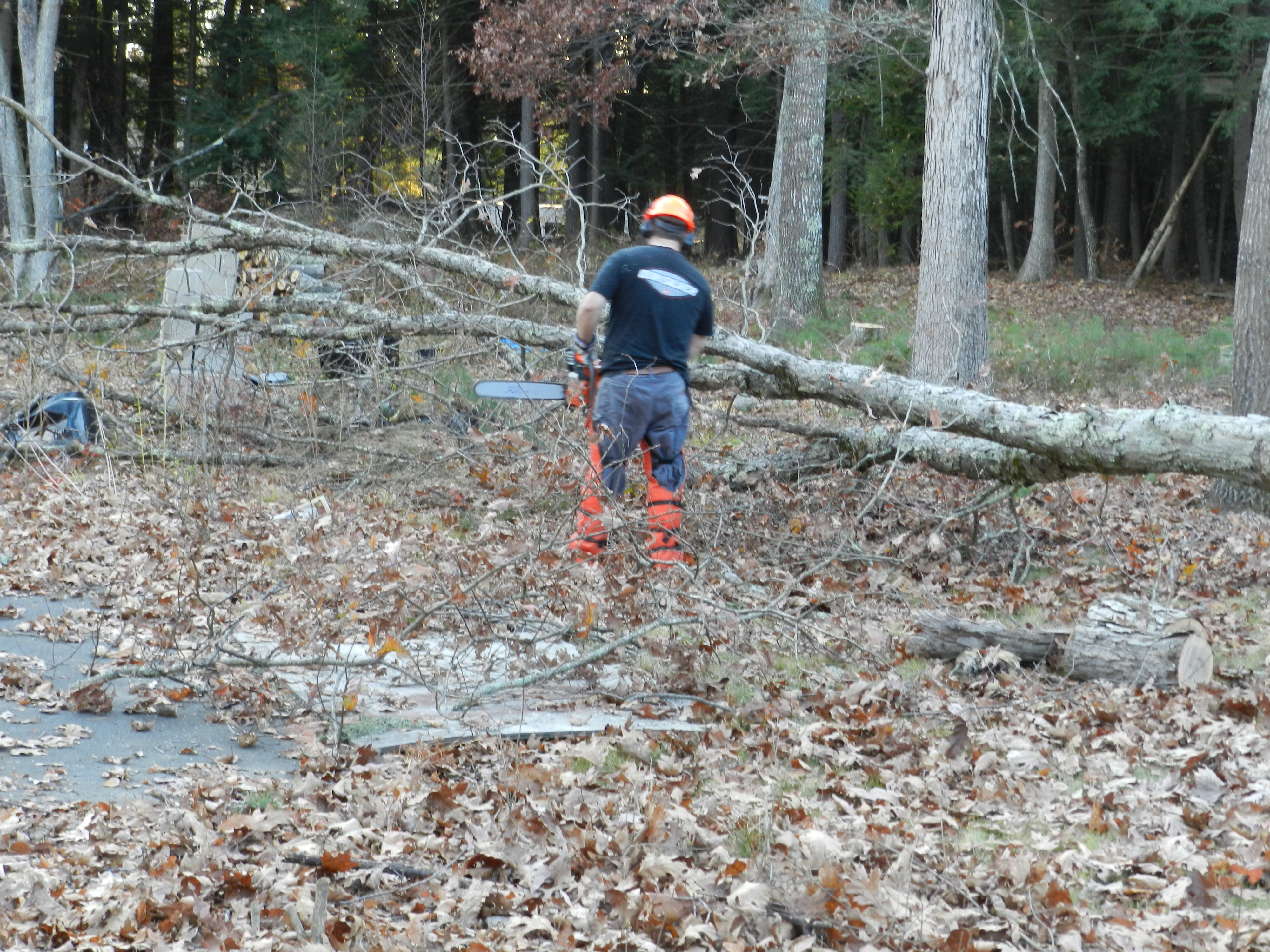
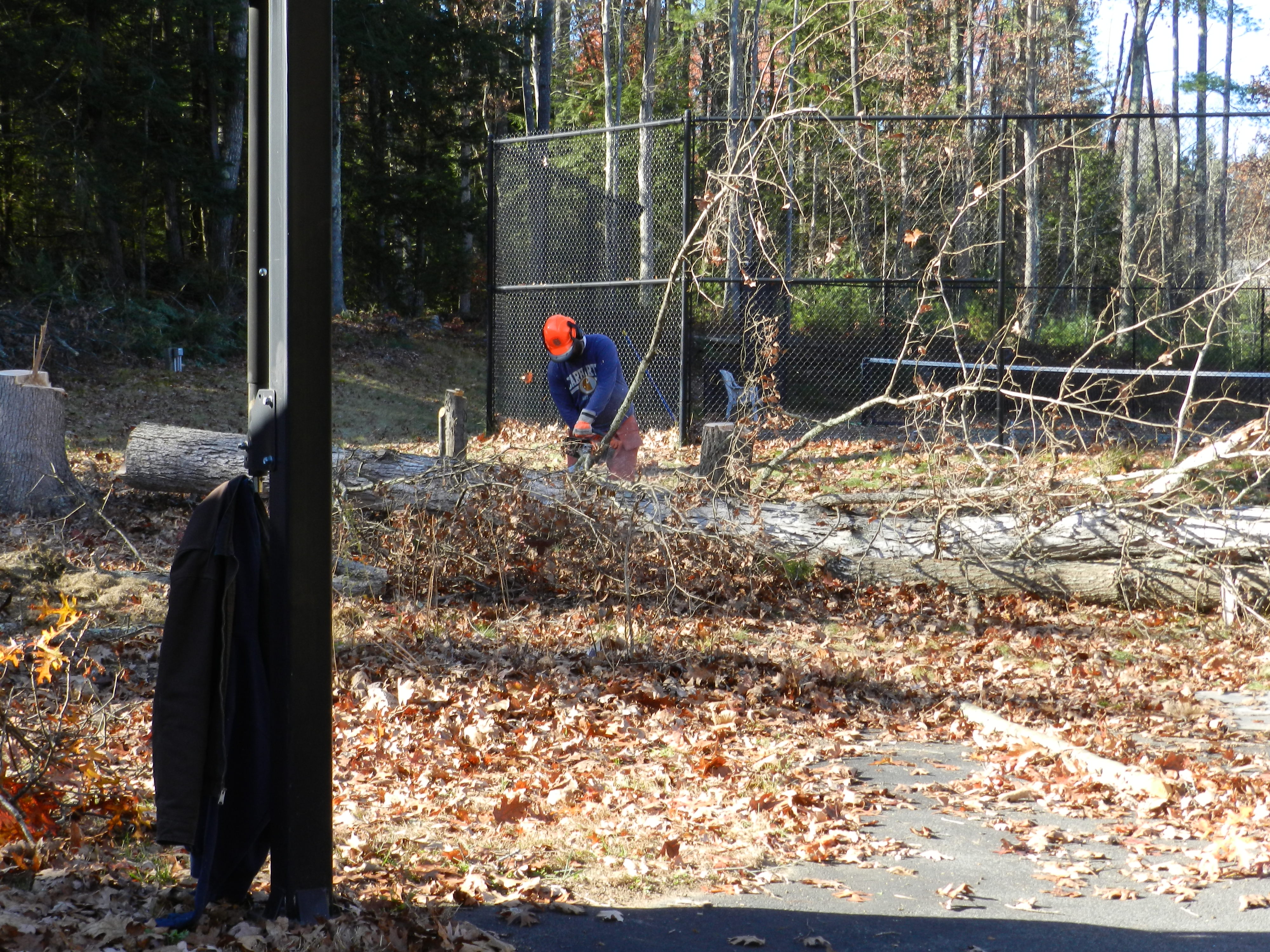
When working with large trees and high powered saw, make sure to ALWAYS wear the appropriate safety gear. Above you can see me wearing my steel toe boots, Kevlar chaps, eye protection, helmet with hearing protection and face shield and Kevlar reinforced gloves.  The chaps are like wearing an insulating blanket and rough to wear in the summer, but in cooler months they help you stay warm.

Limbing the tree
Limbing the tree

How do I cut down a larger tree?

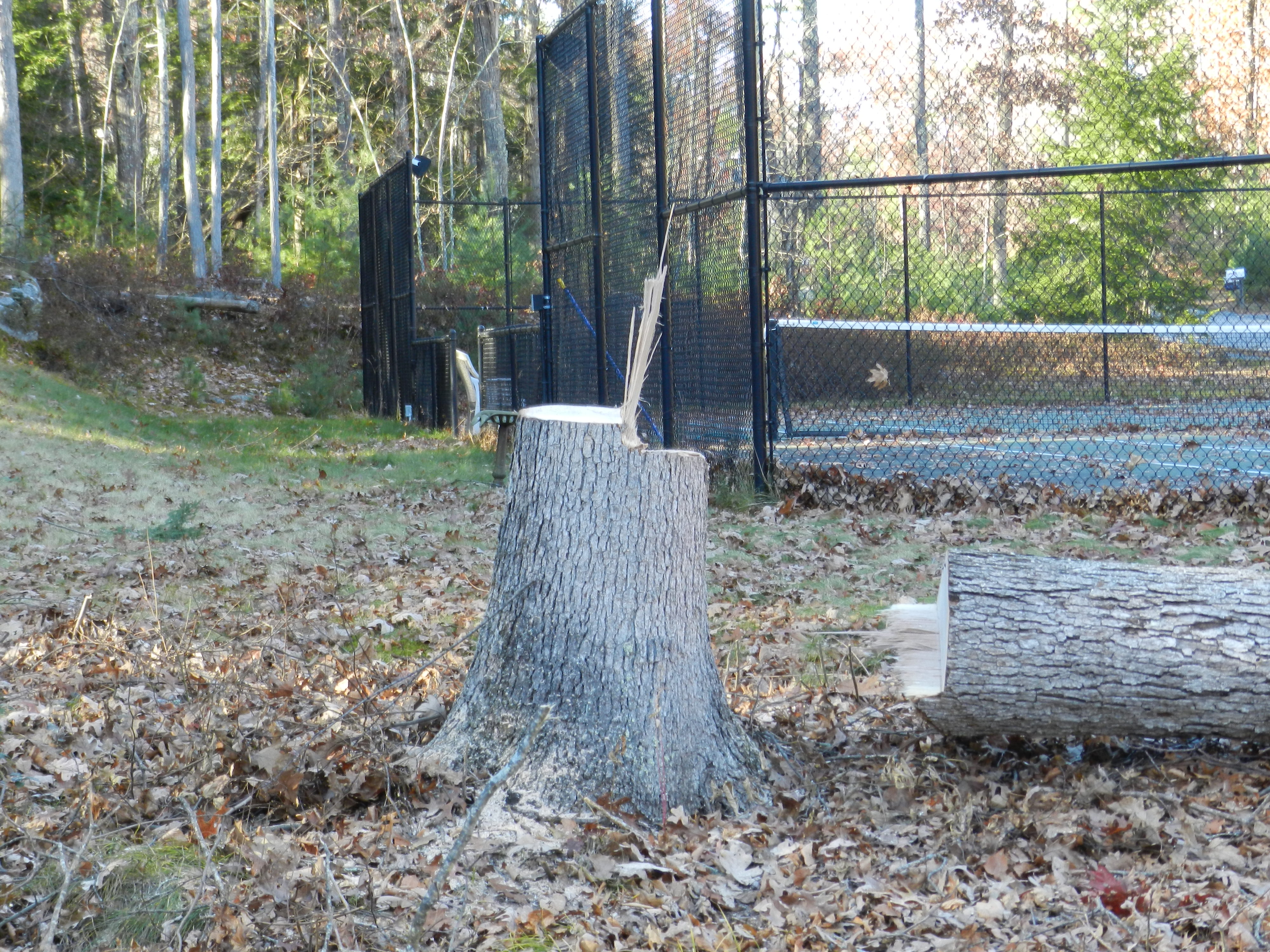
I start by walking around the tree from all sides, sighting up at it to see what way it leans and were the mass is held by the limbs. I then mentally think about what direction I have enough space to drop to the tree without hitting houses, other trees, people or fences. With a plan in place I set about felling the tree. The process is much the same whether I use an axe or a chainsaw. I cut in at an angle on the side of the tree facing the way I want it to fall. I then make a horizontal cut to remove that wedge of wood. It should only be about 1/3 of the way through the tree. You want the intersection of those two cuts to land right on each other so you have a smooth hinging surface and a controlled drop.

90 Foot tall oak trees take a LOT of work to break down

I then come from behind the tree and make a horizontal cut until I leave about a 1.5″” wide hinge of wood that will help control the fall. This cut should be about 2″ above the bottom of the wedge cut (As seen in the photo below).  If done properly the tree should slowly start to fall over exactly where you want it. The tree shown here was a 90 foot tall oak, so when it hit the ground it shook the ground with an incredible thud — anything in it’s path will get crushed. When cutting a tree like this make sure you have a clear retreat path, usually 45 degree from the way you expected the tree to fall, that way you are not in the path of a falling or splitting tree or anything it kicks up.

Notch cut and hinge used for a controlled drop

Once on the ground I start removing all the limbs from the tree. I start with all the limbs that are not holding the trunk up off the ground to make room to better access the trunk. Any limbs or branches that are holding up the trunk are likely going to bind on your chainsaw if you are not careful. Being mindful of where the tree may move as you release that tension you can use a sharp axe to remove these limbs or careful wedge cuts that will not bind the saw. When doing this sort of work you need to be thinking about where the trunk is likely to fall after removing this limb, so you’ll want to mind your legs and feet.

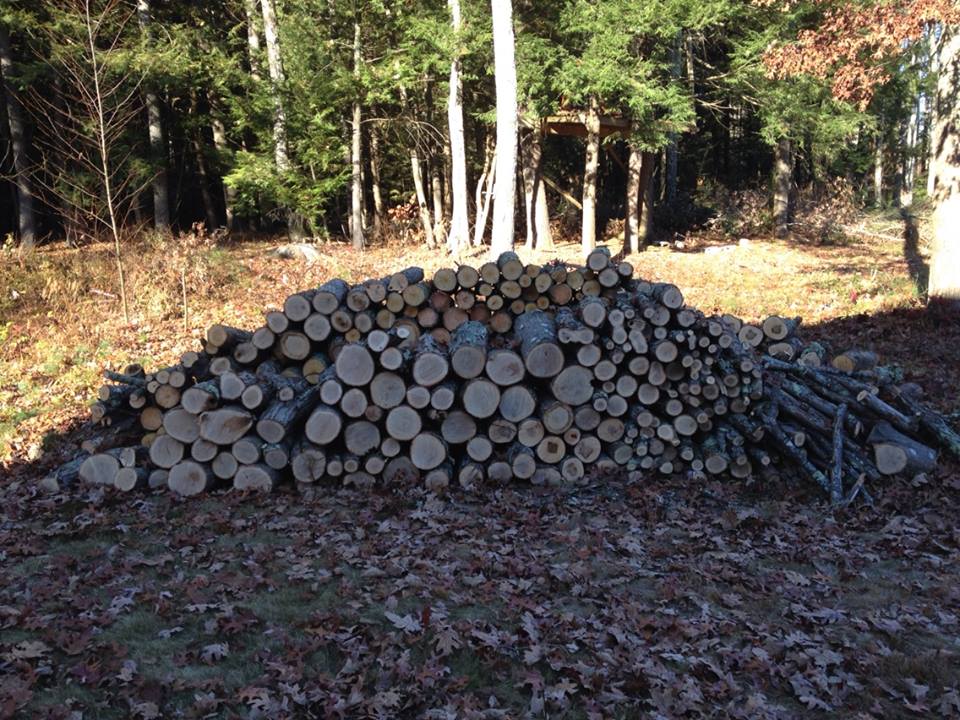
Breaking down the de-limbed tree into firewood

Once the limbs are removed I break the tree trunk down into either firewood or whatever I am looking to use the wood for. These trees will be processed down into several projects — a few bowl blanks, a new base for my anvil, a few chopping benches for the shop, a stump to split firewood on and of course firewood. The incredible amount of brush and branches will be ground up into chips and distributed elsewhere on the property.

More Tips on cutting trees:

  • Try to cut tree during the colder months or winter as there will be less sap and thus less weight and cleaner cuts
  • Use plastic wedges when cutting a larger stump so that it does not bind on your saw’s bar and the wedge will not damage the chain
  • Use plastic or even larger metal wedges to help a cut tree (notched and ready to hinge) that is not falling. You can use a large mallet or beetle to drive in a wedge and help give it that little push it needs to start going over.
The result of a weekend of hard work

Even with all of the above information running through my head, and the sometimes backbreaking labor to break down these trees, there was still a lot of time to think. As I was doing the above work I was building the timber framed barn over and over again in my head, so by the time I actually get around to cutting the frame it will be like second nature. Unfortunately the snowy weather is creeping up on me fast, so it will be a race to see if I can get the shed put up this fall/winter or if it will get delayed until spring.

I’ll keep you posted.

Take care,
-Bill Rainford